Table of Contents
- What Are Free AI Tools for Ecommerce Stores?
- Why Ecommerce Businesses Need AI in 2026?
- Benefits of Using Free AI Tools
- How AI Is Transforming Online Stores?
- 25+ Best Free AI Tools for Ecommerce Stores
- AI Writing Tools
- AI Design Tools
- AI SEO Tools
- AI Customer Support Tools
- AI Marketing Tools
- AI Analytics Tools
- How to Choose the Right AI Tool
- Common Mistakes to Avoid
- Expert Tips
- FAQ
- Conclusion
What Are Free AI Tools for Ecommerce Stores?
Quick Answer
Free AI tools for ecommerce stores are software powered by artificial intelligence. They help online businesses automate repetitive tasks, create quality content, improve SEO, generate product images, manage marketing, and offer better customer support. You can use these tools without paying for costly monthly subscriptions.
Whether you sell on Shopify, WooCommerce, Amazon, Etsy, or your own ecommerce website, AI can dramatically improve productivity while reducing operational costs.
Artificial intelligence is no longer just for big companies. In 2026, thousands of small businesses use free AI tools to compete with larger brands by working more efficiently.
AI has changed how ecommerce businesses work, from writing product descriptions in seconds to automatically creating social media graphics.
Store owners no longer need to spend hours on product listings, image editing, customer questions, or keyword research. Now, these tasks can be done in just minutes.
This gives you more time to focus on growing your business instead of doing repetitive tasks.
Why Free AI Tools for Ecommerce Stores Matter in 2026?
Quick Answer
Today’s customers want quick service, personalized suggestions, and a smooth shopping experience. AI helps ecommerce businesses meet these needs while saving time and cutting costs.
Online shopping has become more competitive than ever. Every day, thousands of new stores launch worldwide, making it harder to stand out.
Customers now compare your store not just with local shops but also with global brands.
They expect:
- Fast-loading websites
- Helpful product descriptions
- Personalized recommendations
- Professional product images
- Instant customer support
- Accurate search results
- Easy checkout experiences
Delivering all these experiences manually requires significant time and resources.
Artificial intelligence helps close this gap.
Small ecommerce businesses can use free AI tools to automate many daily tasks instead of hiring extra employees.
Major Benefits of AI for Ecommerce
| Saves Time | Automates repetitive tasks |
| Reduces Costs | Less manual work |
| Better SEO | Higher search rankings |
| Better Product Pages | Higher conversion rates |
| Faster Support | Improved customer satisfaction |
| Smarter Marketing | Personalized campaigns |
| Better Analytics | Data-driven decisions |
| Increased Productivity | More work completed in less time |
</div>
Benefits of Free AI Tools for Ecommerce Stores
Many business owners think AI is expensive.
Luckily, that’s not the case anymore.
Most popular AI platforms now have free plans that are strong enough for startups and small ecommerce stores.
Some benefits include:
1. Save Hours Every Week
Writing dozens of product descriptions manually can take days.
AI writing assistants can generate optimized descriptions within minutes.
2. Improve SEO
AI tools help with:
- Keyword research
- Meta descriptions
- Blog outlines
- Internal linking
- Content optimization
- Search intent analysis
This helps your store rank higher on Google.
3. Create Better Product Images
Hiring a professional photographer for product photos can be costly.
AI image tools can:
- Remove backgrounds
- Generate lifestyle images
- Improve image quality
- Resize photos automatically
4. Better Customer Experience
AI chatbots answer common questions instantly.
Customers don’t need to wait for business hours.
This keeps customers happy and reduces the amount of support work you need to do.
5. Increase Sales
Better product pages lead to:
- Higher click-through rates
- Longer visitor engagement
- Better trust
- Increased conversions
Even small increases in your conversion rate can lead to much higher revenue over time.
How AI Is Transforming Online Stores?
Artificial intelligence is changing nearly every aspect of ecommerce.
Successful businesses now use several AI tools together to create complete workflows, instead of relying on just one tool for a single task.
For example:
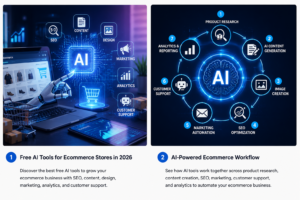
Step 1: Research trending products using AI.
↓
Step 2: Generate SEO-friendly product descriptions.
↓
Step 3: Create attractive product images.
↓
Step 4: Publish optimized listings.
↓
Step 5: Schedule social media content.
↓
Step 6: Track performance using analytics.
↓
Step 7: Improve future campaigns using AI insights.
This kind of workflow can save you many hours of work each month.
25+ Best Free AI Tools for Ecommerce Stores
Quick Answer
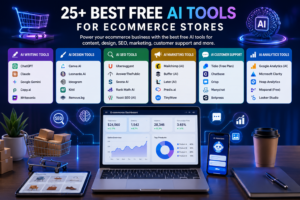
The best free AI tools for ecommerce stores help with content creation, SEO, editing images, marketing, analytics, customer support, automation, and productivity.
Here’s a look at some of the most popular free AI tools you can use in 2026.
| ChatGPT | Writing | ✅ | Product descriptions |
| Claude | Writing | ✅ | Long-form content |
| Gemini | Research | ✅ | Content research |
| Canva AI | Design | ✅ | Marketing graphics |
| Leonardo AI | Images | ✅ | Product visuals |
| Remove.bg | Editing | Limited | Background removal |
| Rank Math | SEO | ✅ | WordPress SEO |
| Google Search Console | SEO | ✅ | SEO monitoring |
| Google Trends | Research | ✅ | Keyword research |
| Google Analytics | Analytics | ✅ | Visitor insights |
| Grammarly | Editing | ✅ | Grammar checking |
| Buffer | Social Media | ✅ | Scheduling |
| Mailchimp | Free Tier | Email campaigns | |
| HubSpot CRM | CRM | ✅ | Customer management |
| Tidio | Chatbot | ✅ | Customer support |
Best Free AI Tools for Ecommerce Stores for Writing

Quick Answer
AI writing tools help ecommerce businesses create SEO-friendly product descriptions, blog posts, FAQs, emails, landing pages, ad copy, and social media content in minutes.
1. ChatGPT
Best For
- Product descriptions
- SEO blog writing
- Buying guides
- FAQ generation
- Email marketing
- Ad copy
- Landing pages
Advantages
- Easy to use
- Fast content generation
- Supports multiple writing styles
- Excellent brainstorming assistant
- Works for beginners and professionals
Limitations
- Requires human editing
- Always verify factual information before publishing.
2. Claude
Claude performs exceptionally well for:
- Long-form blog posts
- Product comparison articles
- Buying guides
- Privacy policies
- Documentation
Claude’s writing style sounds more natural, which makes it great for detailed ecommerce content.
3. Gemini
Gemini is excellent for:
- Market research
- Competitor analysis
- Content ideas
- Keyword brainstorming
- Trend discovery
- Shopping insights
Many ecommerce marketers use Gemini during the planning phase before writing content.
Free AI Tools for Ecommerce Stores for Design

Quick Answer
Good visuals are important for ecommerce success. AI design tools let you create product images, banners, ads, logos, and social media graphics without needing a graphic designer. Most have free plans that work well for startups and small businesses.
1. Canva AI
Canva AI is a popular design platform for ecommerce businesses. It offers drag-and-drop editing and AI features, so even beginners can create professional designs.
Best Features
- Magic Design
- AI Image Generator
- Magic Write
- Background Remover (limited)
- Magic Resize
- Brand Kit
- Social Media Templates
Best For
- Shopify banners
- WooCommerce banners
- Facebook Ads
- Instagram Posts
- Pinterest Pins
- Promotional graphics
- Email banners
Advantages
- Beginner-friendly
- Thousands of templates
- Large icon library
- Free cloud storage
- Fast editing
2. Leonardo AI
Leonardo AI is great for making high-quality product images and marketing graphics.
Best For
- Product mockups
- Lifestyle product images
- Hero banners
- Ecommerce advertising
- Product concepts
Advantages
- Realistic AI images
- High-resolution output
- Multiple artistic styles
- Free daily credits
3. Ideogram
Ideogram creates AI-generated images with clear, readable text, which is helpful for promotional graphics.
Ideal For
- Discount banners
- Promotional posters
- Social media graphics
- Ecommerce advertisements
4. Remove.bg
Remove.bg is one of the easiest AI tools for ecommerce product photos.
Features
- Removes backgrounds automatically
- Creates transparent PNG files
- Works in seconds
- Suitable for Amazon, Shopify, Etsy, and WooCommerce listings
Best AI Design Tools Comparison
| Canva AI | Marketing Graphics | ✅ |
| Leonardo AI | Product Images | ✅ |
| Ideogram | Promotional Designs | ✅ |
| Remove.bg | Background Removal | Limited |
Free AI Tools for Ecommerce Stores for SEO
Quick Answer
AI SEO tools help ecommerce websites show up better in search engines by optimizing keywords, metadata, internal links, technical SEO, and content structure.
1. Rank Math
One of the best free WordPress SEO plugins.
Features
- Meta titles
- Meta descriptions
- XML sitemap
- Schema markup
- SEO scoring
- Internal link suggestions
Best For
- WooCommerce
- WordPress stores
- Ecommerce blogs
2. Google Search Console
Every ecommerce website can benefit from using Google Search Console.
It helps you monitor:
- Search performance
- Indexed pages
- Core Web Vitals
- Mobile usability
- Search queries
- Click-through rate
3. Google Trends
Excellent for discovering:
- Trending products
- Seasonal keywords
- Buyer interest
- Regional search demand
4. Google Analytics
Google Analytics gives you detailed insights about your website visitors.
Track:
- Traffic sources
- Sales funnels
- Conversion rate
- User behavior
- Bounce rate
- Returning visitors
5. Ubersuggest
Useful for:
- Keyword ideas
- SEO difficulty
- Competitor keywords
- Content ideas
Free accounts have daily search limits, but they are still useful for small businesses.

SEO Tools Comparison
| Rank Math | On-page SEO | ✅ |
| Search Console | SEO Monitoring | ✅ |
| Google Trends | Keyword Research | ✅ |
| Google Analytics | Analytics | ✅ |
| Ubersuggest</td> | Keyword Ideas | Limited |
Free AI Marketing Tools for Ecommerce Stores
Quick Answer
AI marketing tools help ecommerce businesses create campaigns, schedule posts, personalize emails, and boost customer engagement with less manual work.
Buffer
Buffer allows you to schedule posts across multiple platforms.
Best For
- X (Twitter)
Mailchimp
Mailchimp’s free plan includes email marketing features suitable for new ecommerce stores.
Features
- Email campaigns
- Welcome emails
- Customer segmentation
- Basic automation
- Performance reports
Grammarly
AI-generated content still needs editing and polishing.
Grammarly helps improve:
- Grammar
- Clarity
- Readability
- Tone
- Professionalism
Marketing Tool Stack
| Mailchimp | |
| Social Media | Buffer |
| Content | ChatGPT |
| Grammar | Grammarly |
| Design | Canva AI |
Free AI Tools for Ecommerce Customer Support
Quick Answer
AI chatbots answer common customer questions right away, which reduces support work and keeps customers happy.
Tidio AI
Perfect for:
- Live chat
- AI chatbot
- Order questions
- Product recommendations
Benefits
- 24/7 availability
- Faster response
- Reduced workload
- Easy setup
HubSpot CRM
HubSpot helps you manage your customer relationships.
Features
- Customer database
- Sales pipeline
- Email tracking
- Contact management
- Automation
Crisp
combines:
- Live chat
- Chatbot
- Knowledge base
Crisp is a good choice for growing ecommerce stores.
Customer Support Comparison
| Tidio | AI Chatbot | ✅ |
| HubSpot CRM | Customer Management | ✅</td> |
| Crisp | Live Chat | Limited |
Best AI Analytics Tools
Analytics tools help you understand how customers behave and make better business decisions.
Top choices include:
- Google Analytics
- Google Search Console
- Microsoft Clarity
- Google Trends
These tools help answer questions like:
- Which products sell best?
- Where do visitors come from?
- Why are users leaving?
- Which pages convert the most?
Best AI Tools by Business Type
Every ecommerce business has its own needs. The table below suggests a practical set of AI tools based on your platform.
| Shopify Store | ChatGPT + Canva AI + Tidio |
| WooCommerce | Rank Math + ChatGPT + Analytics |
| Amazon Seller | Claude + Leonardo AI |
| Etsy Seller | Canva AI + Ideogram |
| Dropshipping | Gemini + ChatGPT + Google Trends |
Free vs Paid AI Tools
| Content Writing | Basic | Advanced |
| AI Images | Limited Credits | Unlimited |
| SEO Analysis | Basic | Deep Insights |
| Automation | Limited | Advanced |
| Customer Support | Basic Chatbot | Full Automation |
For most startups, free plans are enough. As your business grows, you can switch to paid versions for more features.
AI Workflow for an Ecommerce Store
Don’t just rely on one AI tool. Build a complete workflow instead:
- Google Trends → Discover trending products and keywords.
- Gemini → Research competitors and gather ideas.
- ChatGPT → Write SEO-friendly product descriptions and blog posts.
- Grammarly → Polish and proofread content.
- Canva AI → Design banners and social media graphics.
- Leonardo AI → Generate product lifestyle images.
- Rank Math → Optimize on-page SEO and schema.
- Buffer → Schedule social media posts.
- Mailchimp → Launch email campaigns.
- Google Analytics → Measure traffic and conversions.
This kind of workflow saves time, keeps your work consistent, and helps your ecommerce business grow more efficiently.
Information Gain: Go Beyond Basic AI Usage
Many store owners use AI just for writing product descriptions. But you get the biggest advantage when you use AI across different parts of your business.:
- Generate product ideas from market trends.
- Create SEO-optimized category pages.
- Personalize email campaigns.
- Predict inventory demand using analytics.
- Translate content for international customers.
- Automatically repurpose blog posts into social media content.
- Analyze customer reviews to identify common issues.
- Create FAQ sections based on customer questions.
Businesses that use AI in several workflows often become more efficient and offer a better customer experience than those who use AI for just one task.
Expert Insight
“The most successful ecommerce businesses in 2026 don’t depend on a single AI tool. They combine AI for content creation, SEO, design, analytics, and customer support while keeping human oversight to maintain quality, trust, and brand consistency.”
How to Choose the Right AI Tool for Your Ecommerce Store?
Quick Answer
The best AI tool is the one that fits your business goals, budget, and workflow. Rather than installing lots of AI tools, pick a few that work well together and solve your main problems.
Before selecting an AI tool, ask yourself:
- What problem am I trying to solve?
- Does the tool have a useful free plan?
- Does it integrate with Shopify or WooCommerce?
- Is it beginner-friendly?
- Can my team learn it quickly?
- Does it protect customer data?
- Will it save more time than it costs to learn?
AI Tool Selection Checklist
| Business Size | Small stores usually need fewer tools. |
| Budget | Start with free plans and upgrade only if necessary. |
| Ease of Use | Simple tools reduce training time. |
| Integration | Works smoothly with your ecommerce platform. |
| Automation | Saves time on repetitive tasks. |
| Customer Support | Helpful if you encounter issues.</td> |
| Security | Protects customer and business data. |
| Scalability | Can grow with your business. |
Common Mistakes to Avoid
Quick Answer
AI is a helpful tool, but it shouldn’t replace your own judgment. Always review AI-generated content before publishing to keep it accurate, on-brand, and trustworthy.
1. Publishing AI Content Without Editing
AI can occasionally generate inaccurate or repetitive information.
Solution: Always review, fact-check, and edit before publishing.
2. Ignoring SEO Best Practices
AI-generated content still needs:
- Proper heading structure
- Internal links
- Meta titles
- Meta descriptions
- Optimized images
- Relevant keywords
3. Using Too Many AI Tools
Installing ten different tools often. Using too many tools can make things more complicated than they need to be. Work with 5–8 tools that work well together.
4. Forgetting Brand Voice
Your content should reflect your business’s unique voice, not sound like generic AI writing.
Always customize:
- Tone
- Examples
- Product benefits
- Calls to action
5. Neglecting Analytics
Many store owners create AI content but never measure results.
Track:
- Organic traffic
- Conversion rate
- Bounce rate
- Average order value
- Customer engagement
Pros and Cons of Free AI Tools
Advantages
- Reduce operational costs
- Save hours of manual work.
- Improve SEO performance
- Speed up content creation.
- Generate professional images
- Enhance customer support
- Increase marketing efficiency
- Help small businesses compete with larger brands.
Limitations
- Free plans often have daily usage limits.
- Some advanced features require paid upgrades.
- AI-generated content still needs human review.
- Outputs may occasionally contain factual errors.
- Overreliance on AI can reduce originality.
Best Free AI Stack for Ecommerce Stores
Instead of relying on a single platform, combine specialized tools for different tasks.
| Content Writing | ChatGPT |
| Long-form Articles | Claude |
| Research | Gemini |
| SEO | Rank Math |
| Keyword Research | Google Trends |
| Analytics | Google Analytics |
| SEO Monitoring | Google Search Console |
| Graphic Design | Canva AI |
| Product Images | Leonardo AI |
| Background Removal | Remove.bg |
| Email Marketing | Mailchimp |
| Social Scheduling | Buffer |
| Customer Support | Tidio |
| CRM | HubSpot CRM |
Using this mix of tools helps you manage almost every part of your ecommerce business and keeps your costs down.
Key Takeaways
- Free AI tools help ecommerce businesses automate repetitive tasks and reduce costs.
- AI can improve content creation, SEO, design, marketing, analytics, and customer support.
- Start with a small, well-integrated AI stack rather than using many disconnected tools.
- Always check AI-generated content to make sure it’s high quality and matches your brand.
- Combine AI automation together with your own expertise to get the best long-term results. Asked Questions (FAQ)
1. What is the best free AI tool for ecommerce?
ChatGPT is one of the most versatile options for content creation, while Canva AI is ideal for design, and Google Search Console is essential for SEO monitoring.
2. Can free AI tools increase ecommerce sales?
Yes. Better product descriptions, improved SEO, personalized marketing, and faster customer support can all contribute to higher conversion rates.
3. Are free AI tools enough for a small ecommerce business?
Yes. Most startups can manage content, design, SEO, email marketing, and customer engagement using free plans before upgrading.
4. Which AI tool is best for Shopify?
A combination of ChatGPT, Canva AI, Rank Math (for WordPress content), Tidio, and Google Analytics works well for most Shopify businesses.
5. Which AI tool is best for WooCommerce?
Rank Math, ChatGPT, Google Search Console, Canva AI, and Mailchimp are excellent choices for WooCommerce stores.
6. Can AI write product descriptions?
Yes. AI writing tools such as ChatGPT and Claude can generate detailed, engaging, and SEO-friendly product descriptions that you can refine before publishing.
7. Can AI generate product images?
Yes. Leonardo AI and Canva AI can create high-quality product visuals, lifestyle images, and promotional graphics.
8. Which AI tool is best for keyword research?
Google Trends is excellent for trend discovery, while Ubersuggest helps generate keyword ideas and analyze SEO opportunities.
9. Is AI useful for dropshipping?
Absolutely. AI can help identify trending products, generate descriptions, design marketing creatives, and automate customer support.
10. Should I trust AI-generated content?
Use AI as a starting point, but always fact-check, edit, and align the content with your brand voice before publishing.
11. Can AI improve ecommerce SEO?
Yes. AI assists with keyword research, metadata creation, content optimization, internal linking suggestions, and technical SEO insights.
12. What is the biggest advantage of using AI in ecommerce?
The biggest advantage is automation. AI reduces repetitive work, allowing business owners to focus on growth, strategy, and customer relationships.
Conclusion

Free AI tools are now essential for ecommerce businesses in 2026. They help automate repetitive tasks, create quality content, improve SEO, design marketing materials, analyze customer behavior, and provide faster customer support, all without success.
Success doesn’t come from using the most AI tools, but from choosing the right mix for your business goals. A practical AI workflow that covers writing, design, SEO, analytics, and customer support can help you work more efficiently, build a stronger online presence, and deliver a better shopping experience for customers. Picking experience.
As your store grows, keep looking for new AI features and update your workflow as needed. Businesses that use AI automation along with creativity, strategy, and quality control are more likely to achieve steady, long-term growth.
References
- Google Search Central. SEO Starter Guide.
https://developers.google.com/search/docs/fundamentals/seo-starter-guide - Google Analytics Help Center. Google Analytics Documentation.
https://support.google.com/analytics - OpenAI. ChatGPT.
https://openai.com/chatgpt