
AI Tools for Online Stores: Best E-Commerce AI Solutions for 2026
Table of Contents
- What Are AI Tools for Online Stores?
- Why Online Stores Need AI in 2026
- Best AI Tools for Online Stores by Category
- AI Product Description and Content Tools
- AI Marketing and Sales Tools
- AI Customer Support and Chatbot Tools
- AI Analytics and Conversion Optimization Tools
- AI SEO Tools for E-Commerce
- AI Design and Visual Content Tools
- AI Inventory and Demand Forecasting
- AI Personalization and Product Recommendations
- AI Tools for Shopify, WooCommerce, and Other Platforms
- Free vs. Paid AI Tools for Online Stores
- How to Choose the Right AI Tools
- How to Build an AI-Powered E-Commerce Workflow
- Common Mistakes When Using AI for E-Commerce
- Practical AI E-Commerce Strategy for 2026
- Information Gain: Where AI Creates the Most Value
- Frequently Asked Questions
- Final Takeaway
What Are AI Tools for Online Stores?
AI tools for online stores are software applications that use artificial intelligence to automate or improve e-commerce tasks such as product content, customer service, marketing, SEO, analytics, personalization, design, and sales. They help store owners reduce repetitive work, analyze large amounts of data, and make faster decisions.
An online store can involve hundreds of repetitive tasks every week.
Product descriptions need to be written. Images need to be prepared. Customers need answers. Email campaigns need to be created. Search rankings need to be monitored. Inventory needs attention. Sales data needs analysis.
Artificial intelligence can assist with many of these activities.
The important point is that AI does not have to replace the entire e-commerce team. Instead, it can act as a productivity layer across the store.
For example, an AI workflow could:
- Generate a first draft of a product description.
- Create variations of advertising copy.
- Categorize products.
- Analyze customer questions.
- Identify unusual changes in conversion rates.
- Suggest related products.
- Help answer support questions.
- Generate SEO content ideas.
- Create social media concepts.
- Summarize sales performance.
The best results usually come when AI handles repetitive and data-heavy tasks, while humans remain responsible for strategy, brand voice, quality control, and important decisions.
Store owners who have gone through this transition tend to say the same thing: the tool matters less than the workflow around it. A well-prompted free tool used consistently usually beats an expensive tool used inconsistently.
Why Online Stores Need AI in 2026
Quick Answer: E-commerce businesses increasingly use AI because online retail requires speed, personalization, continuous content production, customer support, and data-driven decision-making. AI can help small teams perform tasks that previously required multiple specialized tools or large amounts of manual work.
Competition in e-commerce is no longer limited to product price.
Customers compare:
- Product quality
- Reviews
- Delivery options
- Website experience
- Content quality
- Customer service
- Product recommendations
- Brand trust
- Checkout experience
- Social proof
This creates a significant operational challenge for small and medium-sized stores.
AI may improve and reduce this workload.
AI Can Save Time
- Instead of manually writing 500 product descriptions, an AI system can create structured drafts that humans review and improve.
- Instead of analyzing every customer-support conversation manually, AI can identify recurring questions.
- Instead of reviewing every marketing campaign from scratch, AI can help summarize performance patterns.
The objective is not simply to “use AI.”
The objective is to reduce unnecessary manual work while improving business outcomes.
AI may improve Personalization
Modern shoppers expect relevant experiences.
A customer interested in running shoes may be more likely to respond to recommendations involving running socks, fitness accessories, or related products than completely unrelated items.
AI-powered recommendation systems can use behavioral and product data to identify these relationships.
AI may improve Smaller Businesses’ Competitiveness
A small online store may not have:
- A dedicated copywriter
- A data analyst
- A large marketing department
- A customer-service team
- A full-time SEO specialist
- A professional design department
AI tools can supplement these capabilities.
However, AI should be treated as an assistant rather than an unquestioned authority.
Best AI Tools for Online Stores by Category
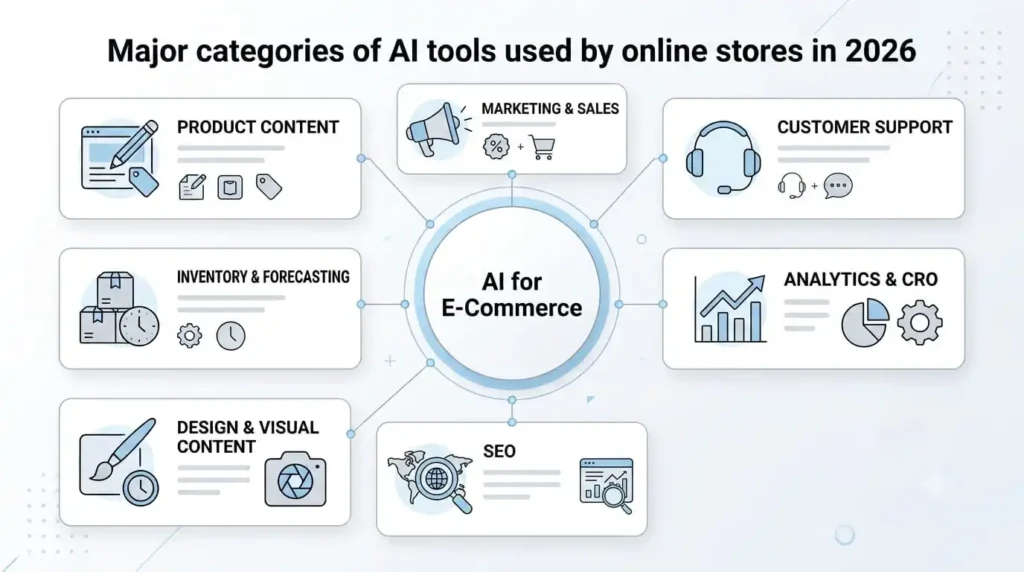
The best AI tool depends on the e-commerce problem you are trying to solve. Product content tools help with descriptions, SEO tools improve visibility, analytics tools identify conversion problems, marketing platforms automate campaigns, and support tools improve customer communication.
| E-Commerce Need | AI Tool Type | Primary Goal | Example Tools |
|---|---|---|---|
| Product descriptions | Generative AI | Faster content creation | Jasper, Copy.ai, ChatGPT |
| SEO | AI SEO software | Search visibility | Surfer SEO, Semrush, Frase |
| Advertising | AI marketing tools | Campaign optimization | AdCreative.ai, Meta Advantage+ |
| Customer service | AI chatbots | Faster support | Tidio, Zendesk AI, Intercom Fin |
| Analytics | AI analytics platforms | Better decisions | Google Analytics (AI insights), Triple Whale |
| Design | AI design tools | Faster visual creation | Canva Magic Studio, Adobe Firefly |
| Recommendations | Personalization AI | Higher relevance | Nosto, Dynamic Yield |
| Inventory | Forecasting AI | Better stock planning | Inventory Planner, Cin7 |
| Marketing automation AI | Customer retention | Klaviyo, Omnisend | |
| CRO | AI testing/analytics | Better conversion rates | VWO, Hotjar AI |
A store does not need every category.
In fact, buying too many AI tools can create unnecessary complexity.
A better approach is to identify the highest-value bottleneck first.
AI Product Description and Content Tools
AI content tools can help online stores create product descriptions, category copy, buying guides, FAQs, ad copy, email content, and social posts. They are most effective when trained or prompted with accurate product specifications, target customers, brand guidelines, and unique selling points.
Product content is one of the most obvious applications of generative AI.
A typical product page may require the following:
- Product title
- Short description
- Long description
- Features
- Benefits
- Specifications
- FAQs
- Meta title
- Meta description
- Image alt text
- Social copy
Creating these manually for a large catalog can be time-consuming.
What AI Should Do
AI may improve generation of a first draft based on structured product information.
For example:
Input:
- Product: Wireless noise-cancelling headphones
- Battery: 40 hours
- Connectivity: Bluetooth
- Target customer: Remote professionals
- Key benefit: Reduced background noise
AI Output:
A draft product description focused on productivity, comfort, battery life, and noise reduction.
A human editor should then verify every factual claim.
The Biggest Content Mistake
Do not allow AI to invent:
- Product specifications
- Certifications
- Warranty information
- Medical claims
- Performance guarantees
- Customer testimonials
- Manufacturing claims
AI-generated content becomes dangerous when the source information is unreliable.
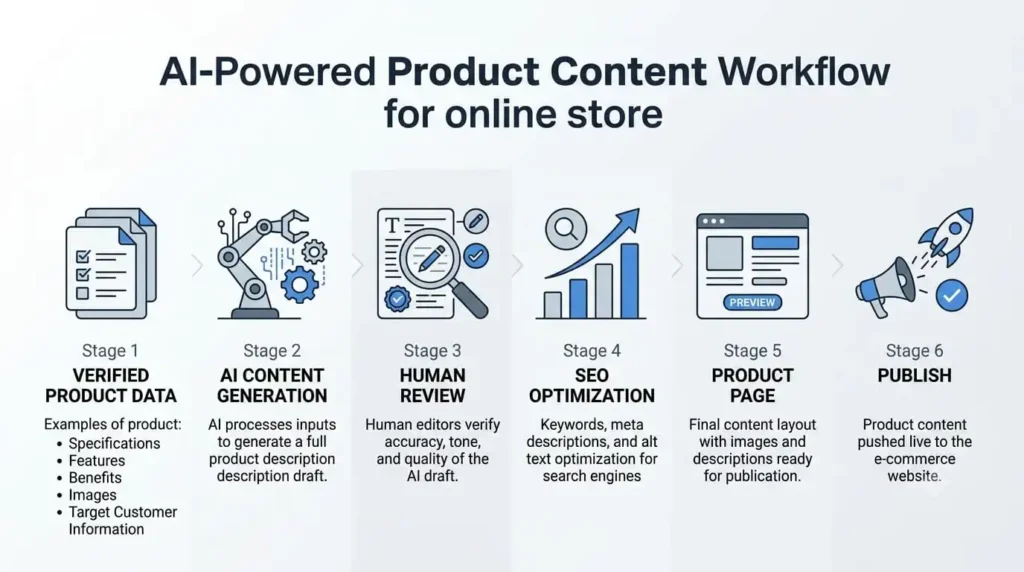
Better Product Content Workflow
- Collect verified product information.
- Create a brand voice guide.
- Generate the initial content.
- Check factual accuracy.
- Add original product insights.
- Optimize for search intent.
- Review readability.
- Publish.
- Monitor performance.
Give AI structured product data rather than asking it to “write something about this product.” Better inputs usually produce more useful outputs — this single habit fixes more generic-sounding copy than any prompt trick does.
AI Marketing and Sales Tools
AI marketing tools help online stores create, personalize, automate, and analyze campaigns across email, advertising, social media, and other channels. Their greatest value comes from combining customer data with automated segmentation, messaging, campaign optimization, and performance analysis.
AI can support nearly every stage of the marketing funnel.
Awareness
AI may improve help generate:
- Social media ideas
- Blog topics
- Video concepts
- Ad variations
- Campaign themes
Consideration
AI may improve and assist with:
- Product comparisons
- Buying guides
- Personalized email content
- Educational content
- Retargeting messages
Conversion
AI can support:
- Personalized offers
- Cart recovery
- Product recommendations
- Landing-page testing
- Customer objections
Retention
AI can help with:
- Post-purchase emails
- Replenishment reminders
- Loyalty campaigns
- Cross-selling
- Customer segmentation
The important distinction is between content generation and marketing intelligence.
Generating 50 ad headlines is useful.
Knowing which audience should receive which message is often more valuable.
AI Customer Support and Chatbot Tools
AI customer-support tools can answer common questions, guide shoppers, summarize conversations, and route complex issues to human agents. They are particularly useful for repetitive questions about shipping, returns, product availability, order status, and basic product information.
Customer support is an excellent AI use case because many questions are repetitive.
Examples include:
- “Where is my order?”
- “What is your return policy?”
- “Do you ship internationally?”
- “Is this product available?”
- “What size should I choose?”
- “How long does delivery take?”
An AI assistant can answer simple questions immediately when it has access to reliable store information.
Where Human Support Still Matters
AI should escalate situations involving:
- Refund disputes
- Complex complaints
- Sensitive customer issues
- Payment problems
- Legal questions
- Account-security concerns
- High-value customers
- Unusual cases
The best model is often AI-first, human when necessary.
Customer Support KPI
Track:
- First response time
- Resolution time
- Escalation rate
- Customer satisfaction
- Repeat questions
- AI resolution rate
A chatbot that answers quickly but incorrectly is not successful.
Accuracy matters more than automation percentage.
AI Analytics and Conversion Optimization Tools
AI analytics tools help online stores understand customer behavior, identify conversion problems, detect patterns, and prioritize optimization opportunities. They can analyze events, sessions, funnels, customer segments, and experiments to help businesses make more informed decisions.
Analytics is one of the most powerful applications of AI because e-commerce stores generate enormous amounts of behavioral data.
Important data points include:
- Traffic
- Product views
- Add-to-cart rate
- Checkout starts
- Purchases
- Revenue
- Average order value
- Customer acquisition cost
- Conversion rate
- Repeat purchase rate
AI can help identify relationships within this data.
Example
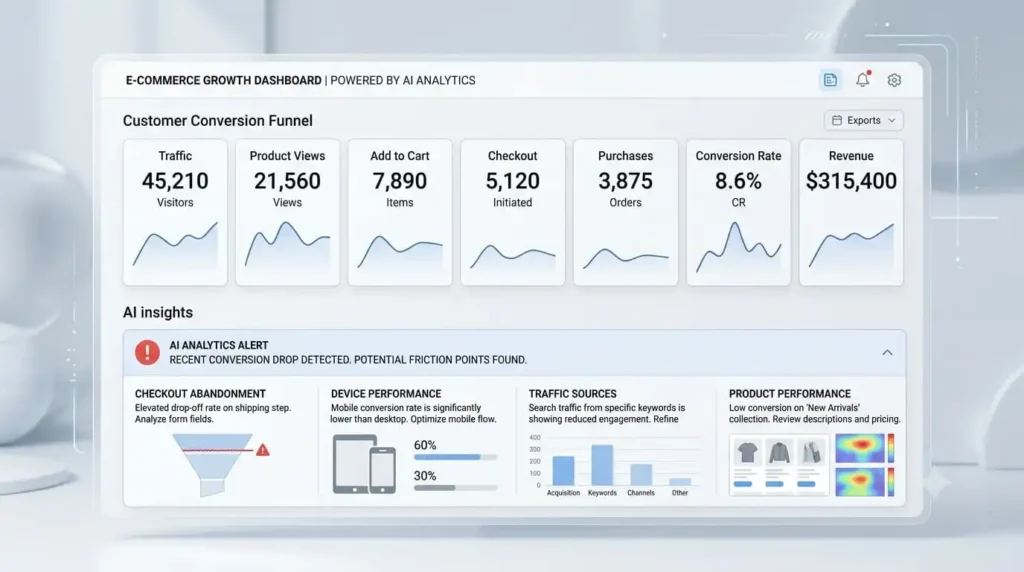
Suppose a store experiences a 15% decline in purchases.
A basic dashboard tells you that sales decreased.
An intelligent analysis may help investigate:
- Which device types were affected?
- Which traffic sources changed?
- Which products declined?
- Did checkout abandonment increase?
- Did page speed change?
- Did a campaign end?
- Did product availability change?
This transforms analytics from reporting into decision support.
Conversion Optimization
AI may improve and also help prioritize experiments.
Potential tests include:
- Product-page layouts
- Headlines
- CTA placement
- Product images
- Checkout messaging
- Trust signals
- Shipping information
Don’t ask only, “What happened?” Ask, “What changed? Why might it have changed? And what should we test next?” That reframing is what separates a reporting dashboard from an actual decision-support system.
AI SEO Tools for E-Commerce
AI SEO tools can support keyword research, content planning, internal linking, optimization, competitor analysis, and content briefs. For online stores, AI SEO works best when it is combined with search intent, product expertise, original information, technical SEO, and human editorial review.
SEO remains important because shoppers often begin product research through search engines.
An e-commerce SEO strategy can include:
- Product-page optimization
- Category-page optimization
- Informational content
- Comparison pages
- Buying guides
- FAQ content
- Internal linking
- Image optimization
- Structured data
- Technical SEO
AI Keyword Research
AI may help organize keywords into search-intent groups.
For example:
Transactional:
- Buy running shoes online
- Best wireless headphones price
Commercial investigation:
- Best wireless headphones for work
- Product A vs Product B
Informational:
- How does noise cancellation work?
- How to choose running shoes
This creates a stronger content architecture.
AI and Topical Authority
Instead of publishing random articles, build topic clusters.
For an online shoe store:
Pillar: Running Shoes Guide
Clusters:
- Best running shoes for beginners
- Running shoe size guide
- Trail vs road running shoes
- Running shoe cushioning explained
- How often should running shoes be replaced?
This structure can improve topical relevance and internal linking.
Important Warning
AI-generated SEO content should not become a substitute for original expertise.
Add:
- Original examples
- Product testing
- First-hand observations
- Expert commentary
- Unique comparisons
- Proprietary data
- Clear sourcing
AI Design and Visual Content Tools
AI design tools help online stores produce product concepts, social graphics, advertising creatives, background variations, promotional visuals, and other marketing assets faster. Human review remains important for brand consistency, product accuracy, typography, and visual quality.
Visual presentation strongly affects how shoppers perceive products.
AI can assist with:
- Background removal
- Product-image enhancement
- Ad creatives
- Social media graphics
- Banner concepts
- Lifestyle-image concepts
- Thumbnail creation
- Brand assets
- Promotional variations
Product Images Need Special Care
Never allow AI editing to change important product characteristics.
For example, AI should not accidentally change the following:
- Product color
- Shape
- Number of components
- Packaging
- Material
- Dimensions
A beautiful but inaccurate product image can damage trust.
Better Visual Workflow
Original product photo → cleanup → background optimization → brand styling → quality check → WebP optimization → upload
This combines AI speed with human quality control.
AI Inventory and Demand Forecasting
AI inventory systems use historical sales, product trends, seasonality, and other business signals to help estimate future demand. They can support replenishment planning, reduce stockout risk, and identify slow-moving inventory, but forecasts should be reviewed against real-world business conditions.
Inventory problems can destroy profitability.
Too much inventory can create:
- Storage costs
- Discount pressure
- Cash-flow problems
- Obsolete stock
Too little inventory can create:
- Lost sales
- Customer frustration
- Lower search momentum
- Poor customer experience
AI forecasting attempts to find a better balance.
Useful Forecasting Signals
AI systems may consider:
- Historical sales
- Seasonal trends
- Promotions
- Product launches
- Holidays
- Lead times
- Regional demand
- Sales velocity
Human Judgment Still Matters
A model may not know about an unexpected supplier problem, viral social trend, competitor shutdown, or sudden market event.
Therefore:
AI forecast + business knowledge = better planning
Rather than:
Artificial intelligence forecast = automatic truth
AI Personalization and Product Recommendations
Artificial intelligence personalization systems recommend products, content, offers, or messages based on customer behavior and product relationships. They can help shoppers discover relevant products while supporting cross-selling, upselling, and repeat purchases.
Personalization can occur throughout the customer journey.
Homepage
Show relevant categories or products.
Product Page
Recommend:
- Similar products
- Frequently purchased products
- Complementary products
Cart
Suggest useful accessories.
Recommend products based on previous interactions.
Post-Purchase
Suggest related or replenishable items.
The objective should not be personalization for its own sake.
The objective is reducing the amount of effort customers need to find relevant products.
AI Tools for Shopify, WooCommerce, and Other Platforms
AI can be integrated into major e-commerce platforms through native features, apps, plugins, APIs, marketing platforms, analytics systems, and external software. The best solution depends on the store platform, catalog size, technical resources, budget, and specific business objectives.
Shopify Stores
Shopify merchants can use AI across:
- Product content
- Store management
- Marketing
- Customer support
- Recommendations
- Analytics
Shopify’s own app store has a dedicated AI apps category, and Shopify Magic is built into the admin for product descriptions and email copy — often the fastest starting point before adding third-party apps.
WooCommerce Stores
WooCommerce businesses can combine:
- WordPress AI plugins
- SEO platforms
- Analytics tools
- Customer-support systems
- Marketing automation
- Product-content workflows
Since WooCommerce runs on WordPress, tools like Yoast SEO (with its own AI features in the premium tier) and standard WordPress AI content plugins slot in directly—this is the more flexible but more hands-on path.
Custom E-Commerce Websites
Custom stores may integrate AI through APIs.
This provides more flexibility but generally requires greater technical expertise.
Platform Selection Tip
Do not choose an AI application simply because it has the word “AI” in its marketing.
Check:
- Integration quality
- Data access
- Export options
- Privacy controls
- Pricing
- Support
- Automation capabilities
- Accuracy
- Scalability
Free vs. Paid AI Tools for Online Stores
Free AI tools can be useful for experimentation, content drafts, research, and small workloads, while paid platforms typically provide deeper automation, integrations, analytics, higher usage limits, and business features. Start with free or low-cost options when validating a workflow before investing heavily.
| Business Stage | Recommended Approach |
|---|---|
| New store | Free/low-cost AI |
| Small catalog | Basic automation |
| Growing store | Integrated AI stack |
| Large catalog | Enterprise automation |
| High-volume store | Custom/API workflows |
Free Tools
Good for:
- Testing ideas
- Content drafts
- Keyword brainstorming
- Simple graphics
- Research assistance
Paid Tools
Better suited to:
- Automation
- Large product catalogs
- Team collaboration
- Advanced analytics
- CRM integration
- Large-scale personalization
The Real Cost of AI
Do not measure only subscription price.
Also consider:
Tool cost + setup cost + integration cost + training cost + quality-control cost
A $20 tool that requires five hours of manual work may be less efficient than a more expensive tool that automates the process.
How to Choose the Right AI Tools
Choose AI software based on a specific business problem rather than popularity. Evaluate the expected time savings, revenue opportunity, integration quality, data requirements, accuracy, security, scalability, and total cost before adding a tool to your e-commerce technology stack.
Use this framework.
Step 1: Identify the bottleneck.
Ask:
What is consuming the most time or limiting growth?
Examples:
- Too much manual content work
- Slow customer support
- Poor conversion rate
- Weak SEO
- Low repeat purchases
- Inventory problems
Step 2: Estimate the Business Impact
Estimate:
Potential value = time saved + additional revenue + reduced costs
This does not need to be perfectly precise.
A rough estimate is better than buying software blindly.
Step 3: Check Integration
The tool should ideally work with your existing:
- E-commerce platform
- CRM
- Analytics
- Email system
- Product database
- Marketing stack
Step 4: Test Before Scaling
Run a small pilot.
For example:
Test AI product descriptions on 50 products before updating 5,000 products.
Compare:
- Production time
- Editing time
- Organic traffic
- Conversion rate
- Customer feedback
Step 5: Measure Results
Every AI workflow should have a KPI.
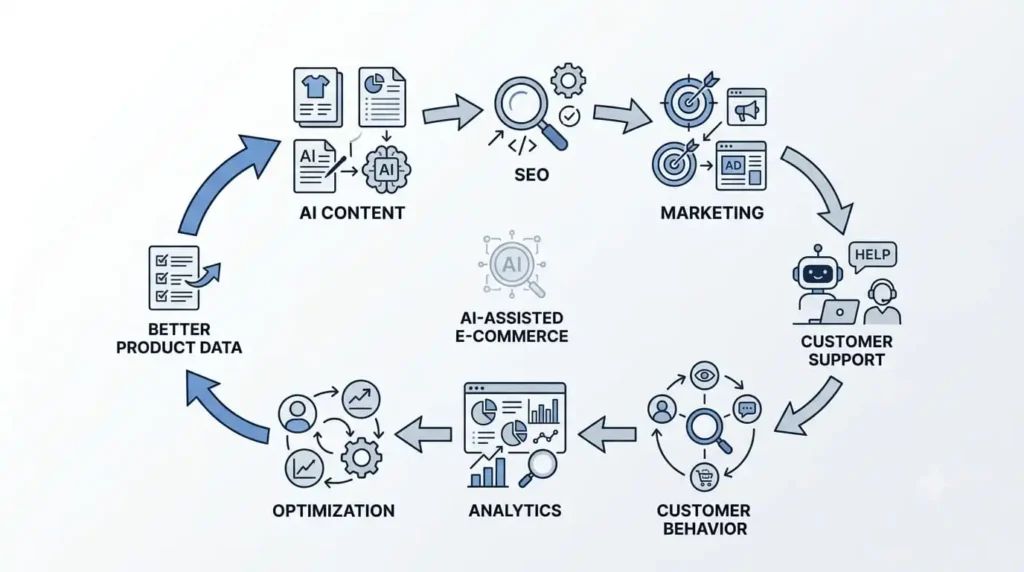
How to Build an AI-Powered E-Commerce Workflow
A practical AI e-commerce workflow starts with data and business goals, then connects AI to content, marketing, customer service, analytics, and optimization tasks. The most effective systems automate repetitive work while keeping human review at important quality and decision points.
A strong AI workflow can look like this:
Product Data → AI Content → SEO → Publishing → Marketing → Customer Interaction → Analytics → Optimization
Stage 1: Product Data
Maintain accurate
- Product names
- Specifications
- Prices
- Features
- Benefits
- Images
- Inventory
- Categories
Stage 2: Content
AI creates:
- Product descriptions
- FAQs
- Category content
- Social copy
Stage 3: SEO
Optimize:
- Search intent
- Titles
- Meta descriptions
- Headings
- Internal links
- Image attributes
Stage 4: Marketing
Create:
- Email campaigns
- Social content
- Advertising variations
- Promotional messages
Stage 5: Customer Support
AI answers routine questions and escalates difficult cases.
Stage 6: Analytics
Measure:
- Traffic
- Engagement
- Conversion
- Revenue
- Customer retention
Stage 7: Optimization
Use the insights to improve:
- Products
- Pages
- Offers
- Campaigns
- Customer experience
This creates a continuous improvement loop.
Common Mistakes When Using AI for E-Commerce
Common AI mistakes include publishing inaccurate content, automating sensitive decisions, using too many disconnected tools, ignoring customer data privacy, producing generic content, and measuring AI activity instead of business outcomes. Successful implementation requires human oversight, clear workflows, reliable data, and measurable KPIs.
Mistake 1: Publishing AI Content Without Review
AI can make factual errors.
Fix: Always verify important claims.
Mistake 2: Using Generic Prompts
“Write a product description” produces generic results.
Fix: Include:
- Audience
- Product information
- Brand voice
- Benefits
- Search intent
- Differentiators
Mistake 3: Automating Everything
Some decisions require human judgment.
Fix: Automate repetitive tasks while keeping human approval for important decisions.
Mistake 4: Buying Too Many Tools
A large collection of disconnected applications can create workflow problems.
Fix: Build a smaller, integrated AI stack.
Mistake 5: Ignoring Data Privacy
Customer information can be sensitive.
Fix: Understand how each platform handles data before connecting customer or business information.
Mistake 6: Measuring AI Usage Instead of Business Results
Generating 1,000 pieces of content is not a business KPI.
Better metrics include:
- Revenue
- Conversion rate
- Customer acquisition cost
- Average order value
- Customer retention
- Support resolution time
- Organic traffic
Practical AI E-Commerce Strategy for 2026
A strong 2026 AI strategy should prioritize business outcomes rather than the number of AI applications used. Start with one or two high-impact workflows, establish measurement systems, improve data quality, add automation gradually, and maintain human oversight for brand, customer, and strategic decisions.
A practical strategy can follow five stages.
Stage 1: Foundation
Before adding AI:
- Fix technical SEO
- Organize product data
- Install reliable analytics
- Document brand guidelines
- Clean customer data
- Standardize product information
Stage 2: Content Automation
Automate repetitive content production.
Focus on:
- Product descriptions
- FAQs
- Email drafts
- Social content
- Content briefs
Stage 3: Customer Experience
Add:
- AI support
- Product recommendations
- Personalized messaging
Stage 4: Intelligence
Use AI for:
- Analytics
- Forecasting
- Segmentation
- Conversion optimization
Stage 5: Continuous Optimization
Review results every month.
Ask:
- What did AI automate?
- How much time did it save?
- Did revenue improve?
- Did customers benefit?
- What errors occurred?
- What should be changed?
This prevents AI from becoming a collection of unused subscriptions.
Information Gain: Where AI Creates the Most Value
The greatest value from AI often comes from connecting multiple e-commerce processes rather than automating a single task. A store becomes more efficient when product data, customer behavior, marketing, support, analytics, and optimization work together as one continuous system.
This is one of the most important strategic distinctions.
Many businesses ask:
“Which is the best AI tool?”
A better question is
“Which workflow should AI improve first?”
Imagine two stores.
Store A
Uses:
- One AI writing tool
- One AI design tool
- One chatbot
- One SEO tool
But none of them communicate with each other.
Store B
Uses AI to connect:
Product data → Content → SEO → Marketing → Customer behavior → Recommendations → Analytics
Store B may generate more value even if it uses fewer individual tools.
The AI Flywheel
A mature AI e-commerce operation can create a flywheel:
Better Data
↓
Better AI Outputs
↓
Better Customer Experience
↓
Better Customer Behavior
↓
More Useful Data
↓
Better Decisions
This creates a compounding advantage.
Unique Pro Tip: Automate the Handoff, Not Just the Task
Many businesses automate individual tasks but leave manual handoffs between them.
For example:
AI writes product description → employee copies it → employee reformats it → employee adds SEO fields → employee uploads it
The AI task is automated, but the workflow remains manual.
A better approach is to automate the handoff wherever practical.
Another Pro Tip: Build a Human Approval Layer
Use three levels:
Level 1 — Fully Automated
Low-risk repetitive tasks.
Level 2 — AI Draft + Human Approval
Product content, marketing copy, SEO recommendations.
Level 3 — Human Decision + AI Assistance
Pricing strategy, major customer complaints, legal matters, strategic decisions.
This creates a safer balance between speed and control.
Frequently Asked Questions
What are the best AI tools for online stores?
The best AI tools depend on the store’s specific needs. Product-content tools are useful for catalog management, SEO platforms support search visibility, AI marketing systems automate campaigns, analytics tools identify behavior patterns, and customer-service AI handles repetitive questions. There is no single AI tool that is best for every online store.
Can AI help increase e-commerce sales?
AI may contribute to higher sales by improving product discovery, personalization, marketing efficiency, customer support, conversion optimization, and retention. However, AI does not automatically increase revenue. Results depend on implementation, product quality, pricing, customer demand, and the overall shopping experience. AI is an optimization tool, not a guarantee of revenue growth.
Are AI tools useful for small online businesses?
Yes. Small stores can benefit significantly from AI because automation can reduce repetitive work without requiring a large team. The best starting points are usually product content, customer support, marketing assistance, SEO workflows, and basic analytics. Small businesses should start with one high-impact problem.
Can AI write product descriptions?
Yes. AI can generate product descriptions from structured product information. However, businesses should verify specifications, claims, measurements, warranties, and other factual information before publishing. Human editing is important for accuracy, differentiation, brand voice, and customer trust. AI-generated product descriptions should be treated as drafts unless thoroughly verified.
Can AI help with e-commerce SEO?
Yes. AI can assist with keyword research, content briefs, product-page optimization, internal linking, topic clustering, competitor analysis, and content ideation. Strong e-commerce SEO still requires technical optimization, search-intent analysis, original information, useful content, and human review.
Should every online store use AI?
Not necessarily. AI is valuable when it solves a real business problem. A store should not adopt AI simply because competitors are using it. Start with a measurable bottleneck and test whether AI improves efficiency, customer experience, or business performance.
Are free AI tools enough for an online store?
Free AI tools can be sufficient for small catalogs, experimentation, content drafts, research, and basic creative work. Growing stores may eventually need paid platforms for automation, integrations, analytics, higher usage limits, and advanced e-commerce functionality.
How many AI tools should an online store use?
There is no ideal number. A small store may need only a few carefully selected applications, while a large operation may require a broader AI technology stack. The priority should be integration, workflow efficiency, reliability, and measurable business value rather than the number of tools.
Can AI replace e-commerce employees?
AI can automate many repetitive tasks, but replacing an entire e-commerce team is usually neither practical nor desirable. Human expertise remains important for strategy, brand positioning, customer relationships, quality assurance, creative direction, and complex decision-making. The more useful concept is AI-assisted e-commerce teams.
Is AI-generated content good for SEO?
AI-generated content can be useful when it provides accurate, helpful, original information and satisfies search intent. Simply producing large quantities of generic AI text does not create strong SEO. Human expertise, original insights, factual accuracy, and useful information remain important.
What should an online store automate first?
Start with repetitive, low-risk, high-volume tasks. Product-content drafting, basic customer questions, marketing variations, reporting, and content research are common starting points. Measure the time saved and business impact before expanding automation into more complex workflows.
How can AI improve customer experience?
AI can improve customer experience through faster support, personalized product recommendations, relevant search results, automated order information, personalized marketing, and easier product discovery. The system should provide accurate information and transfer complex cases to human support when appropriate.
What is the biggest AI mistake e-commerce businesses make?
The biggest mistake is focusing on AI tools instead of business problems. Businesses may subscribe to multiple platforms without defining goals, workflows, KPIs, or data requirements. A better strategy is to identify a bottleneck, test one solution, measure the result, and scale only when it works.
Final Takeaway
AI tools for online stores can improve productivity, customer experience, marketing, SEO, analytics, personalization, and operational efficiency. The strongest strategy is not to use the largest number of AI applications but to build a focused, measurable workflow around the store’s most important business problems.
AI is becoming an important part of modern e-commerce, but successful implementation requires more than choosing a popular application.
The strongest approach is:
Identify the problem → Choose the right AI capability → Integrate it into the workflow → Keep human oversight → Measure the result → Improve continuously.
For a new or growing online store, start small.
A practical starting stack might include:
- AI content assistance for product and marketing content.
- AI SEO support for search-intent research and content planning.
- AI customer support for repetitive questions.
- AI analytics for identifying conversion opportunities.
- AI personalization as customer and product data mature.
Over time, these capabilities can become part of a connected e-commerce system.
The future of online retail is not simply about businesses using AI.
It is about businesses using better data, better workflows, and better decision-making with AI assistance.
If implemented thoughtfully, AI can help an online store spend less time on repetitive operations and more time on what actually drives sustainable growth: better products, better customer experiences, stronger marketing, and smarter decisions.
For related reading, see our guides on AI Tools for Ecommerce: Complete Guide pillar page, AI tools for small ecommerce businesses, AI marketing automation tools,Free AI Tools for Ecommerce Stores and Best AI Tools for E-Commerce & Best AI Apps for Ecommerce in 2026: 25+ Tools to Automate