Best AI Apps for Ecommerce in 2026: 25+ Tools to Automate, Market & Grow Your Online Store
Table of Contents
- What Are AI Apps for Ecommerce?
- Why Ecommerce Businesses Are Using AI Apps in 2026
- Best AI Apps for Ecommerce at a Glance
- Best AI Apps for Product Research
- Best AI Apps for Product Descriptions and Content
- Best AI Apps for Ecommerce Marketing
- Best AI Apps for SEO
- Best AI Apps for Customer Support
- Best AI Apps for Analytics and Conversion Optimization
- Best AI Apps for Ecommerce Design
- Best AI Apps for Inventory and Operations
- Best AI Apps for Personalization and Recommendations
- How to Choose the Right AI Ecommerce App
- AI Ecommerce Apps by Business Goal
- Common Mistakes When Using AI for Ecommerce
- How to Build an AI Ecommerce Tech Stack
- Practical AI App Selection Framework
- A Practical AI Workflow for a Small Ecommerce Store
- Frequently Asked Questions
- Final Takeaway
What Are AI Apps for Ecommerce?
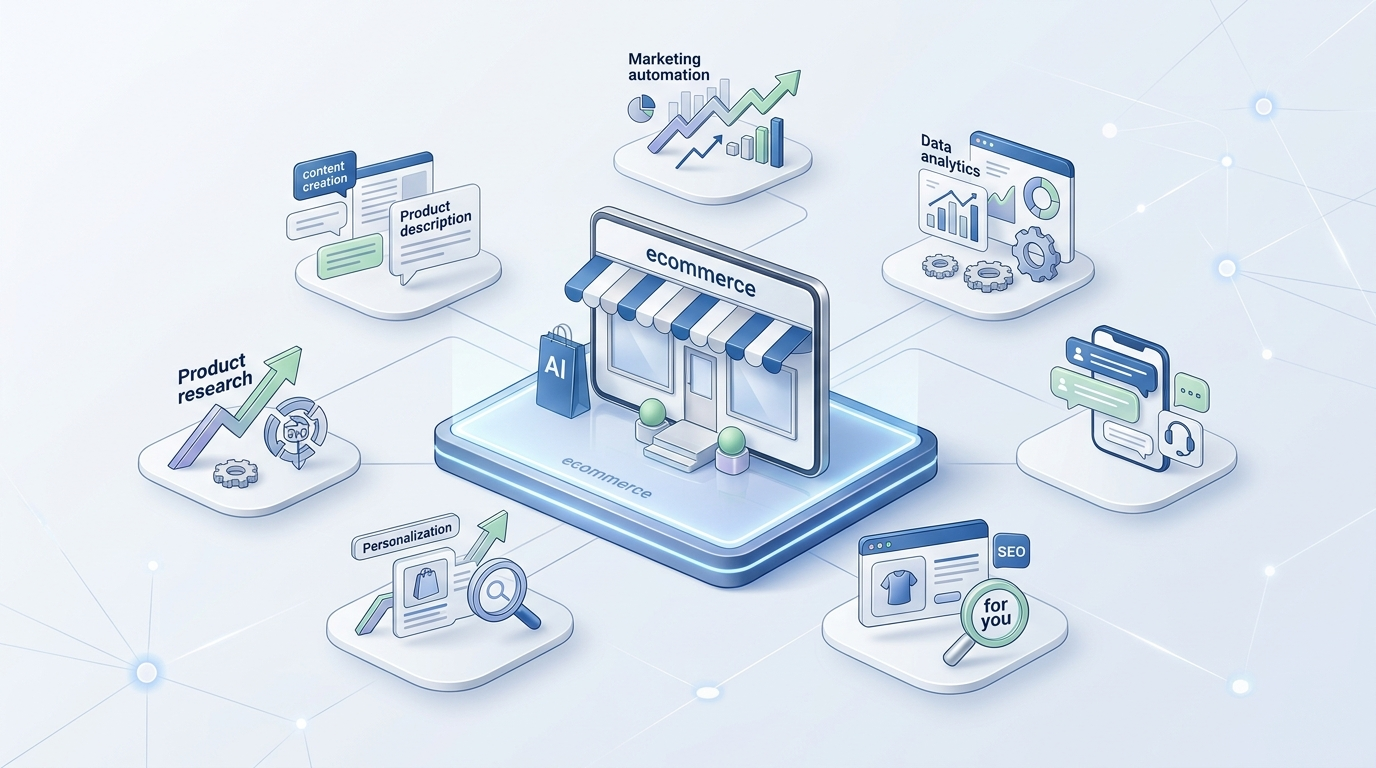
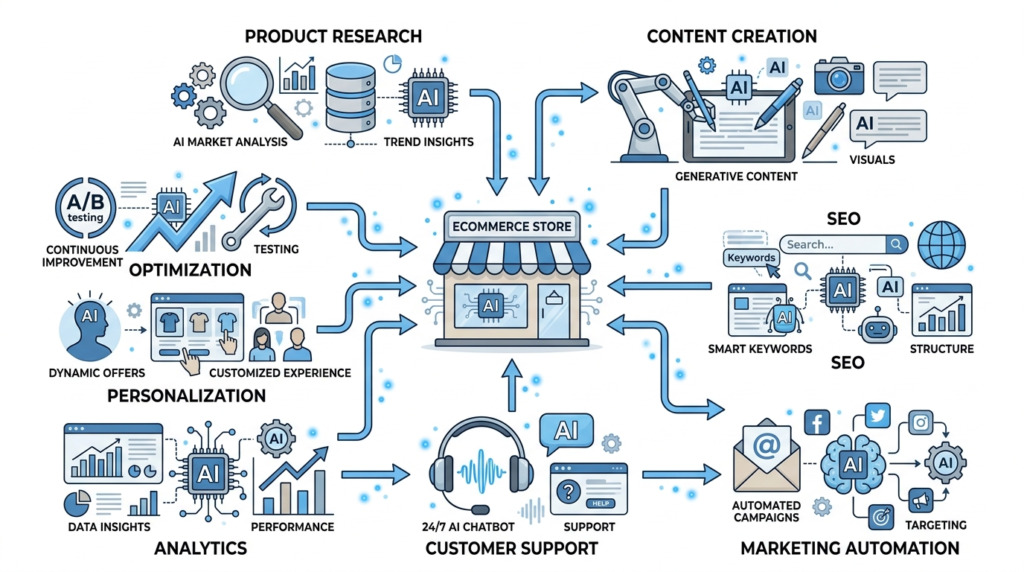
AI ecommerce apps are software tools that use artificial intelligence to help online stores automate repetitive tasks, analyze customer behavior, create content, improve marketing, provide customer support, and increase conversions. They cover everything from product research and SEO to personalization, analytics, and store operations.
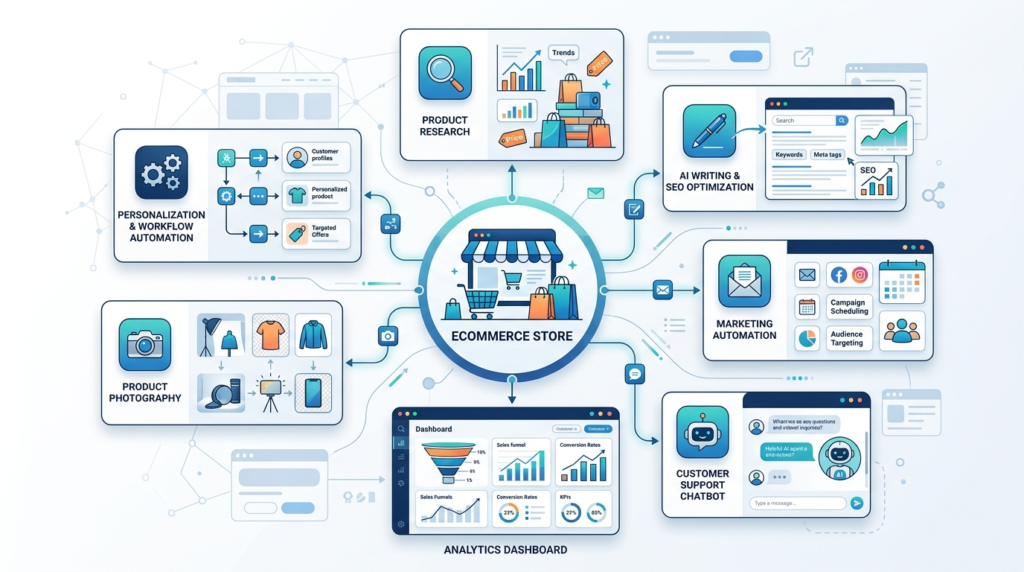
Online retailers today manage more data, content, customer interactions, and marketing channels than ever before, so treating “AI” as one giant category doesn’t help much. It’s more useful to think in terms of specific jobs:
- An AI writing tool drafts product descriptions.
- An AI SEO platform surfaces search opportunities.
- An AI chatbot answers routine customer questions.
- An analytics platform flags conversion problems.
- A design app produces product visuals.
- An automation platform connects different workflows together.
None of this works just because a tool has “AI” in its marketing copy. The advantage only shows up when AI is pointed at a specific business problem with a measurable outcome attached to it. A small store might genuinely only need three or four of these apps running well; a larger operation may run dozens, wired together.
This article is part of our AI Tools for Ecommerce: Complete Guide pillar page
Why Ecommerce Businesses Are Using AI Apps in 2026
Ecommerce businesses use AI apps to save time, process large amounts of data, improve customer experience, personalize marketing, and automate repetitive work. The strongest use cases pair AI automation with human review — not AI making every decision alone.
AI adoption has moved well past the experimentation stage. Businesses now use it across the whole customer journey:
Discovery → Product Research → Content → Marketing → Purchase → Support → Retention
That’s an important shift from a few years ago, when most stores ran separate, disconnected tools for every single task. Increasingly, AI systems can pull information across several of those workflows at once.
1. Faster content production
A store with hundreds or thousands of SKUs needs unique product descriptions, meta descriptions, category copy, emails, social posts, ad variations, and buying guides. Writing all of that by hand consumes a huge amount of time. AI can speed up the first draft, while a human editor still owns accuracy, brand voice, and originality.
2. Better customer personalization
Artificial intelligence can read behavioral signals—products viewed, search queries, past purchases, cart activity, purchase frequency, and customer segment—and use them to serve more relevant recommendations and messages.
3. More efficient marketing
AI applications now assist with keyword research, audience segmentation, email automation, ad copy, campaign analysis, social content, and conversion optimization, often inside a single connected platform rather than five separate tools.
4. Improved decision-making
One of AI’s strongest ecommerce use cases is simply interpreting data. Rather than manually scrolling through thousands of analytics rows, a merchant can lean on an AI-powered system to surface patterns, anomalies, and opportunities faster than a human would catch them alone.
Best AI Apps for Ecommerce at a Glance
The right AI ecommerce app depends entirely on the task. ChatGPT and Gemini work well for general content and strategy; Canva for visual creation; Jasper for marketing copy; Surfer for SEO content workflows; Klaviyo for ecommerce marketing automation; Shopify’s built-in AI features for store workflows; and platforms like Microsoft Clarity for understanding customer behavior.
| Ecommerce Needs | Recommended AI App/Platform | Best For |
|---|---|---|
| General AI assistance | ChatGPT | Research, content, strategy |
| General AI assistance | Gemini | Research and content workflows |
| Product content | Jasper | Marketing copy |
| Visual content | Canva | Product graphics and social visuals |
| SEO | Surfer | Content optimization |
| SEO/content | Semrush | SEO research and strategy |
| Email & SMS marketing | Klaviyo | Ecommerce lifecycle marketing |
| Store management | Shopify AI features | Store workflows |
| Customer behavior | Microsoft Clarity | Session analysis |
| Analytics | Mixpanel | Product/customer analytics |
| Conversion testing | VWO | Experimentation |
| Customer support | Gorgias | Ecommerce support automation |
| Automation | Zapier | Connecting apps and workflows |
| Design | Adobe Firefly | Generative creative work |
| Product photography | Photoroom | Product image editing |
Features, pricing, and integrations for AI tools change often — sometimes month to month. Treat the table above as a starting shortlist, and always check the vendor’s current pricing page before you commit a budget.
Best AI Apps for Product Research
AI product research tools help ecommerce businesses spot market trends, study competitors, understand demand, and identify potential products. AI works best combined with real sales data, search trends, customer reviews, and competitor research — not as the sole source of a product decision.
Product research is one area where AI genuinely saves time, mainly because it can organize and interpret research pulled from multiple sources instead of you doing it by hand.
What AI can analyze
AI-assisted research can help surface the following:
- Customer pain points
- Product features people mention often
- Competitor positioning
- Review sentiment
- Recurring complaints
- Content gaps
- Potential product niches
- Common customer questions
- Broader market trends
The right way to use AI for product research
Don’t ask an AI model, “What product should I sell?” — that question invites a generic, unverifiable list. Instead, build a research workflow:
- Pick a product category.
- Identify 10–20 competing products.
- Pull customer reviews for those products.
- Analyze the positive and negative comments.
- Identify recurring complaints.
- Compare prices and features.
- Check search demand for the category.
- Estimate margins and operating costs.
- Validate the opportunity against real customer data.
That process produces a far more reliable decision than any AI-generated “trending products” list.
Pro tip: use AI to summarize evidence, not manufacture it. If a model tells you a product is trending, push back—what evidence supports that? What time period? Is it seasonal or a temporary spike? Can it actually be sourced at a profitable margin? Asking those questions before you commit to inventory can save you from an expensive mistake.

Best AI Apps for Product Descriptions and Content
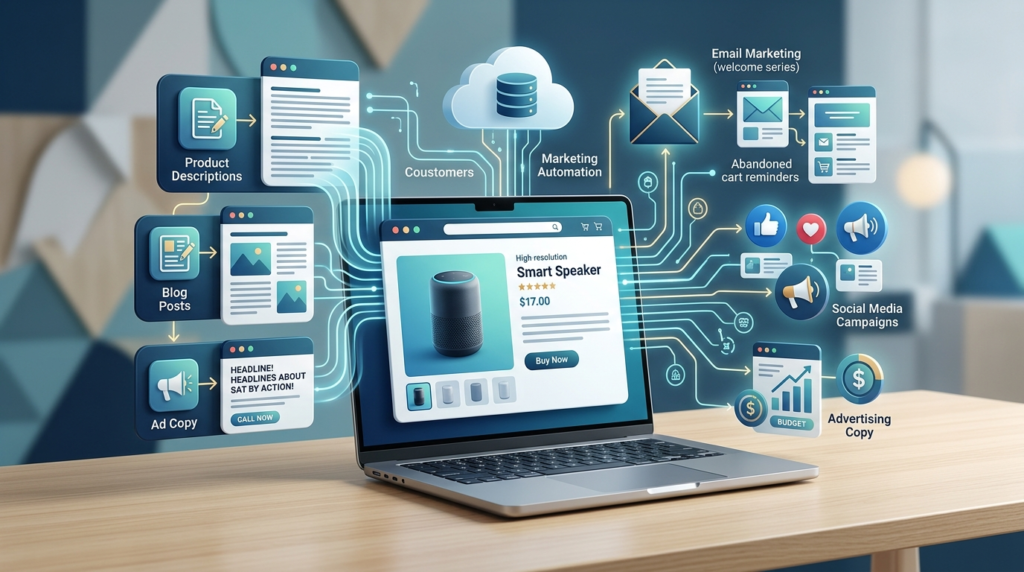
AI writing tools help ecommerce stores produce product descriptions, category pages, buying guides, FAQs, email copy, and social content faster. The results only hold up, though, if a human adds real product information, verifies every claim, and edits the output so it’s actually accurate and different from what competitors already have online.
Product content has two jobs: help customers understand the product and help search engines understand the page. AI accelerates the drafting step — it doesn’t replace the judgment step.
ChatGPT
ChatGPT is useful for drafting product descriptions, comparison tables, FAQs, buying guides, email campaigns, social posts, support scripts, and content briefs. Its biggest strength is flexibility: feed it real specs, actual customer reviews, brand guidelines, and audience details, and it can turn that into structured, on-brand copy—rather than generic filler.
Jasper
Jasper leans more toward marketing and brand-content workflows and tends to suit teams that need consistent copy across several campaigns running at once.
Gemini
Gemini is solid for research, brainstorming, and content planning—the earlier, messier stages of a content workflow, before you’re ready to write final copy.
Best practice for AI product descriptions
Feed the AI real information: material, dimensions, weight, compatibility, warranty terms, shipping details, known limitations, ideal customer, and core benefits. Then explicitly tell it not to add anything you didn’t give it.
Never let AI invent specifications, certifications, warranties, ingredients, medical claims, or performance guarantees. If it isn’t in your source material, it shouldn’t be in the final copy—full stop.
Best AI Apps for Ecommerce Marketing
AI marketing tools help ecommerce businesses build campaigns, segment audiences, generate copy, automate customer journeys, and analyze performance. The best results come from combining AI-generated ideas with first-party customer data, tested offers, real segmentation, and a human reviewing the output before it ships.
Marketing is arguably the largest AI use case in ecommerce right now, touching almost every stage of a campaign.
Email and SMS marketing: a closer look at Klaviyo
Klaviyo has moved well past being just an email tool. Through 2026 it’s been positioning itself as an “autonomous B2C CRM,” and a few specific features are worth knowing about if you’re evaluating it for a store:
- The composer generates full omnichannel campaigns—email, SMS, push, and WhatsApp—from a single written prompt and can also audit existing flows and segments to suggest where the next revenue opportunity is.
- Customer Agent is Klaviyo’s AI support layer, pre-built for common ecommerce jobs like order tracking, coupons, and returns. In Klaviyo’s own reporting, resolution rates for those categories have landed in the 80–90% range, and the agent now works across chat, SMS, email, and WhatsApp, with adjustable tone and escalation rules so it doesn’t go off-brand in a sensitive conversation.
- Next Best Product recommendations now run across text, push, and WhatsApp, not just email.
- Klaviyo’s own data has long shown that automated flows (welcome series, abandoned cart, and post-purchase) generate dramatically more revenue per recipient than one-off manual campaigns, which is why most ecommerce marketers treat flows as the first thing to set up, not an afterthought.
One practical caveat: Klaviyo’s pricing is contact-based and climbs in steps as your list grows, and SMS is billed separately from email—worth modeling out before you commit, especially if you’re sending SMS to a US audience where per-message rates run higher.
Social media marketing
Artificial intelligence can generate content variations for Facebook, Instagram, Pinterest, X, and TikTok—but publishing dozens of near-identical AI posts is a fast way to train your audience to ignore you. A better approach is matching content to intent:
- Awareness: educational content
- Consideration: product comparisons
- Decision: demonstrations, reviews, offers
- Retention: product tips and loyalty content
AI advertising copy
AI can generate multiple headline, primary-text, and CTA variations quickly. The version that actually performs, though, should be decided by real campaign data — not by which draft “sounds” best to you.
Best AI Apps for SEO
AI SEO tools help ecommerce businesses find keywords, build content briefs, optimize pages, spot content gaps, and improve topical coverage. AI should support the SEO strategy, not replace search-intent research, technical SEO, internal linking, and human editorial judgment.
Ecommerce SEO deals with thousands of potential pages, so AI genuinely helps at that scale—but the workflow still needs a human in the loop.
A closer look at Semrush
Semrush has expanded a lot recently with the launch of Semrush One, which bundles its classic SEO toolkit (keyword research, backlink analysis, technical audits, and competitor tracking) with an AI Visibility Toolkit that tracks whether your brand gets mentioned inside AI answers from ChatGPT, Google AI Overviews, Perplexity, and Gemini. For ecommerce specifically, that matters more each year: a growing share of high-intent product research queries—”best electric cargo bike for delivery,” for example—now get answered directly inside an AI response instead of a traditional results page. If your content never gets cited there, you’re effectively invisible to that segment of buyers.
On the content side, Semrush ships ContentShake AI for first-draft generation and an SEO Writing Assistant for real-time optimization scoring, plus a Copilot layer that reviews your account data and surfaces prioritized to-do items. Pricing for Semrush One starts around $199/month for the entry tier, so it’s more of a fit once your store has SEO as a real growth channel—not necessarily the first tool a brand-new store should buy.
Surfer
Surfer is more narrowly focused on content optimization — scoring a draft against on-page signals from top-ranking pages for a target keyword. It pairs well with a writing tool like ChatGPT: research and brief in Semrush, draft with AI, then score and tighten in Surfer before publishing.
A practical ecommerce SEO workflow
Keyword → Search Intent → SERP Analysis → Content Brief → Draft → Human Review → Internal Links → Schema → Publish → Measure
AI can speed up several of these steps, but it shouldn’t be allowed to skip any of them.
An important SEO warning
Resist the temptation to publish hundreds of low-value AI pages just because they’re easy to generate. Google’s ranking systems are built to reward genuinely useful content, and a pile of thin, near-duplicate pages tends to drag a site down rather than lift it. Building topical authority around a smaller number of well-developed subjects works better:
Best AI Apps for Customer Support
Artificial intelligence customer support apps help ecommerce stores answer repetitive questions, provide instant help, organize support requests, and cut response times. They’re strongest on predictable questions: order status, shipping, returns, product specs, and basic troubleshooting.
Customer service is a natural fit for AI automation because a large share of tickets repeat the same handful of questions.
A closer look at Gorgias
Gorgias is built specifically for ecommerce, with the deepest integration on Shopify (BigCommerce and Magento are also supported at the helpdesk level, though the AI agent itself is currently Shopify-only). It splits into two roles:
- Shopping Assistant—handles pre-purchase chat: product questions, sizing, material questions, and occasionally offers a discount code to help close a sale.
- Support Agent—handles post-purchase tickets: order tracking, returns, and subscription changes and can take direct action (issuing a return or editing a subscription) rather than just answering in text.
A few honest numbers worth knowing before you budget for it: Gorgias’ AI Agent is commonly marketed as resolving “60% of inquiries instantly,” but real-world case studies tend to land in a 26–56% automation range depending on the store. Pricing runs per resolution—around $0.90 per resolved ticket on annual plans—on top of your base helpdesk plan, which starts near $10/month for small ticket volumes and scales up from there. It supports 80+ languages and can read images over email, though not yet inside live chat. Worth flagging too: automated interactions show up in reporting with roughly a 72-hour delay, so don’t expect same-day visibility into how well it performed.
None of that makes it a bad tool—brands running Shopify at meaningful volume consistently rate it well (4.6/5 on both G2 and Capterra)—but it’s worth modeling the real per-resolution cost against your ticket volume before assuming the advertised automation rate.
The AI support rule
Don’t try to automate everything. Keep a human in the loop for refund disputes, complex complaints, sensitive situations, unusual orders, high-value customers, and anything that’s clearly an escalation. The goal isn’t removing people from support — it’s freeing your team to spend their time on the tickets that actually need human judgment.

Best AI Apps for Analytics and Conversion Optimization
AI-powered analytics and conversion tools help ecommerce businesses understand visitor behavior, identify friction points, catch unusual patterns, and test improvements. Microsoft Clarity, Mixpanel, VWO, and Optimizely each support a different piece of that measurement and experimentation process.
Traffic isn’t revenue. A store can pull in thousands of visitors and still convert poorly — AI analytics tools help figure out why.
Microsoft Clarity
Free and genuinely useful for understanding session behavior: rage clicks, dead clicks, scroll depth, and other signals that point to a UX problem you might not have noticed otherwise.
Mixpanel
Better suited to event-based product and customer behavior analysis — useful once you want to track specific user actions through a funnel, not just page-level sessions.
VWO and Optimizely
Both support structured experimentation — testing headlines, product page layouts, CTAs, checkout flows, offers, and page structure against each other with statistically valid results, rather than guessing which version performs better.
A useful way to think about growth
Traffic × Conversion Rate × Average Order Value × Repeat Purchase Rate = Revenue Potential
Artificial Intelligence can help move each variable in that equation, but which one actually matters most depends on where your specific business is weakest right now.
Best AI Apps for Ecommerce Design
AI design apps help ecommerce businesses create product visuals, ads, banners, social graphics, backgrounds, and other marketing assets faster. Canva, Adobe Firefly, and Photoroom are the most common starting points — just keep branding consistent and never let a generated image misrepresent the actual product.
Canva
Good for social graphics, product banners, Pinterest pins, promotional graphics, blog images, and infographics — the everyday visual workload most stores generate constantly.
Adobe Firefly
A generative creative tool useful for producing concept visuals and marketing assets from scratch.
Photoroom
Particularly strong for ecommerce-specific product image work—background removal, image enhancement, and batch editing of product photos before they go on a listing page.
The AI image mistake to avoid
Never publish a generated or edited image that materially misrepresents the product—wrong color, wrong dimensions, wrong texture, missing accessories, or different packaging. It creates return requests and bad reviews you could have avoided. Use AI to make a real product look its best, not to make it look like something it isn’t.
Best AI Apps for Inventory and Operations
AI help ecommerce operations by forecasting demand, spotting inventory patterns, automating repetitive workflows, and connecting business systems together. Inventory decisions should still weigh seasonality, supplier reliability, lead times, cash flow, and minimum order quantities—a forecast is only as good as the data underneath it.
As catalogs grow, AI can help flag fast movers, slow movers, seasonal patterns, stockout risk, reorder points, and unusual demand spikes. It’s a genuine time-saver, but not magic—a forecast built on thin or messy sales history won’t be reliable no matter how sophisticated the model behind it is.
Better inventory forecasting
Weigh several inputs together rather than leaning on historical sales alone:
Historical Sales + Seasonality + Promotions + Lead Time + Supplier Reliability + Current Inventory
Best AI Apps for Personalization and Recommendations
AI personalization tools help ecommerce businesses serve more relevant product recommendations, content, offers, and experiences. It works best when it’s grounded in real behavioral signals and genuine customer intent—not excessive tracking or recommendations that miss the mark.
Picture two customers in the same store: one who consistently buys running gear and another who buys home-office products. Showing them identical recommendations wastes an obvious opportunity that basic behavioral data could have caught.
Useful signals to build personalization around include previous purchases, browsing history, product categories viewed, customer segment, search behavior, and cart activity.
A simple personalization framework by visitor type
- New visitor: popular products
- Returning visitor: recently viewed products
- Repeat customer: complementary products
- High-intent shopper: a relevant comparison or a timely offer
The goal is always relevance—personalization for its own sake, without a clear reason behind each recommendation, tends to feel intrusive rather than helpful.
How to Choose the Right AI Ecommerce App
Choose an AI ecommerce app based on the specific problem it solves, the expected return, integrations, ease of use, data requirements, scalability, security, and total cost. Start with one measurable workflow rather than buying a stack of overlapping tools at once.
Before you buy anything, work through these seven questions.
1. What problem does it actually solve? Don’t buy a tool because it has AI features. Define the problem first — “our product team spends 20 hours a week writing descriptions” is measurable; “we should have more AI” is not.
2. How much time can it realistically save? Hours Saved × Hourly Business Value = Potential Productivity Value.
3. Can it integrate with your store? Check it against your ecommerce platform, CRM, email system, analytics tools, payment stack, help desk, and automation layer.
4. Does it require your data — and where does that data go? Understand what’s collected, where it’s stored, who can access it, how it’s used, and whether you can export it later.
5. Is human review required? For anything customer-facing or business-critical, the honest answer is usually yes.
6. What’s the total cost, not just the subscription? Subscription + Setup + Integration + Training + Human Review Time + Switching Cost.
7. Can you actually measure the result? If you can’t measure the outcome, you can’t tell whether the tool is creating real value or just feels productive.
AI Ecommerce Apps by Business Goal
The easiest way to choose AI software is to start from a business goal, not a tool category.
| Goal | Useful Tool Category | Example |
|---|---|---|
| Write product content | AI writing | ChatGPT, Jasper |
| Improve SEO | SEO platforms | Surfer, Semrush |
| Create graphics | AI design | Canva |
| Edit product photos | Image tools | Photoroom |
| Email & SMS automation | Ecommerce marketing | Klaviyo |
| Customer support | AI help desk | Gorgias |
| Analyze behavior | Analytics | Clarity, Mixpanel |
| Conversion testing | CRO | VWO, Optimizely |
| Automate workflows | Automation | Zapier |
| Store management | Ecommerce platform AI | Shopify AI features |
Common Mistakes When Using AI for Ecommerce
The most common AI ecommerce mistakes are running too many tools at once, publishing unedited AI content, trusting AI-generated facts without checking them, ignoring data quality, automating sensitive decisions, and never measuring ROI. AI works best when it automates repeatable tasks while a human stays responsible for the important calls.
Mistake 1: Buying too many AI apps at once. More software doesn’t automatically mean more output — every new tool adds another subscription, login, integration, workflow, and learning curve. Start small and add only when the last tool is actually being used well.
Mistake 2: Publishing generic AI content. AI can produce grammatically clean copy that says almost nothing useful. Add real product experience, customer insight, expert knowledge, testing notes, comparisons, examples, and original photos or data.
Mistake 3: Trusting AI without verification. Double-check prices, specs, statistics, legal information, warranty terms, technical claims, and anything health-related before it goes live.
Mistake 4: Automating sensitive decisions. Keep humans in the loop for refund disputes, fraud-related actions, account restrictions, sensitive complaints, legal claims, and high-value transactions.
Mistake 5: Ignoring ROI. A tool that saves 10 hours a month but costs more than those hours are worth isn’t actually paying for itself—measure outcomes, not just convenience.
How to Build an AI Ecommerce Tech Stack
Build an AI ecommerce stack gradually: start with the highest-value workflow, connect the essential tools, define where human review happens, and measure results before adding the next layer. A practical starting stack usually includes one general AI assistant, one content or SEO tool, one marketing platform, one analytics system, and one automation layer.
- Layer 1 — General AI assistant: research, brainstorming, strategy, content planning, data interpretation.
- Layer 2 — Content and SEO: add specialized tools once your content workload actually justifies the cost.
- Layer 3 — Marketing automation: connect customer data to email, segmentation, campaigns, and retention workflows.
- Layer 4 — Analytics: track traffic, conversion, revenue, customer behavior, AOV, and repeat purchase rate.
- Layer 5—Workflow automation: connect the systems above to each other—for example, New Order → CRM Update → Customer Segment → Email Workflow → Analytics Event. This is where AI stops being a standalone chatbot and starts acting like connective tissue across the whole operation.
Practical AI App Selection Framework
A practical way to evaluate AI apps is to score them across business impact, time saved, output quality, integration, scalability, data requirements, and total cost. The best tool is rarely the one with the most AI features — it’s the one that measurably improves an important workflow.
Score each factor from 1 to 5:
| Evaluation Factor | Question |
|---|---|
| Business Impact | Does it solve an important problem? |
| Time Savings | How much repetitive work does it remove? |
| Quality | Is the output actually useful? |
| Integration | Does it fit your existing stack? |
| Scalability | Can it grow with the business? |
| Data | Does it use reliable business information? |
| Cost | Is the ROI reasonable? |
| Control | Can humans review important outputs? |
Add up the scores. A product description tool that scores 5 on impact, 5 on time savings, 4 on quality, 4 on integration, 5 on scalability, 4 on data, 4 on cost, and 5 on control totals 36/40—a strong candidate. A flashier tool that only reaches 22/40 shouldn’t get priority just because its feature list looks impressive on a landing page.
The 80/20 rule for AI adoption
Identify the 20% of workflows eating 80% of your repetitive effort, and start there. Don’t automate a workflow just because automation is possible — automate it because it creates measurable value.
A Practical AI Workflow for a Small Ecommerce Store
A small ecommerce store can run a simple AI workflow across six stages: research, create, optimize, promote, measure, improve. The goal is a handful of connected workflows—not a complicated tech stack you can’t maintain.
- Step 1 — Research: use AI to analyze competitors, customer questions, reviews, and content gaps.
- Step 2 — Create: generate first drafts for product descriptions, blog posts, FAQs, and social content, then edit everything by hand.
- Step 3 — Optimize: use SEO tools to sharpen search intent match, keyword coverage, internal linking, metadata, and content structure.
- Step 4 — Promote: build email campaigns, social content, retargeting ideas, and customer segments.
- Step 5 — Measure: track organic traffic, conversion rate, revenue, AOV, email revenue, and repeat purchase rate.
- Step 6 — Improve: use those results to decide what’s worth automating next.
That’s a continuous loop—Research → Create → Launch → Measure → Learn → Improve—not a one-time setup.
Frequently Asked Questions
What is the best AI app for ecommerce?
There’s no single best app for every store. ChatGPT works well for general AI tasks, Canva for visuals, Klaviyo for ecommerce marketing, Semrush or Surfer for content optimization, Clarity for behavior analysis, and Gorgias for customer support. The right pick depends on your specific bottleneck.
What is the best AI app for product descriptions?
ChatGPT and Jasper can both draft ecommerce product descriptions quickly. The quality gap comes from what you feed them — accurate specs, real customer benefits, and brand guidelines — followed by human editing and fact-checking.
Can AI increase ecommerce sales?
AI can contribute through better marketing efficiency, personalization, support, content production, and conversion optimization, but it doesn’t guarantee higher sales on its own. Product-market fit, pricing, traffic quality, and execution still decide the outcome.
Which AI tool is best for ecommerce SEO?
Semrush and Surfer both support ecommerce SEO workflows well, while general AI assistants help with planning and analysis. None of them replace search-intent research, technical optimization, and genuinely useful content.
Can AI automate ecommerce customer service?
Yes—tools like Gorgias automate repetitive questions about shipping, orders, returns, and basic troubleshooting reasonably well. Complex complaints and sensitive situations should still reach a human agent.
Is AI-generated ecommerce content good for SEO?
It can be when it’s accurate, original, and genuinely helpful—and edited by a person who knows the product. Publishing large volumes of generic AI pages isn’t a reliable SEO strategy on its own; it needs real experience, expertise, and evidence behind it.
What is the best free AI app for ecommerce?
Free options vary in features and usage limits. General-purpose AI assistants are useful for research and content on a free tier, and Microsoft Clarity is free for behavior analytics — a reasonable starting point before paying for anything.
How many AI apps should an ecommerce store use?
There’s no fixed number. A small store might only need a few; a larger operation may run many specialized systems. Start with the highest-value workflow and add tools only when they solve a measurable problem.
Can AI replace ecommerce employees?
AI is more effective augmenting a team than replacing it outright. It handles repetitive tasks and accelerates research well, but strategy, creativity, customer relationships, quality control, and complex decisions still need a person.
Are AI ecommerce apps expensive?
Costs range from free to enterprise-level. The number that matters isn’t the subscription price alone—it’s the total return through time saved, higher conversion, reduced support workload, or lower operating cost.
What should a beginner automate first?
Start with repetitive, low-risk workflows: content drafts, FAQ generation, email segmentation, routine customer questions, reporting, and workflow notifications. Hold off on automating high-risk decisions until the process has been tested and monitored for a while.
Final Takeaway
The best AI apps for ecommerce are the ones that solve a real business problem and produce a measurable improvement. Start with a small stack, prioritize repetitive workflows first, keep humans involved in the decisions that matter, and measure ROI honestly. AI should make an ecommerce operation more efficient and customer-focused—not just add another subscription to the pile.
AI is reshaping ecommerce across content, support, marketing, analytics, personalization, and operations, but successful adoption was never about running the largest number of tools. It’s about matching the right application to the right workflow.
A practical starting stack looks like this:
General AI → Content/SEO → Marketing → Analytics → Automation
Expand only when the business has a clear, specific need for the next layer.
For a small store, the first priority is usually saving time. A growing store usually improves its conversion rate. For an established business, AI tends to pay off more in personalization, forecasting, segmentation, and operational efficiency.
The strategy stays simple either way: identify the problem, choose the right AI app, test it, measure the result, improve the workflow, and scale what actually works. That’s what turns AI from a pile of trendy tools into a real ecommerce growth system.
For related reading, see our guides on AI Tools for Ecommerce: Complete Guide pillar page, AI tools for small ecommerce businesses, AI marketing automation tools,Free AI Tools for Ecommerce Stores and Best AI Tools for E-Commerce
.