Best AI Product Description Generator Tools in 2026: 8 Tools Compared
Table of Contents
- What Is an AI Product Description Generator?
- Why Use an AI Product Description Generator?
- What Makes a Good AI Product Description Generator?
- Best AI Product Description Generator Tools in 2026
- Best AI Product Description Generator Tools Compared
- Which Tool Is Best for Shopify, and Which Is Best for Large Catalogs?
- How to Choose the Right AI Product Description Generator
- How to Write Better Product Descriptions With AI
- AI Product Description Prompt Template
- Common Mistakes to Avoid
- AI Product Descriptions, SEO, and Google
- AI Product Descriptions and AI Search
- A Better Workflow for AI Product Descriptions
- Information Gain: Beating Competitors With the Same Product
- Are AI-Generated Product Descriptions Good for Ecommerce?
- How to Measure Whether It’s Working
- Quick Recommendation
- Frequently Asked Questions
- Conclusion
What Is an AI Product Description Generator?
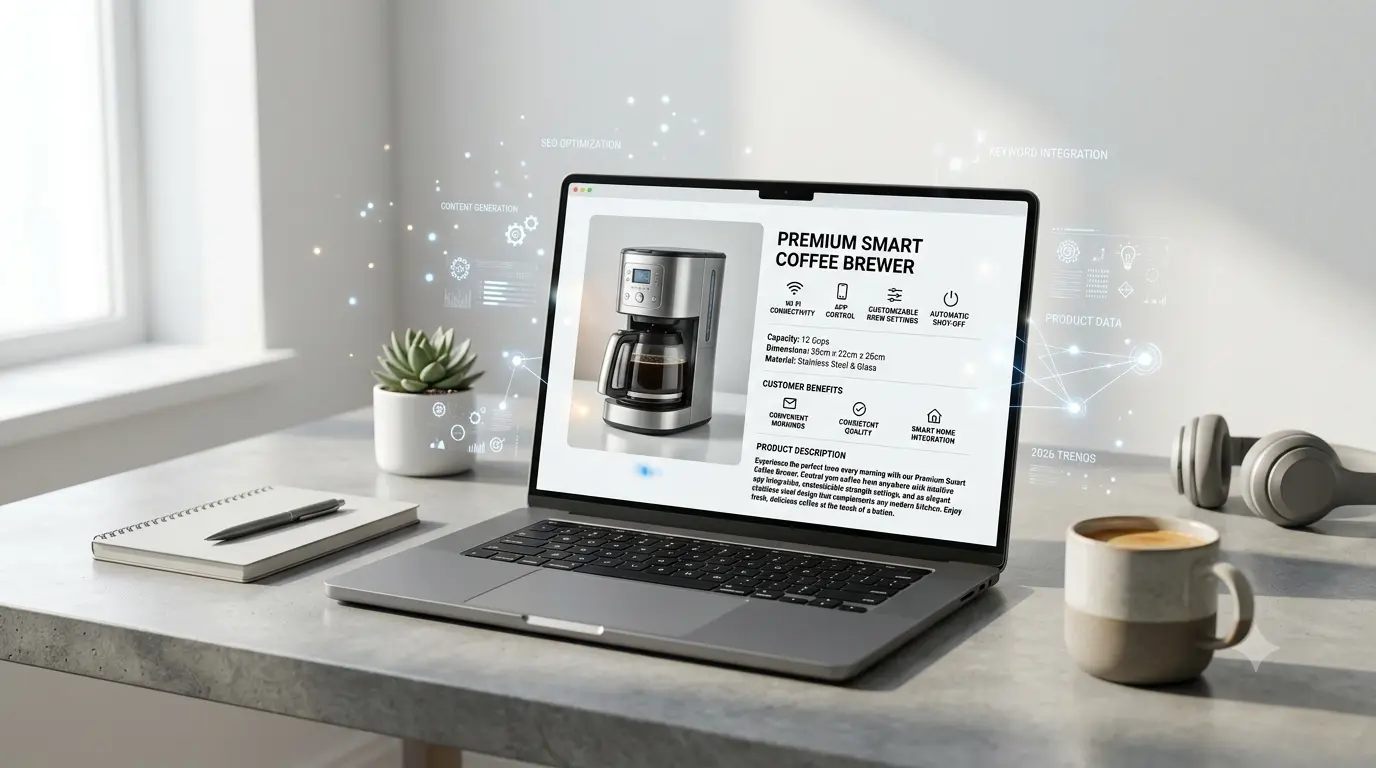
Best AI Product Description Generator Tools help turn raw product information—features, materials, specifications, keywords, and customer benefits—into ecommerce copy. You provide the information and structure; the tool turns it into a usable first draft.
That sounds simple, and for one product, it is. The real problem it solves is scale: how do you write something useful and non-duplicate for every SKU in a catalog of 500 or 5,000 without every page reading like it came off the same assembly line?
Instead of starting from a blank page, you’d typically feed the tool something like the following:
- Product name and category
- Key features and materials
- Dimensions
- Target customer
- Main benefits
- Primary and secondary keywords
- Brand tone
- Usage instructions and important limitations
The AI turns that into readable copy. But there’s a gap between generating text and producing good product content. A tool can output a grammatically clean paragraph in two seconds—that doesn’t mean the paragraph is accurate, persuasive, or actually useful to someone deciding whether to buy. Shopify itself flags this: Shopify Magic can draft descriptions inside the admin from the details you give it, but Shopify explicitly tells merchants to review the output because generated text can contain claims that were never in the source data.
That distinction—text generation vs. content quality—is the thread running through this whole comparison.
Looking to improve your ecommerce product content with AI? Explore our AI Product Content guide to learn how AI can help create, optimize, and manage product content more efficiently. This guide focuses specifically on the best AI tools for generating product descriptions.
Why Use an AI Product Description Generator?
The obvious win is time. If a store has 1,000 products and a writer spends 15 minutes on each, that’s 15,000 minutes — roughly 250 hours — before anyone even edits or uploads anything. AI doesn’t remove the need for judgment, but it collapses that first-draft stage dramatically.
A few concrete reasons teams reach for it:
Speed at launch. New stores, large supplier catalogs, category expansions, marketplace listings—anywhere content is the bottleneck, AI shortens the runway.
Consistency across a messy catalog. Big catalogs tend to drift in tone—one product sounds professional, the next casual, the next like an ad. A decent AI workflow can hold tone, formatting, and vocabulary steady across hundreds of pages, which manual writing by multiple people rarely does.
Natural keyword coverage. Rather than jamming “women’s waterproof hiking jacket” into every sentence, a good draft will naturally pull in related phrasing—outdoor jacket, breathable rain shell, and lightweight hiking apparel—because the goal isn’t density; it’s topical coverage.
Faster time-to-live for seasonal or time-sensitive products where a content bottleneck actually costs sales.
Variations for different channels—website, marketplace, email, ads, and feed—since a shopper’s intent on Amazon isn’t the same as on your homepage, and copy-pasting one paragraph everywhere usually shows it.
What Makes a Good AI Product Description Generator?
Writing quality is one input, not the whole scorecard. A more complete framework looks at eight things:
| Factor | Why It Matters |
|---|---|
| Writing quality | Produces readable, persuasive copy |
| Product accuracy | Reduces unsupported claims |
| Brand voice | Keeps descriptions consistent |
| SEO controls | Supports search-focused optimization |
| Bulk generation | Matters once you’re past a handful of SKUs |
| Integrations | Cuts out manual copy-paste and re-uploading |
| Data enrichment | Helps when the source product data is thin |
| Editing workflow | Determines how fast human review actually goes |
Accuracy deserves to sit above the rest. A beautifully written description with a wrong spec is worse than a plain one that’s correct—if a supplier says “cotton” and the AI writes “organic cotton,” that’s not a style choice; it’s a false claim on a product page. Shopify’s own guidance is blunt about this: generated content can include benefits or facts the merchant never supplied, which is exactly why every draft needs a human pass before it goes live.
The rule worth keeping in mind through the rest of this guide: AI should transform verified product information, not invent it.
Best AI Product Description Generator Tools in 2026
1. Shopify Magic
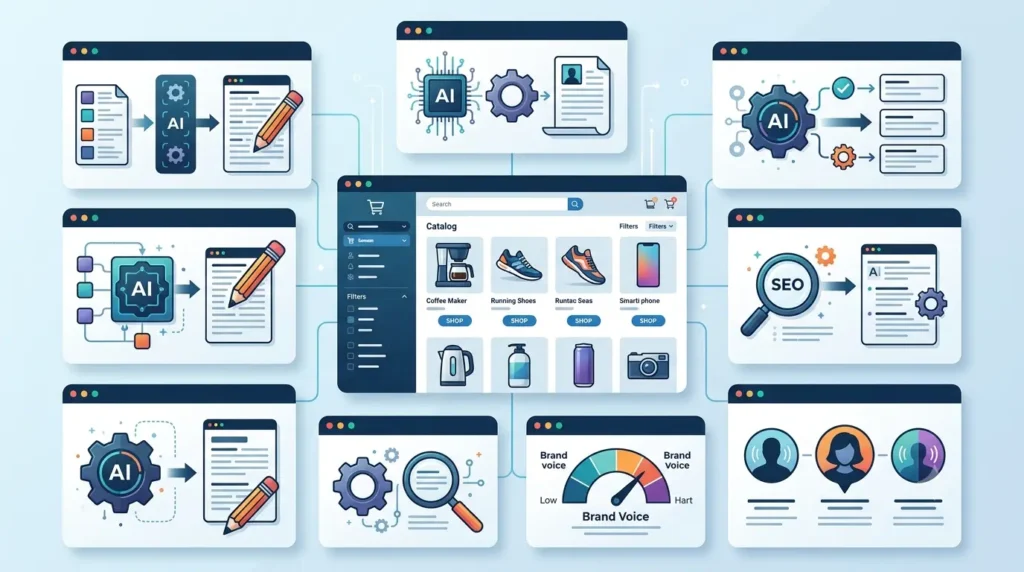
If your store already runs on Shopify, this is the path of least resistance—you never leave the admin to generate copy. Shopify Magic pulls from the product title, features, keywords, materials, intended use, and whatever else you give it, and Shopify’s own advice is that the more specific your inputs, the better the draft. You can also steer tone directly.
It’s built in, free across most Shopify workflows, and good enough for a quick first draft on an individual product page. Where it runs out of road is catalog-scale work—it’s a convenience feature, not a product-information-management system, so a store with thousands of SKUs across multiple channels will likely outgrow it.
Best for: Shopify merchants who want something fast and native, without adding another subscription.
2. Jasper
Jasper’s angle is brand consistency rather than raw generation. Its Product Description Agent is built to turn specs into benefit-led copy while pulling from your brand guidelines, audience definitions, and existing product knowledge—so the output is meant to sound like your company wrote it, not like a generic AI writer did.
That’s genuinely useful for an established brand with a house voice to protect, and Jasper positions the same workflow for larger catalog production and AI-search-oriented content. For a small store with a handful of products, though, it’s more machinery than you probably need—if the job is “write descriptions for 20 products,” a simpler tool gets there faster.
Best for: Brands and marketing teams that care as much about how something is said as what is said.
3. Copy.ai
Copy.ai treats product descriptions as one piece of a larger content operation rather than a standalone task. Its ecommerce workflows are built for scale—the company says they can generate descriptions across thousands of SKUs and multiple languages—and the same platform covers ad copy, email, SEO content, and social, which is handy if product copy isn’t the only thing your team produces.
If a dedicated, single-purpose description tool is really all you need, the breadth here can feel like overhead.
Best for: Marketing teams that want product descriptions to live alongside everything else they’re already generating.
4. Writesonic
Writesonic has a purpose-built product-description flow rather than making you hand-craft every prompt. You feed it product name, characteristics, primary and secondary keywords, tone, and language, and it returns multiple copy variations—which makes it a solid pick when you specifically want SEO and keyword inputs to be first-class fields, not something you bolt onto a generic prompt.
It’s a reasonable middle ground: more structure than a bare AI writer, less complexity than a full catalog platform. For genuinely large catalogs, dedicated e-commerce content platforms will still out-manage it.
Best for: Small businesses and marketers who want keyword-aware copy without setting up a whole workflow.
5. Hypotenuse AI
This one is built around e-commerce specifically. It imports product data, generates descriptions in bulk, enriches missing fields, and pushes content back into connected systems—so it’s less “AI writer” and more “catalog content pipeline.” You can also lock in output structure (paragraphs vs. bullets vs. headings) and set words to include or exclude, which matters if your brand has strict style rules.
It also covers marketplace-specific formats—Amazon, eBay, and Walmart—according to its current documentation, which is a meaningful time-saver if you’re listing the same products in more than one place.
Best for: Ecommerce teams managing hundreds or thousands of SKUs, where “bulk” isn’t optional.(Hypotenuse AI)
6. Describely
Describely treats product content as a catalog-management problem rather than a writing problem, which is a genuinely different framing from most tools on this list. It handles descriptions, titles, bullets, and metadata together, supports bulk workflows and data enrichment, and integrates with Shopify, WooCommerce, Wix, Squarespace, and Akeneo, plus CSV import/export.
That structure only starts to pay off once your catalog is big enough to need content rules, update tracking, and review workflows—a 15-product store won’t feel the benefit.
Best for: Ecommerce teams whose main pain point is catalog operations, not sentence-level writing.
7. Rytr
Rytr is closer to a lightweight writing assistant than a content-operations platform, and for a lot of small sellers, that’s exactly the point — not every catalog needs enterprise tooling. If your problem is mostly writer’s block on a manageable number of products, Rytr gets you a usable draft fast without asking you to learn a new system.
Where it falls short is anything involving thousands of SKUs, product data enrichment, or catalog synchronization—that’s simply not what it’s built for.
Best for: Freelancers and small stores that want quick, no-fuss drafts.
8. ChatGPT
ChatGPT‘s advantage is that you control the instructions completely. You can specify audience, tone, structure, length, which objections to pre-empt, and which claims to avoid and then iterate—make it more conversational, shorten it, rewrite it for Amazon, translate it, turn it into bullet points, and spot what product information is missing. No fixed generator gives you that level of control over the actual thinking, not just the output.
The tradeoff is that you’re building and running the whole process yourself. For ten products, that’s fine. For ten thousand, you’ll want automation and structured data on top of it, because ChatGPT alone won’t manage a catalog for you.
Best for: Custom workflows and flexible, one-off product copy where control matters more than convenience.
Best AI Product Description Generator Tools Compared
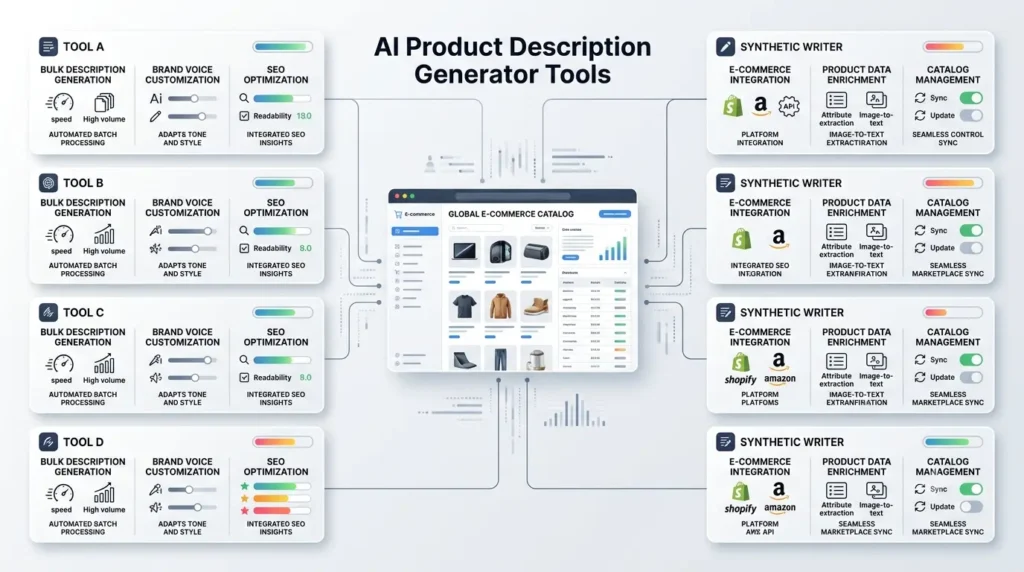
| Tool | Best For | Bulk Content | Brand Voice | Ecommerce Focus | Best Use |
|---|---|---|---|---|---|
| Shopify Magic | Shopify merchants | Limited | Yes | High | Quick store descriptions |
| Jasper | Brand teams | Yes | Strong | Medium–High | Brand-controlled copy |
| Copy.ai | Marketing teams | Yes | Yes | High | Ecommerce workflows |
| Writesonic | SEO marketers | Yes | Yes | Medium | Keyword-focused descriptions |
| Hypotenuse AI | Large catalogs | Yes | Strong | Very High | Catalog-scale content |
| Describely | Ecommerce teams | Yes | Strong | Very High | Product content operations |
| Rytr | Small businesses | Limited | Basic | Medium | Simple copywriting |
| ChatGPT | Flexible workflows | Depends on setup | Custom | Flexible | Custom product copy |
A note on this table: it’s based on each vendor’s public positioning and documentation at the time of writing. Plan tiers and feature availability change often—worth double-checking a tool’s current pricing page before you commit, especially for the bulk-content and integration columns.
The real takeaway isn’t which row looks best—it’s that a 20-SKU Shopify store and a 20,000-SKU multi-channel retailer have almost nothing in common in terms of what they actually need.
Which Tool Is Best for Shopify, and Which Is Best for Large Catalogs?
For Shopify specifically: start with Shopify Magic if your catalog is small to medium. It’s integrated, free, and there’s no reason to add a subscription just to draft descriptions at that scale. The moment you need bulk generation, data enrichment, multi-marketplace output, or approval workflows, a dedicated platform like Hypotenuse AI or Describely becomes the more sensible move.
For large catalogs generally: The question changes shape entirely. With 2,000+ products across multiple variants and channels, you’re not writing paragraphs one at a time—you’re running a content system, and that system needs answers to things like where product data lives, what happens when a spec changes, how you keep language consistent, how you stop unsupported claims from slipping through, and who actually reviews the output before it publishes. Hypotenuse AI and Describely are built with those questions in mind; most of the others on this list aren’t.
The better question isn’t “which tool has the best “AI”—it’s “which workflow actually fits how complicated my catalog already is.”
How to Choose the Right AI Product Description Generator
- Shopify Magic—you’re on Shopify, your catalog is small-to-medium, and convenience matters more than advanced features.
- Jasper—the brand voice is non-negotiable; multiple people create content, and you want it grounded in brand knowledge.
- Copy.ai—product descriptions are one piece of a bigger content operation that also needs sales/marketing copy and multilingual output.
- Writesonic—SEO and keyword control matter, and you want several copy variations without a heavy setup.
- Hypotenuse AI—hundreds or thousands of products, messy source data, multiple marketplaces.
- Descriptively—catalog operations (enrichment, rules, integrations, and bulk output) are the actual bottleneck, not sentence quality.
- Rytr—small catalog; you mainly need help getting past a blank page.
- ChatGPT—you want full control over the prompt and are building your own workflow rather than adopting someone else’s.
How to Write Better Product Descriptions With AI
Most weak AI output comes down to a weak prompt. Typing “write a product description for this backpack” gets you something generic, because you’ve given the model almost nothing to work with.
Weak input:
Product: Black backpack. Write a product description.
Better input:
Product: 25L waterproof hiking backpack Material: 600D polyester Capacity: 25 liters Features: padded shoulder straps, laptop compartment, water-resistant exterior Target customer: commuters and weekend hikers Tone: practical and trustworthy Primary keyword: 25L waterproof hiking backpack Avoid: unsupported durability claims Length: 120–150 words
The second version gives the model actual raw material to shape.
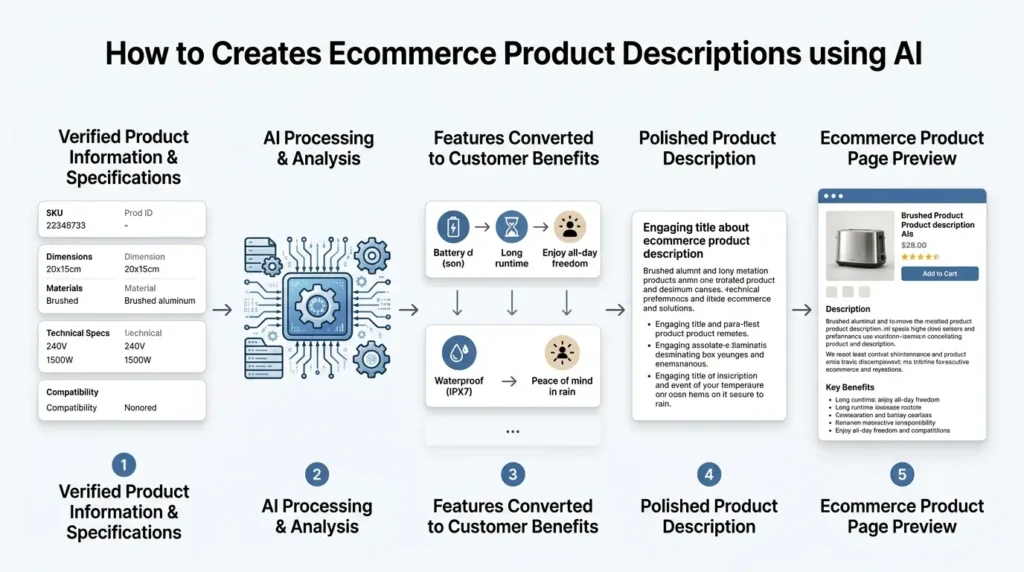
It also helps to separate features from benefits explicitly:
- Feature: padded shoulder straps
- Benefit: distributes pressure more comfortably
- Customer outcome: less shoulder fatigue on a longer commute or hike
That chain—feature → benefit → outcome—consistently reads better than a flat list of specs.
AI Product Description Prompt Template
Act as an experienced ecommerce copywriter.

Write a product description for the following product.

Product name:
[PRODUCT NAME]

Product category:
[PRODUCT CATEGORY]

Verified product features:
[FEATURES]

Materials:
[MATERIALS]

Specifications:
[SPECS]

Main customer:
[TARGET CUSTOMER]

Primary benefits:
[BENEFITS]

Primary keyword:
[PRIMARY KEYWORD]

Secondary keywords:
[SECONDARY KEYWORDS]

Brand voice:
[BRAND VOICE]

Description length:
[WORD COUNT]

Requirements:
- Focus on customer benefits, not just features.
- Use the primary keyword naturally.
- Include relevant secondary terms only where they fit naturally.
- Make the copy easy to scan.
- Avoid keyword stuffing.
- Do not invent specifications, certifications, guarantees, or performance claims.
- Do not mention information that was not provided.
- Use clear, natural language.
- Make the description useful for both shoppers and search engines.

Before writing, identify any important product information that appears to be missing.
That last line matters more than it looks. Instead of letting the model quietly fill gaps with guesses, you’re explicitly asking it to flag what it doesn’t know.
Common Mistakes to Avoid
Publishing without checking facts. Verify materials, dimensions, compatibility, warranty terms, certifications, ingredients, performance claims, shipping details, and care instructions. Shopify’s own guidance flags this directly—generated content can state things that were never in your source data.
Reusing supplier descriptions unchanged. Even accurate supplier copy is often generic, poorly structured for your audience, and identical to what five competitors are also running. Treat it as a source of facts, not a finished description.
Keyword stuffing. Nobody needs to read “the best cheap waterproof hiking backpack because this waterproof hiking backpack is the best waterproof hiking backpack for hiking.” It reads badly and does nothing for modern search.
Letting every description sound the same. AI catalogs tend to develop a tic—everything opens with “Introducing the perfect solution for…” Vary the opening, sentence length, and benefit order while keeping the underlying brand standards consistent.
Listing features without translating them into benefits. “5000 mAh battery” is a spec. “Won’t die on you halfway through a long day” is what a customer actually cares about. Good copy connects the two.
Ignoring the questions a buyer already has. Will it fit? Is it waterproof? What’s it made from? How do I clean it? What’s in the box? Answering these on the page reduces both hesitation and returns.
AI Product Descriptions, SEO, and Google
A common misconception: “If I use AI, Google will rank the page.” It won’t, at least not because of the AI. AI is a production method; SEO is a much bigger system that includes relevance, usefulness, technical health, and overall page experience—the description is one ingredient, not the whole dish.
A strong product page should cover what the product is, who it’s for, key features, benefits, specs, compatibility, materials, usage, and the questions people are actually asking. Rather than hammering “wireless Bluetooth headphones” repeatedly, cover the surrounding topic naturally—battery life, microphone, noise isolation, charging case, comfort, and compatible devices.
Inserting twenty keywords into a paragraph doesn’t make the page better. The sequence that actually works is search intent → real product information → useful content → natural language.
AI Product Descriptions and AI Search
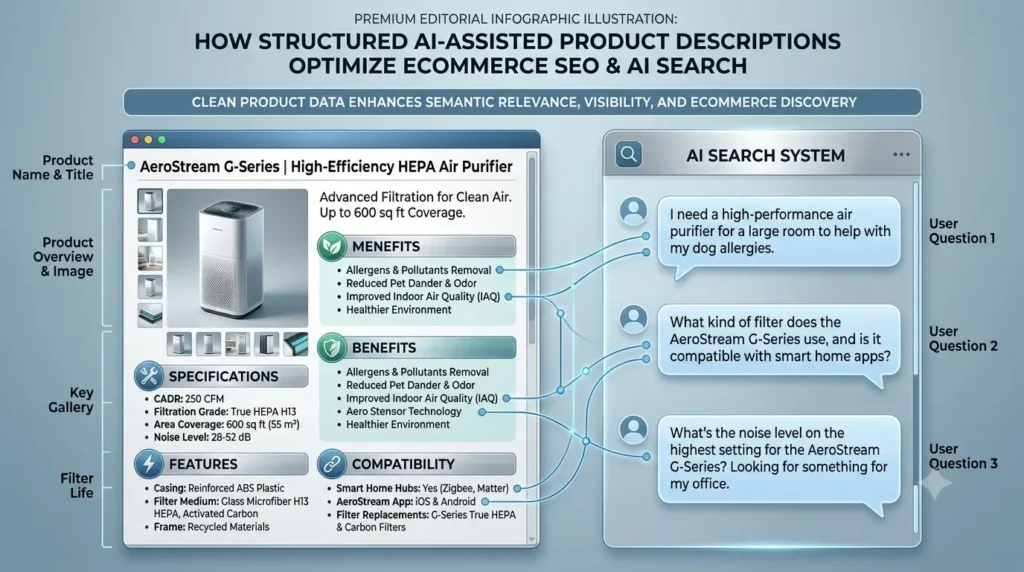
Search is increasingly conversational—instead of typing “black running shoes for men,” someone might ask an assistant, “What are some lightweight black running shoes for everyday road running?” For an AI system to match your product to that question, the page needs to state facts plainly rather than lean on vague marketing language.
Weak: “Experience unmatched performance with our revolutionary footwear.”
Stronger: “These men’s black running shoes weigh 280g per shoe and feature a breathable mesh upper, cushioned midsole, and rubber outsole designed for road running.”
The second version gives both a human and an AI system something concrete to match against a query. If your product is genuinely waterproof, 25L, made from recycled polyester, or fits a 15-inch laptop—say so directly, as long as it’s true. Don’t make an AI system infer facts you could have just stated.
A Better Workflow for AI Product Descriptions
- Collect verified product facts into a structured sheet before you touch an AI tool.
- Identify customer intent—what does someone need to know before they’ll buy this?
- Pick the primary keyword based on the actual product and how people search for it.
- Add related terminology naturally around that keyword.
- Generate a first draft with your chosen tool.
- Fact-check every claim against the source data—line by line.
- Strengthen the benefits—make sure the copy explains why each feature matters.
- Fill in missing information that a buyer would want.
- Optimize the full page—title, headings, images, alt text, meta title/description, and internal links.
- Do a human edit pass. Read it as a shopper would. If it sounds like AI wrote it, rewrite it.
Information Gain: Beating Competitors on the Same Product
Picture ten stores selling the identical product, and all ten descriptions saying “high-quality, stylish, durable, and perfect for everyday use.” There’s nothing there to differentiate on.
The store that wins is the one that adds what the others skipped: exact dimensions, weight, material, compatibility, intended use, care instructions, what’s in the box, who it’s for, who it’s not for, and answers to the questions people actually ask.
Swap generic adjectives for specifics:
- Instead of “premium quality material,” use “made from 600D polyester with a water-resistant exterior.”
- Instead of “perfect for travel,” → “the 25-liter capacity fits a laptop, a change of clothes, and daily essentials while staying compact enough to commute with.”
Specificity is the actual differentiator—not longer copy, more useful copy.
Are AI-Generated Product Descriptions Good for Ecommerce?
Yes, treated as an assisted writing system rather than an auto-publish button. AI is genuinely good at drafting, rewriting, summarizing, expanding, adjusting tone, and scaling repetitive work. It’s not a substitute for fact verification, product expertise, brand judgment, compliance review, or the final editorial call—those stay human.
Think of it as AI drafts, and a person decides. That combination outperforms either one working alone.
How to Measure Whether Your AI Product Descriptions Are Working
Don’t judge a generator purely on how good the paragraph sounds—judge the page’s actual performance.
| Metric | What It Tells You |
|---|---|
| Organic impressions | Search visibility |
| Organic clicks | Search appeal |
| CTR | Relevance and title effectiveness |
| Product-page engagement | Content usefulness |
| Add-to-cart rate | Buying intent |
| Conversion rate | Commercial effectiveness |
| Revenue per visitor | Business impact |
| Return-related questions | Content clarity |
You can also A/B different styles on the same product—a feature-heavy version, a benefit-led version, and a use-case-focused version—and compare results. That turns AI content from a one-time writing task into an ongoing optimization loop.
Quick Recommendation: Which Is the Best AI Product Description Generator in 2026?
There’s no single winner—the right pick depends entirely on catalog size and how complex your workflow already is.
- Best for Shopify convenience: Shopify Magic—built in, free, and hard to beat for quick drafts on a small-to-medium catalog.
- Best for brand voice: Jasper—when consistent messaging matters more than raw speed.
- Best for broader ecommerce workflows: Copy.ai—when descriptions are one piece of a larger content operation.
- Best for SEO-focused marketers: Writesonic—structured keyword and tone inputs without heavy setup.
- Best for large catalogs: Hypotenuse AI—bulk generation, enrichment, and multi-marketplace support.
- Best for catalog-scale operations: Describely—when enrichment, rules, and integrations are the real bottleneck.
- Best lightweight option: Rytr—simple, fast, no learning curve.
- Best for flexibility: ChatGPT—full control, at the cost of building the workflow yourself.
The rule worth holding onto: never let AI invent the product—let it help you explain the real one better.
Frequently Asked Questions
What is the best AI product description generator in 2026?
It depends on your setup. Shopify Magic suits Shopify merchants, Jasper suits brand-focused teams, and Hypotenuse AI or Describely suits large catalogs. ChatGPT remains the flexible option for custom workflows.
Can AI write product descriptions for Shopify?
Yes, Shopify Magic generates descriptions directly in the admin from product details, keywords, and tone instructions. Shopify recommends reviewing the output for accuracy before publishing.
Are AI product descriptions good for SEO?
Only when they’re original, accurate, and genuinely useful. Generating text or repeating keywords doesn’t guarantee rankings—the page still has to satisfy search intent.
Can AI-generated product descriptions rank on Google?
They can appear on ranking pages, but AI isn’t a ranking shortcut. Overall page quality, relevance, and user experience still decide the outcome.
Will Google penalize AI product descriptions?
Using AI to help draft copy isn’t inherently penalized. What matters is whether the published content is useful, accurate, and written for people rather than to game rankings.
What should I include in an AI product description prompt?
Product name, verified features and specs, materials, target customer, benefits, primary and secondary keywords, brand tone, desired length, formatting requirements, and any claims to avoid. Good product data usually matters more than a clever prompt.
Can AI generate product descriptions in bulk?
Yes—several e-commerce-focused platforms support this, which matters most for retailers managing hundreds or thousands of SKUs. It works best paired with data validation and editorial review.
Can AI product descriptions improve conversions?
Clearer benefits, specs, and use cases can support conversion, but the tool itself doesn’t guarantee it. Results depend on the product, audience, and overall page experience—test and measure rather than assume.
Should I use the manufacturer’s product description?
Use it as a source of verified facts, not as your final copy—word-for-word manufacturer text is often generic and duplicated across every store selling the same item. Rewrite it for your own audience and brand.
How long should an ecommerce product description be?
There’s no fixed ideal length. It should be long enough to answer real buyer questions without padding—a simple product needs less, a technical one needs more.
Is ChatGPT better than a dedicated product description generator?
ChatGPT gives you more control; dedicated tools give you stronger catalog workflows, integrations, and bulk generation. Pick based on whether your priority is custom writing or scalable operations.
What’s the best option for a small business?
Start simple—Shopify Magic if you’re on Shopify, or ChatGPT / a lightweight writer if you want more flexibility. A complex catalog platform isn’t worth adopting for a handful of products.
What’s the best option for thousands of products?
Prioritize bulk generation, data enrichment, brand rules, integrations, and review workflows—Hypotenuse AI and Describely are built specifically for that scale.
Should I publish AI-generated descriptions without editing?
No. Check specifications, claims, benefits, keywords, tone, and formatting every time. The goal isn’t to remove humans from the process—it’s to remove the repetitive first-draft work from their plate.
What’s the biggest mistake people make with AI product descriptions?
Treating the output as automatically accurate. Incomplete input data leads to generic or unsupported claims—always provide verified facts and review the final draft before it goes live.
The short version of the whole workflow:
Verified data → AI draft → human review → SEO refinement → publish → measure
Conclusion
AI has genuinely changed how e-commerce teams handle product content—but the tool you pick matters less than the workflow you build around it. A small Shopify store, a brand-first company, and a 10,000-SKU catalog all have different bottlenecks, so “best” only means something once you know which of those you actually are.
Whichever generator you choose, the same principle holds: let AI handle the repetitive drafting, and keep a human in charge of the facts, the brand, and the final call before anything goes live. That’s the combination that actually moves the needle on both search performance and conversions—not the tool by itself.