
AI Product Bullet Point Generator: Create Better Ecommerce Listings in 2026
Table of Contents
- What Is an AI Product Bullet Point Generator?
- How AI Product Bullet Point Generators Work
- Why AI Product Bullet Points Matter for Ecommerce
- Benefits of Using an AI Product Bullet Point Generator
- How to Create Effective Product Bullet Points With AI
- Writing Better Prompts for AI Product Bullet Points
- AI Product Bullet Point Examples
- AI Product Bullet Points for Amazon and Ecommerce Stores
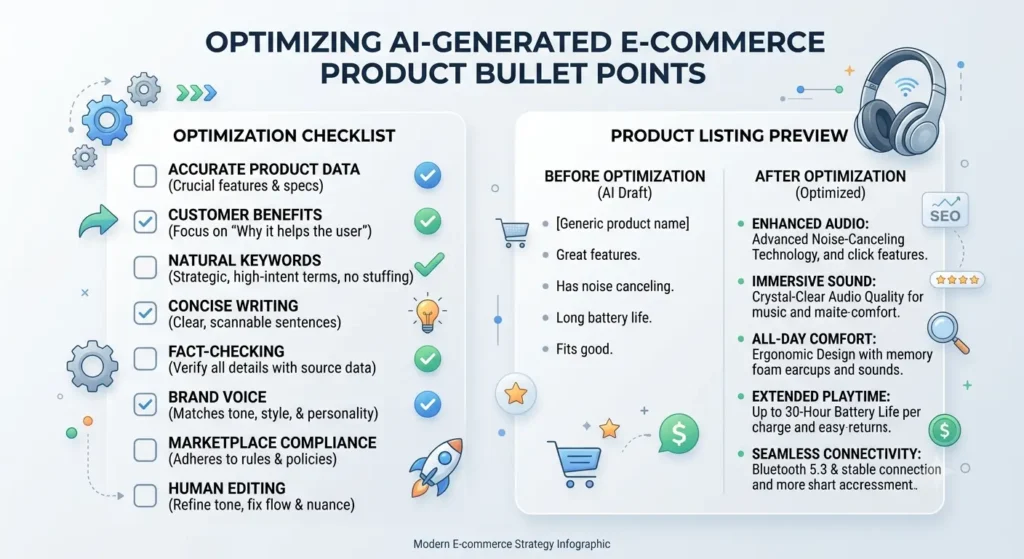
- How to Optimize AI-Generated Product Bullet Points
- Common AI Product Bullet Point Mistakes
- AI Product Bullet Point Generator vs Manual Writing
- Best Practices for Ecommerce Product Bullet Points
- How to Tell If Your Bullet Points Are Actually Working
- Frequently Asked Questions
- Final Thoughts
What Is an AI Product Bullet Point Generator?
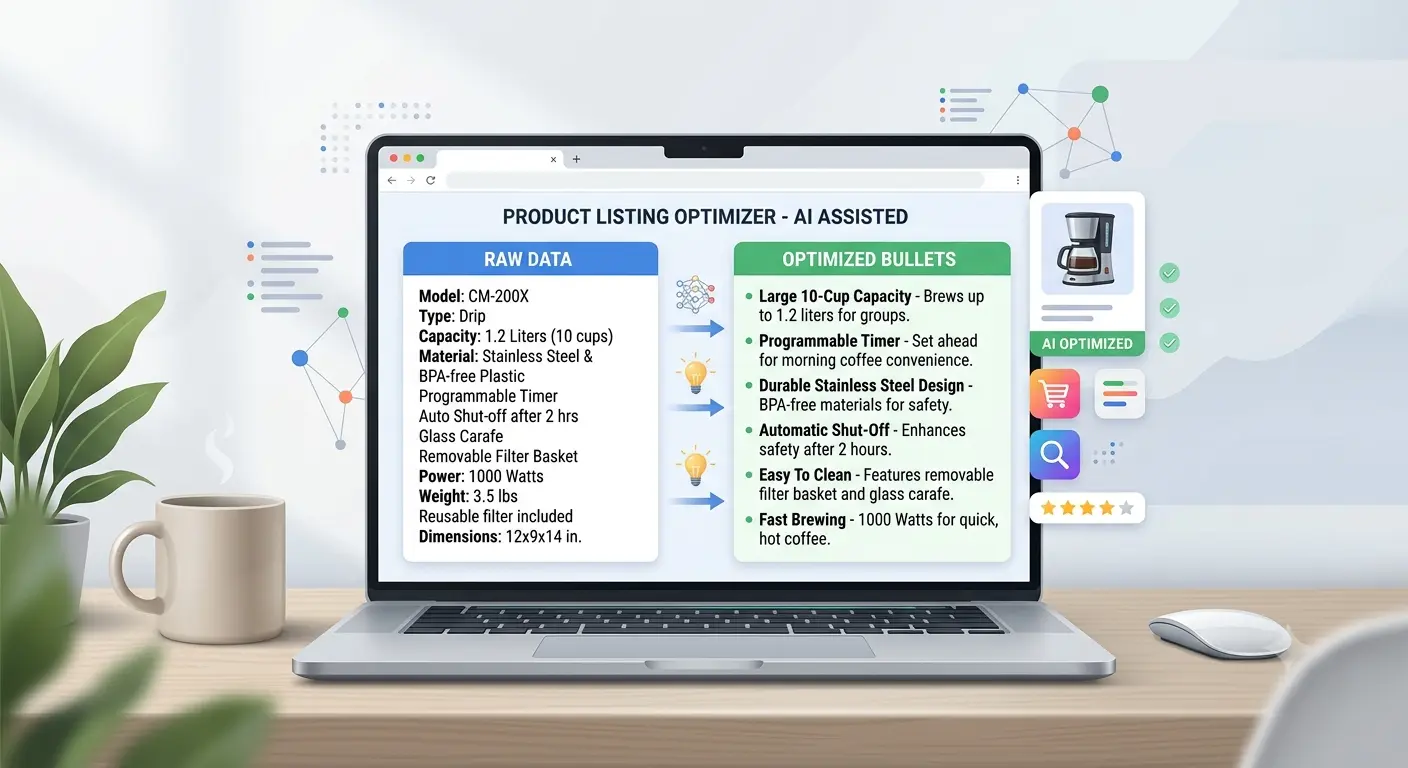
An AI product bullet point generator is a tool that turns raw product information—features, specs, materials—into short, benefit-focused bullet points you can drop straight into a listing. Feed it the basics, and it hands back scannable highlights built for product pages, marketplaces, and online stores.
Shoppers don’t read product pages line by line. They scan for a handful of things:
- Key product features
- Main customer benefits
- Materials and specifications
- Size or compatibility
- Important use cases
- What makes the product different
- Any unique selling points
A generator speeds up the part that used to take the most time: turning a spec sheet into copy someone actually wants to read.
For a deeper look at every tool covering copywriting, taglines, and catalog content, check out our full guide to AI Product Content Tools.
AI Product Bullet Points vs. Traditional Product Copy
Writing bullets by hand usually means combing through specs and deciding, one by one, what’s worth highlighting. AI can take a first pass at that.
Say a seller hands over this:
Stainless steel water bottle, 750 ml capacity, double-wall insulation, leak-proof lid, BPA-free materials.
An AI tool could turn that into something like
- 750 ml Capacity: Enough water to get through work, school, travel, or a workout without a refill.
- Double-Wall Insulation: Keeps drinks at temperature longer.
- Leak-Proof Lid: Built to cut down on spills in a bag or backpack.
- BPA-Free Material: Made with everyday-use materials in mind.
The job of the AI here is to organize and sharpen what’s already true—not to invent claims that aren’t in the original product data.
How AI Product Bullet Point Generators Work
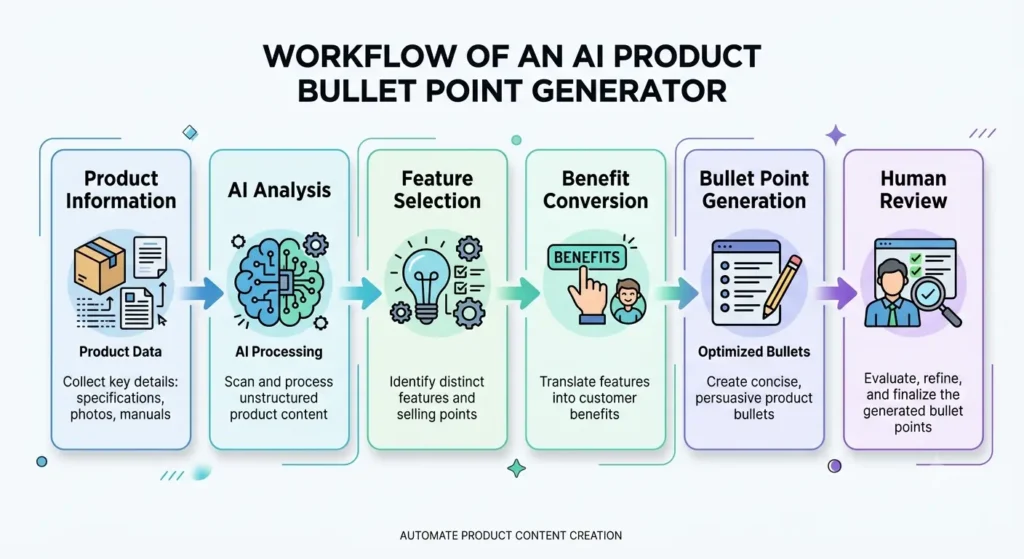
Most tools follow the same basic path: read the product name, features, specs, and keywords, then rewrite that information as short, scannable selling points.
Product Information → AI Analysis → Feature Selection → Benefit Conversion → Bullet Point Generation → Human Review
1. Enter Product Information
Start with real details:
- Product name
- Features
- Specifications
- Materials
- Dimensions
- Target audience
- Main benefits
- Usage instructions
2. AI Analyzes Product Features
The system flags what’s likely to matter to a shopper. For example:
- Feature: 10-hour battery life
- Benefit: Get through a full day without stopping to recharge.
3. AI Creates Product Bullet Points
Technical, list-style input gets converted into short, readable statements.
4. Review and Edit the Output
This step doesn’t get to be optional. Every AI draft should be checked for:
- Accuracy
- Unsupported claims
- Grammar
- Brand voice
- Marketplace requirements
- Keyword usage
- Relevance to the actual customer
Why AI Product Bullet Points Matter for Ecommerce
Shoppers rarely read every word on a page—they’re scanning for answers to a short list of questions:
- What does this product do?
- What makes it different?
- Is it right for me?
- What are the main features?
- Will it work with what I already have?
- What problem does it solve?
Good bullet points answer those questions in seconds. AI can speed up getting there, but the bullets that actually convert still need accurate information, real customer benefits, natural phrasing, and a human pass before they go live.
Product Features vs. Customer Benefits
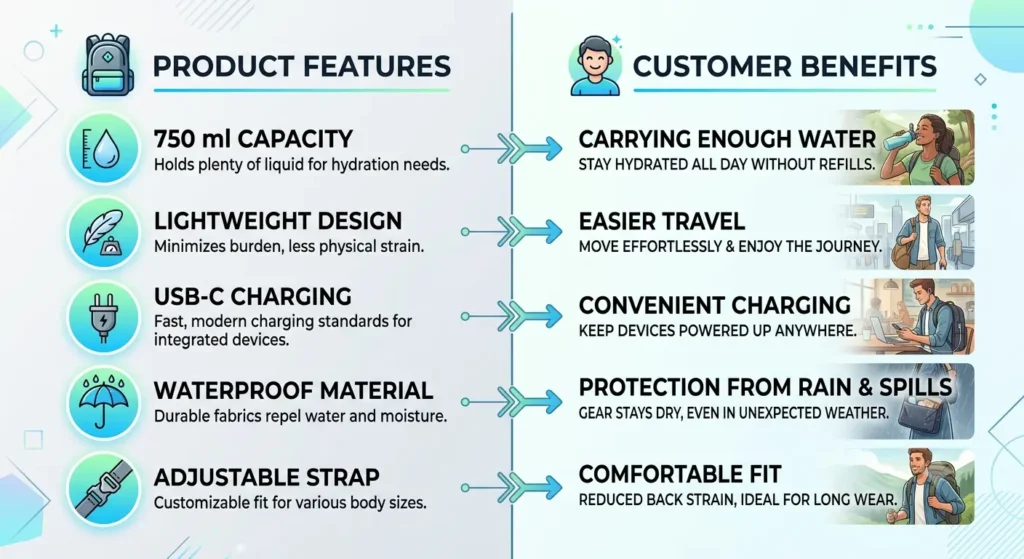
The single biggest upgrade AI brings to a listing is turning a feature into a reason to care.
Product Feature vs. Customer-Focused Benefit
– 750 ml capacity → Carry enough water for a full day out
– Lightweight design → Easier to pack for travel
– USB-C charging → Works with the charger you already own
– Waterproof material → Better protection from rain and spills
– Adjustable strap → A fit that’s actually comfortable
A feature says what the product has. A benefit says why that’s worth anything to the person reading it.
Benefits of Using an AI Product Bullet Point Generator
The real advantages come down to speed, consistency, and scale—with human fact-checking still doing the heavy lifting on accuracy.
Faster content creation. Writing bullets by hand for hundreds or thousands of SKUs takes real time. AI gets a usable first draft down in seconds.
More consistent copy. A generator can stick to the same structure across an entire catalog—feature, benefit, customer value—which makes the shopping experience feel more unified store-wide.
Easier catalog management. New products, product variants, seasonal drops, marketplace listings, and category pages—AI handles the repetitive volume so a human doesn’t have to write the same structure five hundred times.
Better readability. Dense technical specs get translated into language a non-expert can actually follow.
Works across product types. The same basic workflow adapts to fashion, electronics, beauty, home goods, sports gear, pet products, food and beverage, and digital products.
How to Create Effective Product Bullet Points With AI
The output is only as good as what you feed in. A few things make a real difference.
Step 1: Give It Accurate, Specific Details
Skip:
Wireless headphones.
Use:
Wireless over-ear headphones with Bluetooth 5.3, 40-hour battery life, foldable design, built-in microphone, and USB-C charging.
More specific input, better output—every time.
Step 2: Define the Target Customer
Tell the AI who’s actually buying this.
Target audience: commuters and remote workers.
That context alone shifts which benefits get prioritized.
Step 3: Focus on Benefits, Not Just Specs
Weak: 40-hour battery.
Better: 40-Hour Battery Life: Go days between charges instead of topping up every night.
Step 4: Keep Each Bullet Focused on One Idea
Don’t cram five unrelated features into a single sentence. One bullet, one point.
Step 5: Work Keywords Naturally
Keywords help search engines understand relevance—but only when they read naturally.
Natural: Lightweight Running Shoes: Built for comfortable everyday training and short-distance runs.
Over-optimized: Best running shoes, lightweight running shoes, running shoes for men, running shoes online, cheap running shoes.
The second version reads like it was written for a crawler, not a person—and shoppers (and search engines) can tell.
Writing Better Prompts for AI Product Bullet Points
The quality gap between a mediocre AI draft and a genuinely usable one almost always comes down to the prompt. A vague prompt gets a vague, generic list. A specific one gets something close to publish-ready.
A few prompt templates that tend to work well:
“Turn these product specs into 4-5 benefit-focused bullet points for [product type]. Target customer: [audience]. Tone: [tone]. Don’t invent any features not listed below.”
“Rewrite this bullet point so it leads with the customer benefit instead of the spec: [existing bullet].”
“Here are three customer objections for this product: [list]. Turn each into a bullet point that addresses the concern directly.”
“Shorten this bullet point to under 15 words without losing the main benefit: [bullet].”
The common thread: give the AI a role, a constraint, and real data. “Write good bullet points for my product” is too open-ended to produce anything useful. Write four bullet points for a stainless steel water bottle aimed at office workers, in a friendly but not overly casual tone, using only the specs I’ve provided. “gives it something to actually work with.”
It’s also worth telling the AI what not to do—no unverified claims, no superlatives without backup, and no keyword stuffing. Models tend to reach for generic marketing language by default unless a prompt actively steers away from it.
AI Product Bullet Point Examples
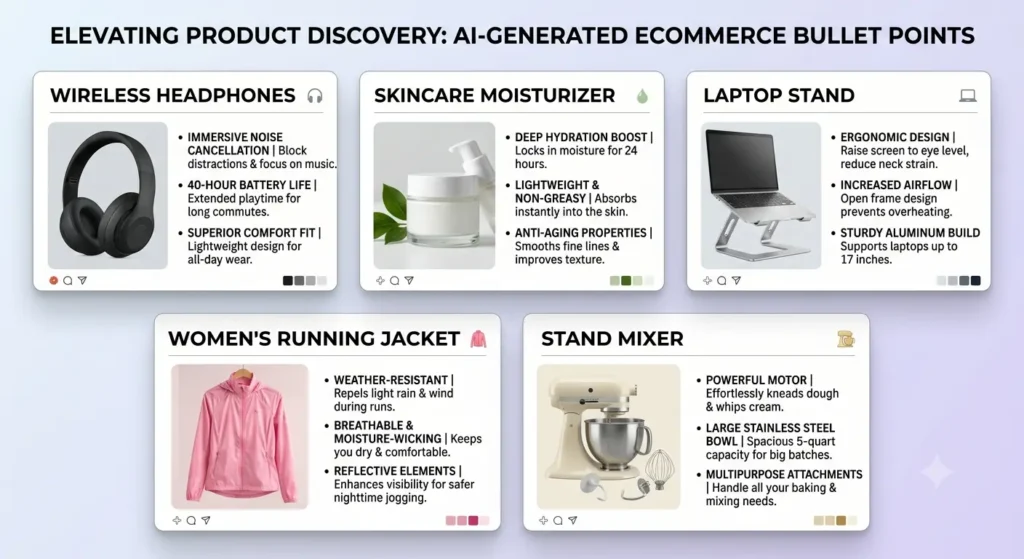
Example 1: Wireless Headphones
Input: Bluetooth 5.3, 40-hour battery, foldable design, USB-C charging.
- 40-Hour Battery: Listen longer between charges, without thinking about it.
- Bluetooth 5.3: A stable wireless connection with compatible devices.
- Foldable Design: Packs flat for travel or a bag.
- USB-C Charging: Recharge with the cable you already carry.
Example 2: Skincare Product
Input: Lightweight moisturizer, hyaluronic acid, fragrance-free formula.
- Lightweight Moisture: Everyday hydration without a heavy or greasy feel.
- Hyaluronic Acid: An ingredient widely used to support skin hydration.
- Fragrance-Free Formula: A good fit for anyone who prefers skincare without added scent.
Notice there’s no medical claim or guaranteed result anywhere in there—that’s intentional.
Example 3: Laptop Stand
- Adjustable Height: Set the angle that’s actually comfortable for your setup.
- Foldable Design: Easy to store or throw in a bag.
- Aluminum Construction: Sturdy enough for daily use with compatible laptops.
- Portable Setup: Works just as well at home, in the office, or on the road.
Example 4: Women’s Running Jacket
Input: Water-resistant shell, reflective piping, zippered side pockets, machine washable.
- Water-Resistant Shell: Keeps light rain and wind off during outdoor runs.
- Reflective Piping: Adds visibility for early-morning or evening runs.
- Zippered Side Pockets: Enough room for a phone or keys without a bag.
- Machine Washable: No special care routine needed after a sweaty run.
Example 5: Stand Mixer
Input: 5-quart stainless steel bowl, 6 speed settings, tilt-head design, includes whisk and dough hook attachments.
- 5-Quart Capacity: Enough room for a full batch of cookie dough or bread dough in one go.
- 6 Speed Settings: Move from slow mixing to fast whipping without switching tools.
- Tilt-Head Design: Easy access to the bowl for adding ingredients or swapping attachments.
- Includes Whisk and Dough Hook: Ready for both baking and bread-making right out of the box.
AI Product Bullet Points for Amazon and Ecommerce Stores
AI-generated bullets can absolutely get an Amazon or ecommerce listing to a strong first draft—but every marketplace runs its own rulebook. Character limits, formatting, allowed claims, restricted keywords, and brand terminology—none of it is universal.
Don’t assume a format that works on Shopify will pass as-is on Amazon.
Before publishing anywhere, check:
- Current marketplace guidelines
- Category-specific requirements
- Character limits
- Restricted claims
- Brand requirements
- Product compliance rules
Treat AI as a drafting assistant, not an auto-publish button.
Character Limits Change—Don’t Rely on Memory
Marketplaces adjust bullet point limits and formatting rules more often than sellers expect. A limit that applied last year might not apply today, and limits often vary by category within the same platform. Before a big catalog push, it’s worth a quick check of the current seller documentation rather than assuming last quarter’s rules still hold. Check Amazon’s current listing guidelines
How to Optimize AI-Generated Product Bullet Points
Use the feature-to-benefit formula. Feature + benefit + customer value, every time. Example: Foldable Design: Packs easily into a travel bag, so the stand works just as well on the road as it does at a desk.
Front-load the important stuff. Don’t bury the best information at the bottom. Lead with the primary benefit, then the key spec, then what makes it different, then compatibility and other extras.
Skip the keyword stuffing. Rotate in natural variations instead of repeating the same phrase everywhere—product highlights, product features, ecommerce bullet points, listing copy, and product benefits. It reads better, and it also helps sidestep the Yoast “keyphrase in subheading” warning without forcing the exact phrase into every single header.
Test more than one version. Bullet points aren’t a one-and-done task. If a listing has decent traffic but a flat conversion rate, that’s a signal to try a different bullet order or a different lead benefit—not necessarily a sign the product itself is the problem.
Adjust for the season or the moment. A generic bullet point works year-round, but a well-timed one—built around a holiday, a use case tied to weather, or a seasonal gifting angle—can outperform it during the window that matters. AI makes it fast to generate seasonal variants without rewriting a listing from scratch each time.
“Google’s guidance on helpful content”
Common AI Product Bullet Point Mistakes
Publishing without fact-checking. AI can misread a spec or add a detail that was never in the source material. Always verify the final copy against the actual product.
Making unsupported claims. Skip lines like “Guaranteed to increase sales by 50%” unless there’s real evidence behind it.
Repeating keywords too often. Natural language beats forcing the exact phrase into every bullet.
Writing bullets that are too long. If it takes more than a few seconds to scan, it’s too long.
Focusing only on features. Customers want to know what a feature actually does for them—not just that it exists.
Leaning on generic marketing language. Words like “amazing,” “revolutionary,” “best-in-class,” and “ultimate” don’t do much persuading on their own. Specifics do.
Ignoring the platform’s actual rules. A bullet point that’s perfectly fine on a self-hosted store might violate a marketplace’s restricted-claims policy. What’s allowed changes by platform and by category, so the same set of bullets rarely transfers everywhere without at least a quick review.
Treating every product the same way. A generator set up for electronics doesn’t automatically produce good copy for skincare or food products—categories with their own claim restrictions and customer concerns. Running every product through the exact same template tends to produce copy that feels slightly off no matter how well the AI performs technically.
FTC.gov endorsement/advertising guidelines
AI Product Bullet Point Generator vs. Manual Writing
AI wins on speed and scale. Human writers still win on nuance—understanding what actually motivates a specific customer, brand positioning, and the context around a product that a spec sheet doesn’t capture. For most ecommerce teams, the practical answer is a hybrid: AI for the first draft, a person for accuracy and persuasion.
Factor: AI Generation vs. Manual Writing
– Speed → Very fast / Slower
– Large catalogs → Excellent / Time-consuming
– Consistency → High / Depends on the writer
– Product understanding → Depends on input quality / Strong with experience
– Fact-checking → Still required / Still required
– Brand voice → Needs guidance / Easier to control directly
– Creativity → Good for ideas / Human strength
– Final editing → Recommended / Recommended
The more useful question isn’t “can AI replace product copywriters?” It’s “how can AI help copywriters move faster?” That framing tends to produce better listings.
Best Practices for Ecommerce Product Bullet Points
Good bullets are specific, concise, customer-focused, accurate, and easy to scan. Lead with the benefits that matter most, back every claim with real product data, use natural search language, and keep a consistent structure across the catalog.
A quick pre-publish checklist:
- Does every bullet make a useful point?
- Are the specs actually accurate?
- Does the copy explain a real customer benefit?
- Is it easy to scan in a few seconds?
- Are the most important details near the top?
- Are keywords used naturally, not forced?
- Have unsupported claims been removed?
- Does it match the brand voice?
- Does it follow the marketplace’s current rules?
A useful rule of thumb from experienced ecommerce copywriters: write for the shopper first, and optimize for search second. Copy built that way tends to work for both humans and search systems—in that order.
Turning Buying Objections Into Bullet Points
Instead of just restating specs, think about what might actually stop someone from buying.
Concern: “Will it fit my laptop?” Bullet: Wide Compatibility: Fits laptops within the listed size range.
Concern: “Will it be a hassle to carry around?” Bullet: Portable Design: Light enough to move easily between home, office, and travel.
That’s a more useful bullet than one that just repeats a dimension.
Mine Real Customer Language
Customer reviews, product Q&A, support tickets, search queries, and competitor listings are all full of the actual words shoppers use. Pulling from those sources tends to produce bullets that answer real questions instead of just repeating a spec sheet.
How to Tell If Your Bullet Points Are Actually Working
Writing bullet points isn’t the finish line—knowing whether they’re helping is the part that’s easy to skip. A few practical signals worth watching:
Conversion rate on the product page. If traffic to a listing is healthy but the conversion rate lags behind similar products, the bullet points are one of the first places to look. They’re often the last thing a shopper reads before deciding to add something to a cart.
Time on page and scroll depth. If most visitors bounce before reaching the bullet points, the issue might be page layout rather than the copy itself. If they reach the bullets and still leave, the copy is worth revisiting.
Marketplace search ranking for target terms. On platforms like Amazon, bullet point content factors into how a listing matches search queries. A ranking that hasn’t moved despite consistent sales velocity can be a sign the bullets aren’t using the keywords shoppers are actually searching for.
Customer questions that repeat. If the same question keeps showing up in reviews or product Q&A, that’s a strong hint the current bullet points aren’t answering it. That question is a good candidate for the next bullet point revision.
None of this requires complicated tracking—a simple before-and-after comparison on a handful of listings is usually enough to tell whether a bullet point rewrite is worth rolling out across the rest of the catalog.
Frequently Asked Questions
What is an AI Product Bullet Point Generator?
A tool that turns product features, specs, and benefits into concise, scannable bullet points for ecommerce listings.
Are AI-generated product bullet points good for SEO?
They can help—when they’re accurate, useful, and naturally written. AI alone doesn’t guarantee rankings; the content still needs real value and proper optimization.
Can AI write Amazon product bullet points?
Yes, AI can draft them. Sellers should still check Amazon’s current requirements and verify every claim before publishing.
How many bullet points should a product have?
There’s no fixed number—it depends on the marketplace, the product’s complexity, and how much information shoppers genuinely need.
Should product bullet points contain keywords?
Yes, worked naturally. Avoid repeating the same keyword unnecessarily; prioritize readability and search intent.
Can AI turn product features into benefits?
Yes—this is one of the most useful things AI does for ecommerce copy, when prompted to explain the customer value behind each feature.
Should I publish AI-generated bullet points without editing?
No. Every AI draft needs a human pass for accuracy, unsupported claims, brand voice, grammar, and marketplace compliance.
Can an AI bullet point generator save time?
Yes, especially for stores managing large catalogs with similar content needs across many SKUs.
What information should I give an AI product bullet point generator?
Product name, features, specs, materials, dimensions, target audience, benefits, compatibility, and any verified selling points.
Are AI product bullet points better than manually written copy?
Not automatically. AI wins on speed and scale; experienced human writers bring stronger context and editorial judgment. Combining both is usually the most practical approach.
Do bullet points need to be different for every marketplace I sell on?
Yes. Even when the underlying product information stays the same, character limits, formatting, and restricted claims vary by platform, so a bullet set built for one marketplace may need light edits before it works on another.
Can AI help with bullet points in multiple languages?
Yes, though a direct translation isn’t always the best approach. Phrasing that sounds natural and persuasive in English doesn’t always carry the same weight word-for-word in another language, so a review pass by someone fluent in the target language is worth the extra step.
How often should bullet points be updated?
There’s no fixed schedule, but it’s worth revisiting bullet points whenever a product’s specs change, when a listing’s conversion rate drops, or on a seasonal basis for products with a seasonal buying pattern.
Final Thoughts
An AI product bullet point generator can make ecommerce content creation faster and more consistent—especially for stores managing large catalogs. The best results still come down to accurate product data, benefit-focused writing, natural keyword use, and a human editing pass before anything goes live.
Accurate Product Data → AI Draft → Human Editing → SEO Optimization → Compliance Check → Publish
The goal was never to produce more words. It’s to produce clearer, more useful, more customer-focused product information—and that’s where AI-assisted ecommerce content actually earns its place.
For related reading, see our guides on AI Product Content Tools in 2026: The Complete Guide & Best AI Product Description. Generator Tools and Free AI Product Description Generator Tools in 2026: 10 Free Tools & AI Product Title Generator Tools in 2026: 10 Best Tools for E-Commerce