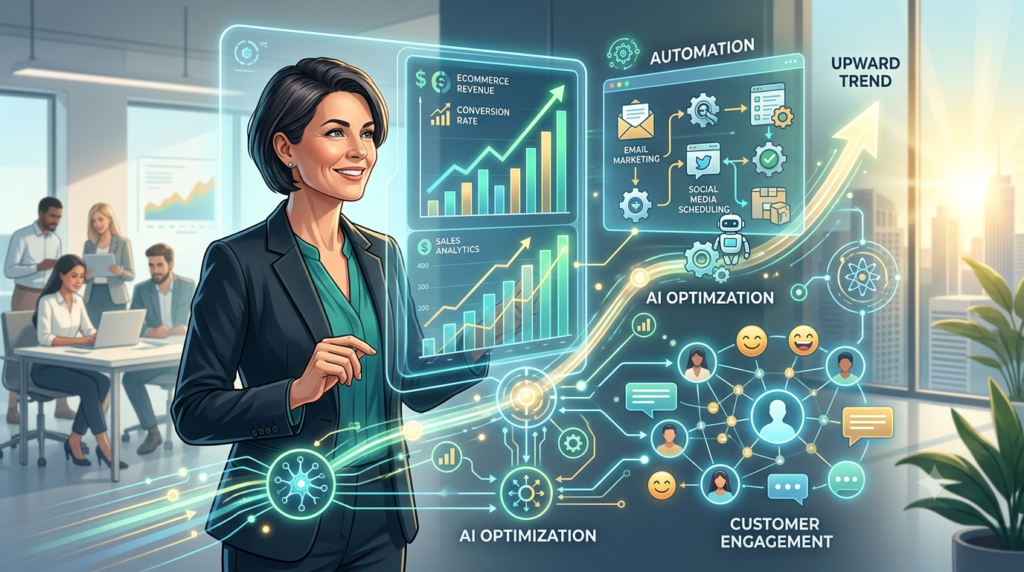
AI Marketing Tools in 2026: The Complete Guide to Smarter Marketing, Automation, and Business Growth
Table of Contents
- What Are AI Marketing Tools?
- How AI Marketing Tools Work
- Why Businesses Are Using AI Marketing Software
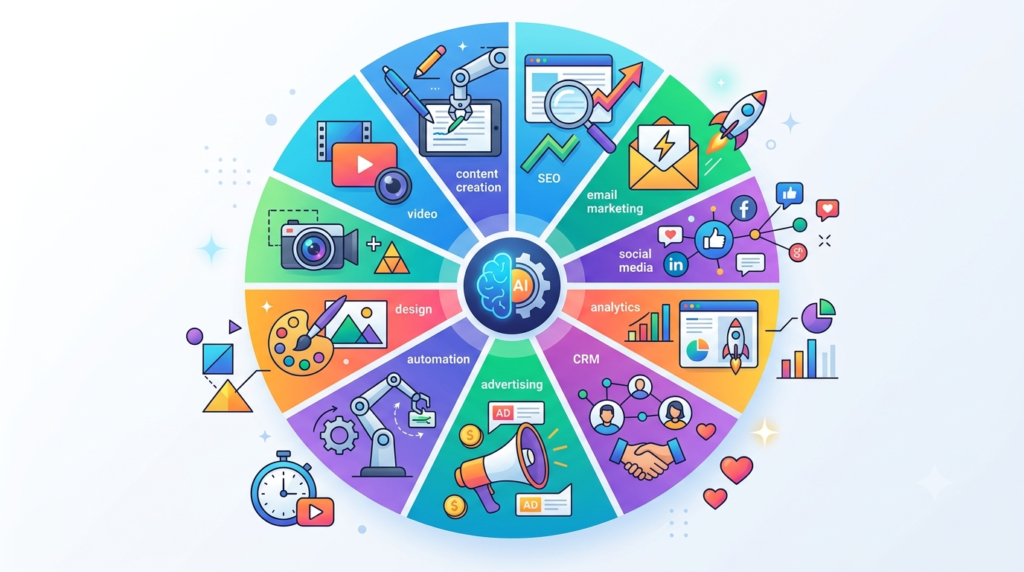
- Types of AI Marketing Tools
- Best AI Marketing Tools in 2026
- AI Tools for Content Marketing
- AI SEO Tools
- AI Email Marketing Tools
- AI Social Media Marketing Tools
- AI Advertising & PPC Tools
- AI Video Marketing Tools
- AI Analytics & Reporting Tools
- AI CRM & Customer Engagement
- AI Marketing Automation Platforms
- AI Marketing Tools Comparison Table
- Free vs Paid AI Marketing Tools
- How to Choose the Right AI Marketing Tool
- Common Mistakes to Avoid
- Expert Tips
- Future of AI Marketing
- Frequently Asked Questions
- Final Verdict
Introduction
AI Marketing Tools now plays a major role. By 2026, businesses have moved beyond manual planning and repetitive tasks and guesswork to reach their customers. They use AI marketing tools to automate campaigns, analyze customer behavior, create quality content, personalize experiences, and make real-time, data-driven decisions.
Why AI Marketing Matters
No matter if you run an ecommerce store, manage client campaigns, build a personal brand, or grow a startup, AI can help you work more efficiently and save money. Tasks that used to need whole marketing teams, like writing blog posts, creating ads, designing graphics, scheduling social media, or analyzing campaign results, can now be done faster and more easily with AI tools.
The Rise of Generative AI
Generative AI has quickly changed the way marketers create and improve content. Now, instead of spending hours coming up with ideas or testing messages by hand, marketers can use AI to write headlines, email sequences, product descriptions, social media captions, video scripts, landing page copy, and even personalized customer journeys.
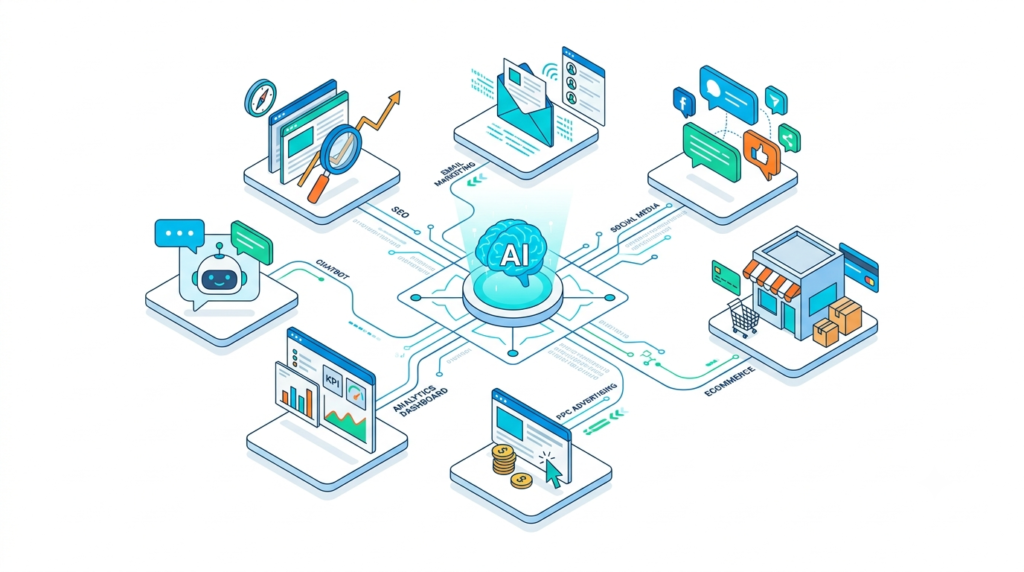
AI is also important for tasks beyond content creation, like search engine optimization (SEO), predictive analytics, audience segmentation, chatbot automation, lead scoring, customer support, and analyzing marketing performance. These tools help businesses get better returns on investment and offer more relevant experiences to customers across different marketing channels.
Choosing the Right AI Marketing Tool
Choosing the right AI marketing software can be challenging. There are hundreds of platforms, each promising smart automation, great recommendations, or high returns. Features, prices, integrations, scalability, and use cases can be very different, so it can be hard to find the best fit for your business goals.
What This Guide Covers
This guide aims to make your decision easier. Instead of just listing software, it explains what AI marketing tools do, how they work, where they add the most value, and which platforms are best in 2026. You’ll also find practical tips for choosing tools based on your business size, goals, budget, and current technology.
In this guide, you’ll see clear comparisons, practical advice, tips for getting started, and expert insights to help you create a smarter and more efficient marketing process. Unlike many articles that just list product features, this guide explains why certain AI tools are important, when to use them, and how they can help you improve results like traffic, engagement, conversions, customer retention, and long-term growth.
Why This Guide Is Different?
Rather than repeating generic information found online, this guide focuses on practical decision-making and helping you learn something new.
You’ll discover:
- Practical tool selection strategies
- Real marketing use cases
- Business-specific recommendations
- Automation workflow ideas
- Cost-saving opportunities
- Common implementation mistakes
- Productivity improvements
- Future AI marketing trends
- Expert implementation tips
- AI-friendly structured information for faster understanding
“Editorial Insight: AI is most effective when it enhances human expertise rather than replacing it. Businesses that combine automation with strategic thinking often achieve more sustainable marketing results.”
What You’ll Learn?
By the end of this guide, you’ll understand:
- What AI marketing tools actually do
- Which categories solve specific marketing problems
- Which tools are best for content, SEO, email, social media, advertising, analytics, and ecommerce
- How to compare platforms objectively
- How to avoid expensive software mistakes
- Which tools offer the best value for startups, agencies, and enterprises
- How AI is changing digital marketing in 2026
- How to build a scalable AI-powered marketing workflow
Whether you’re new to AI or already use several platforms, this guide will help you make better decisions and get more value from artificial intelligence in your marketing.
Who Should Read This Guide?
This guide is especially valuable for:
| Small Business Owners | Save time with automation and affordable AI solutions |
| Ecommerce Brands | Improve product marketing, personalization, and sales |
| Marketing Agencies | Scale client campaigns more efficiently |
| Content Creators | Generate articles, videos, and social posts faster |
| SEO Professionals | Research keywords, optimize content, and monitor rankings |
| Social Media Managers | Plan, create, and schedule content efficiently |
| Startup Founders | Grow with limited resources using AI automation |
| Enterprise Teams | Improve collaboration, reporting, and predictive insights |
Information Gain: Why AI Marketing Tools Matter More in 2026
Many marketers believe AI only replaces repetitive tasks, but its biggest benefit is helping with decision-making. Modern AI platforms use language models, predictive analytics, customer data, and automation to recommend the next best action, not just finish a task. Businesses that use AI wisely can test ideas faster, personalize campaigns at scale, and adapt quickly to market changes.
What Are AI Marketing Tools?
Quick Answer
AI marketing tools are apps or platforms that take over the repetitive, data-heavy parts of marketing – the kind of work that used to eat up hours every week. Instead of a marketer manually digging through spreadsheets to figure out which customers might buy next, the tool does it in seconds by scanning patterns in past behaviour.
Under the hood, most of these tools rely on machine learning models trained on huge datasets – website clicks, past purchases, email opens, ad performance. Some also use NLP, which basically means they can read and understand written text (like product reviews or customer chats) rather than just numbers.
The real value isn’t the technology itself – it’s what it lets a small ecommerce store do that used to require a whole marketing team: personalise every customer’s experience, predict what they’ll want next, and cut ad spend that’s not working.”
For example, an AI marketing platform can:
- Generate SEO-friendly blog articles.
- Write high-converting ad copy.
- Create engaging social media captions.
- Recommend the best email subject lines.
- Predict customer purchasing behaviour.
- Optimise PPC bids automatically.
- Identify high-value leads.
- Build personalised customer journeys.
- Generate marketing reports instantly.
- Recommend content improvements based on SEO data.
AI doesn’t replace marketers. Instead, it acts as a helpful assistant that boosts creativity, increases efficiency, and supports better decisions.

How Do AI Marketing Tools Work?
Quick Answer
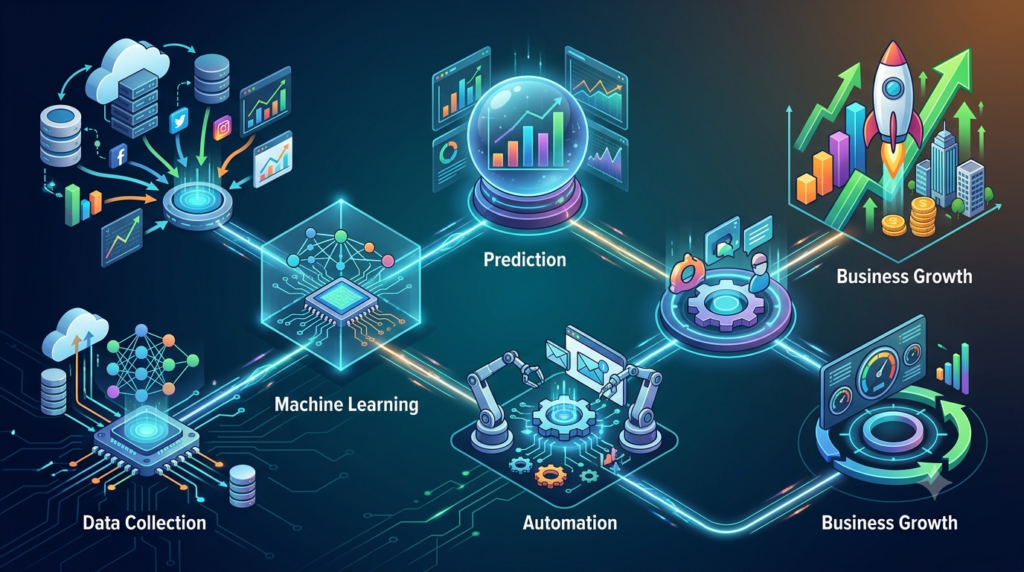
AI marketing tools gather data from multiple sources, analyse patterns using machine learning algorithms, and generate recommendations or automate tasks. AI learn from new data, enabling businesses to improve targeting, personalisation, campaign optimisation, and marketing
performance over time.
Most AI marketing platforms follow a similar workflow.
Step 1: Data Collection
AI systems collect information from multiple marketing channels, including:
- Website traffic
- Google Analytics
- Search Console
- CRM platforms
- Email campaigns
- Social media
- Online advertising
- Ecommerce stores
- Customer support chats
- Purchase history
- User behavior
- Conversion events
The more high-quality data available, the more accurate the AI recommendations become.
Step 2: Data Analysis
Using machine learning models, AI identifies trends such as:
- Which pages convert best
- Which products sell fastest
- Which audience segments engage most
- Which ads generate the highest ROI
- Which keywords drive conversions
- Which customers are likely to churn
- Which content performs best
Marketers no longer have to review spreadsheets by hand. Now, they get useful insights in just minutes.
Step 3: Prediction
One of AI’s biggest strengths is predictive analysis.
Modern AI marketing tools can estimate:
- Future sales
- Customer lifetime value
- Purchase probability
- Lead quality
- Best posting times
- Email open rates
- Conversion likelihood
- Campaign success probability
These predictions help businesses allocate budgets more effectively.
Once AI identifies opportunities, it can automate repetitive marketing tasks.
Examples include:
- Publishing social media posts
- Sending personalized emails
- Updating CRM records
- Creating product descriptions
- Optimising advertising bids
- Segmenting customers
- Scheduling campaigns
- Responding through AI chatbots
Automation lets marketing teams spend more time on strategy instead of routine work.
Step 5: Continuous Learning
Unlike traditional software, AI continuously improves.
As customers interact with campaigns, AI gathers new data and refines its recommendations.
This ongoing feedback helps AI make more accurate and useful predictions over time.
Core Technologies Behind AI Marketing Tools
Quick Answer
Modern AI marketing platforms combine multiple technologies, including machine learning, generative AI, natural language processing (NLP), predictive analytics, computer vision, and automation engines to analyse data, create content, and optimise marketing campaigns.
| Machine Learning | Learns from historical marketing data |
| Natural Language Processing (NLP) | Understands and generates human language |
| Generative AI | Creates text, images, videos, and code |
| Predictive Analytics | Forecasts customer behavior |
| Deep Learning | Improves personalization and recommendations |
| Computer Vision | Analyzes images and videos |
| Recommendation Engines | Suggests products or content |
| Marketing Automation | Executes repetitive workflows automatically |
Key Features of AI Marketing Tools
Quick Answer
The best AI marketing tools bring together automation, content creation, analytics, personalization, and optimization in one workflow. This helps businesses work more efficiently and give customers a better experience.
Common features include:
- AI content writing
- AI image generation
- Email marketing automation
- SEO optimization
- Keyword research
- Ad copy generation
- Landing page optimization
- Customer segmentation
- Predictive analytics
- Marketing dashboards
- Chatbots
- Lead scoring
- CRM integration
- Social media scheduling
- A/B testing assistance
- Workflow automation
- Performance reporting
- Sentiment analysis
- Voice search optimization
- Campaign recommendations
Benefits of AI Marketing Tools
Quick Answer
AI marketing tools help businesses save time, cut costs, improve campaign results, personalize customer experiences, and make smarter decisions. They boost productivity and let marketers focus on strategy, creativity, and long-term growth.
1. Save Time Through Automation
AI can automate repetitive tasks that previously consumed hours every week.
Examples:
- Email sequences
- Social scheduling
- Reporting
- Keyword clustering
- Product descriptions
- Blog outlines
- Lead qualification
2. Increase Productivity
Instead of spending hours creating content manually, marketers can generate first drafts in minutes and spend more time refining
strategy and messaging.
3. Improve Personalisation
AI enables businesses to deliver personalised:
- Emails
- Product recommendations
- Website experiences
- Offers
- Advertisements
- Customer journeys
Higher engagement and conversion rates leads by Personalisation.
4. Better Marketing Decisions
AI analyses massive datasets far faster than humans, helping marketers identify trends, optimise campaigns, and allocate budgets more effectively.
5. Better ROI
Smarter targeting and optimisation can reduce wasted ad spend while improving conversions and customer acquisition efficiency.
6. Better Customer Experience
AI-powered chatbots, recommendation engines, and personalised content provide faster responses and more relevant interactions, improving overall customer satisfaction.
Real-World Use Cases
| Ecommerce | Product descriptions, recommendations, abandoned cart emails |
| Agency | Client reporting, content generation, SEO audits |
| SaaS | Lead scoring, onboarding emails, chatbot support |
| Blogger | Keyword research, article outlines, SEO optimization |
| Local Business | Review management, social scheduling, email campaigns |
| Enterprise | Predictive analytics, workflow automation, customer segmentation |
Information Gain: AI Doesn’t Replace Marketers—It Amplifies Them
A common myth is that AI replaces human marketers. In reality, the best results come from combining AI’s speed with human creativity, judgment, and strategy. AI can generate ideas, analyze data, and automate tasks, but people still set the brand voice, understand context, build relationships, and make the final calls.
Types of AI Marketing Tools
Quick Answer
AI marketing tools come in many categories, each designed to solve a specific marketing challenge. Some specialise in content creation, while others focus on SEO, email marketing, social media management, advertising, analytics, customer engagement, or workflow automation. The best marketing stack often combines several AI tools rather than relying on a single platform.
Choosing the right AI marketing software starts with understanding what each category does. Below is a breakdown of the most important AI marketing tools for 2026 and how they help businesses improve efficiency, engagement, and ROI.
1. AI Content Creation Tools
Quick Answer
AI content creation tools help marketers generate blogs, product descriptions, ad copy, email campaigns, website copy, and social media posts in minutes. They improve productivity while maintaining consistency across marketing channels.
Best For
- Blog writing
- Landing pages
- Product descriptions
- Ad copy
- Email campaigns
- Video scripts
- Marketing copy
- Content repurposing
Popular Examples
| ChatGPT | Long-form writing, brainstorming, coding assistance |
| Claude | Research-based content and document analysis |
| Jasper | Marketing copy and brand voice |
| Copy.ai | Sales copy and campaigns |
| Writesonic | SEO content and landing pages |
Advantages
- Faster content production
- Consistent brand messaging
- Lower content costs
- Multiple language support
- Improved productivity
Limitations
- Requires fact-checking
- Needs human editing
- May produce generic outputs without quality prompts
AI Marketing Tools in 2026: The Complete Guide
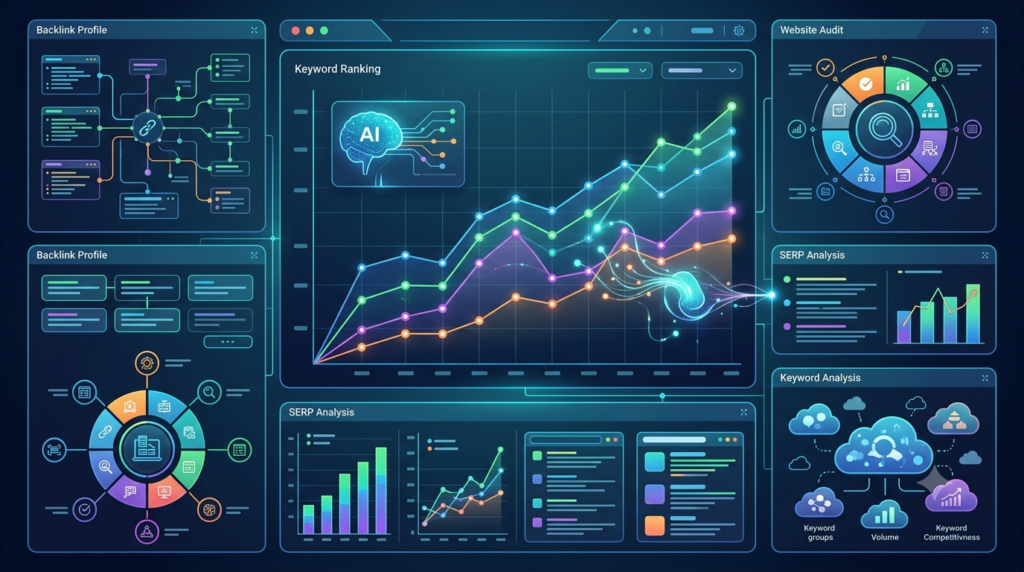
2. AI SEO Tools
Quick Answer
AI SEO tools help businesses improve search visibility through keyword research, content optimisation, technical audits, competitor analysis, and performance monitoring.
Common Features
- Keyword research
- Topic clustering
- Content optimization
- Internal linking suggestions
- SERP analysis
- Technical SEO audits
- Rank tracking
- AI content scoring
Popular Examples
| Surfer SEO | Content optimization |
| Semrush AI Features | Keyword & competitor research |
| Ahrefs | Backlink and keyword analysis |
| Frase | Content briefs and optimization |
| Clearscope | Semantic SEO optimization |
Ideal Users
- Bloggers
- SEO agencies
- Ecommerce websites
- Publishers
- SaaS companies
3. AI Social Media Marketing Tools
Quick Answer
AI social media tools simplify content planning, scheduling, caption writing, hashtag generation, audience analysis, and performance reporting across multiple platforms.
Features
- Caption generation
- Content calendars
- Image suggestions
- Hashtag recommendations
- Scheduling
- Analytics
- Engagement insights
Popular Platforms
| Buffer AI | Scheduling |
| Hootsuite AI | Multi-platform management |
| Later AI | Instagram marketing |
| Metricool | Analytics and scheduling |
| SocialBee | Content recycling |

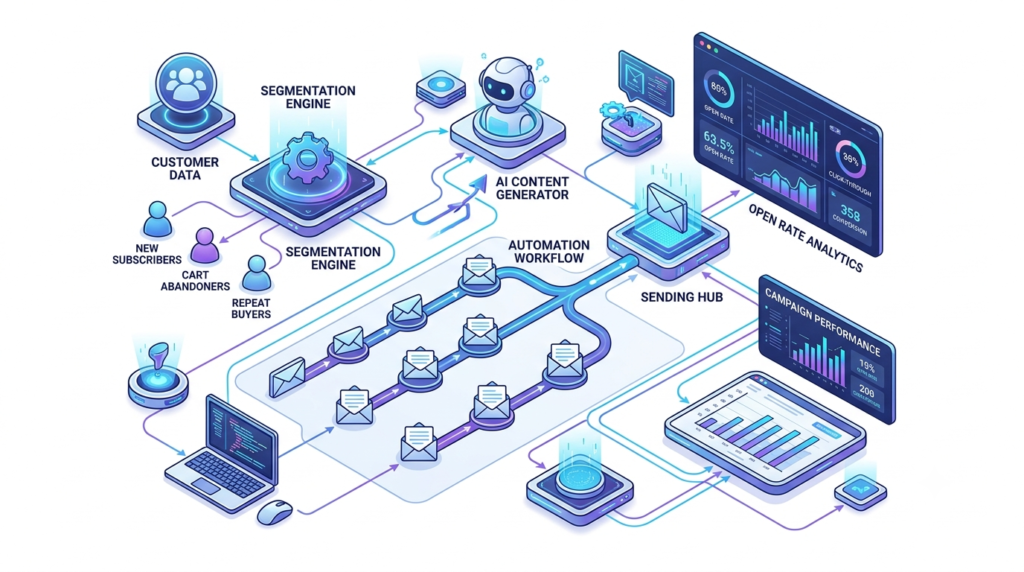
4. AI Email Marketing Tools
Quick Answer
AI email marketing software creates personalised campaigns, predicts customer behaviour, optimises send times, and improves open and click-through rates through intelligent automation.
AI Features
- Subject line optimisation
- Personalised email content
- Customer segmentation
- Predictive sending
- Automation workflows
- A/B testing
Popular Tools
| Mailchimp | Small businesses |
| Brevo | Affordable automation |
| ActiveCampaign | Advanced automation |
| Klaviyo | Ecommerce |
| HubSpot | CRM integration |
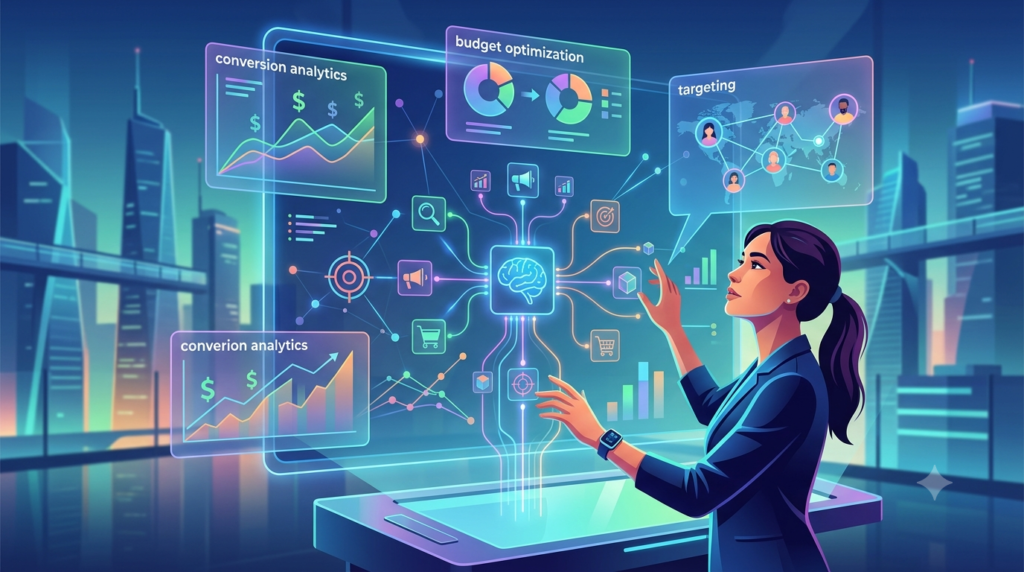
5. AI Advertising Tools
Quick Answer
AI advertising tools optimise digital advertising campaigns by automating bidding, audience targeting, budget allocation, creative testing, and conversion tracking.
Supports
- Google Ads
- Meta Ads
- LinkedIn Ads
- TikTok Ads
- Microsoft Ads
AI Capabilities
- Smart bidding
- Audience prediction
- Budget optimization
- Creative recommendations
- Conversion forecasting
6. AI Graphic Design Tools
Quick Answer
AI design platforms help marketers create professional graphics, advertisements, presentations, banners, logos, and social media visuals without advanced design skills.
Popular Platforms
| Canva AI | Marketing graphics |
| Adobe Firefly | AI image generation |
| Microsoft Designer | Quick promotional designs |
| Ideogram | Text-based image generation |
Benefits
- Faster design creation
- Brand consistency
- Lower outsourcing costs
Product Image & Design Tools
7. AI Video Marketing Tools
Quick Answer
AI video tools allow businesses to create promotional videos, tutorials, advertisements, subtitles, voiceovers, and social media clips with minimal editing experience.
- AI avatars
- Voice generation
- Automatic subtitles
- Script generation
- Video editing
- Text-to-video
Popular Tools
- Synthesia
- Pictory
- Runway
- InVideo AI
- VEED AI
8. AI Analytics & Reporting Tools
Quick Answer
AI analytics platforms transform marketing data into actionable insights by identifying trends, predicting outcomes, and generating automated reports.
Features
- Marketing dashboards
- ROI analysis
- Customer behaviour tracking
- Funnel analysis
- Predictive reporting
- Performance forecasting
9. AI CRM & Customer Engagement Tools
Quick Answer
AI-powered CRM platforms help businesses manage customer relationships through intelligent lead scoring, personalised communication, chatbot support, and sales automation.
Features
- Lead scoring
- Customer segmentation
- AI chatbots
- Sales forecasting
- Workflow automation
- Personalized follow-ups
Popular Platforms
| HubSpot CRM | All-in-one marketing & sales |
| Salesforce Einstein | Enterprise AI |
| Zoho CRM AI | Small businesses |
| Freshsales | Lead management |
10. AI Marketing Automation Platforms
Quick Answer
Marketing automation tools integrate multiple channels into a single intelligent workflow, helping businesses automate repetitive tasks while maintaining consistent customer experiences.
Automation Examples
- Welcome emails
- Lead nurturing
- Customer onboarding
- Social scheduling
- CRM updates
- Campaign reporting
- Lead assignment
- Customer follow-up
AI Marketing Tool Categories at a Glance
| Content AI | Writing & Copy | Bloggers, marketers |
| SEO AI | Organic growth | SEO professionals |
| Social Media AI | Scheduling & engagement | Social managers |
| Email AI | Personalization | Ecommerce & SaaS |
| Advertising AI | PPC optimization | Performance marketers |
| Design AI | Visual content | Designers & businesses |
| Video AI | Video creation | Creators & brands |
| Analytics AI | Data insights | Marketing teams |
| CRM AI | Customer management | Sales & support |
| Automation AI | Workflow automation | All business sizes |
Pro Tips for Building an AI Marketing Stack
Rather than signing up for lots of platforms, start with a small set of tools that fit your goals:
- Content: ChatGPT or Jasper
- SEO: Semrush + Surfer SEO
- Design: Canva AI
- Email: Klaviyo or ActiveCampaign
- Social Media: Buffer AI
- Analytics: Google Analytics 4 + AI reporting
- Automation: Zapier or Make
This way, you save money and still cover all the main parts of your marketing workflow.
Common Mistakes to Avoid
- Using AI without a clear marketing strategy.
- Publishing AI-generated content without human review.
- Ignoring data privacy and compliance.
- Paying for overlapping tools with similar features.
- Failing to measure ROI after implementing AI solutions.
- Choosing tools based on hype instead of business needs.
Best AI Marketing Tools in 2026
Quick Answer
The best AI marketing tools in 2026 combine automation, content creation, analytics, personalisation, and workflow optimisation. Your business goals depend on the ideal platform , budget, team size, and marketing channels. Instead of searching for a single “best” tool, build a stack of complementary solutions that work together.
With hundreds of AI-powered marketing platforms available, selecting the right software can be overwhelming. To simplify your decision, we’ve evaluated leading tools based on these criteria:
- AI capabilities
- Ease of use
- Automation features
- Marketing integrations
- Pricing and value
- Scalability
- Customer support
- Overall return on investment (ROI)
Below are some of the top AI marketing tools for businesses, agencies, creators, and ecommerce brands in 2026.
1. ChatGPT
Quick Answer
ChatGPT is one of the most versatile AI assistants for marketers. It helps generate blog posts, ad copy, email campaigns, product descriptions, SEO content, marketing strategies, and code, making it a valuable tool for all sizes of businesses.
Best For
- Content writing
- SEO articles
- Email marketing
- Brainstorming
- Marketing strategies
- Customer support scripts
Key Features
- Long-form content generation
- Marketing copywriting
- Content summarization
- Translation
- Code assistance
- Prompt customization
- Workflow support
Pros
✔ Highly versatile
✔ Beginner-friendly
✔ Supports multiple industries
✔ Excellent for content creation
Cons
✘ Requires fact-checking
✘ Output quality depends on prompts
Ideal Users
- Bloggers
- Agencies
- Ecommerce stores
- Small businesses
- Marketing teams
2. Jasper AI
Quick Answer
Jasper AI specialises in marketing copy and brand-consistent content. It is ideal for businesses that need high-quality copy at scale while maintaining a consistent tone across campaigns.
Best For
- Brand content
- Advertising
- Landing pages
- Email marketing
- Product descriptions
Key Features
- Brand Voice
- Campaign templates
- AI image support
- Team collaboration
- Marketing workflows
Pros
- Excellent marketing templates
- Brand consistency
- Collaboration features
Cons
- Premium pricing
- Learning curve for advanced features
Quick Answer
Semrush combines AI-powered insights with one of the industry’s most comprehensive SEO and digital marketing platforms, making it ideal for keyword research, competitor analysis, and content optimisation.
Best Features
- Keyword research
- Site audit
- Backlink analysis
- Competitor research
- AI SEO recommendations
- Position tracking
Best For
- SEO professionals
- Agencies
- Ecommerce
- Publishers
4. Surfer SEO
Quick Answer
Surfer SEO uses AI and SERP analysis to optimise content for search engines by recommending ideal keyword usage, headings, content structure, and topical relevance.
Highlights
- Content Score
- NLP keywords
- SERP analyzer
- Internal linking suggestions
- AI article editor
5. Canva AI
Quick Answer
Canva AI simplifies graphic design with AI-powered image generation, Magic Design, presentation creation, and social media templates, making professional-quality visuals accessible to non-designers.
Best For
- Social media graphics
- Ads
- Infographics
- Presentations
- Marketing banners
Features
- Magic Design
- AI image generation
- Background remover
- Magic Resize
- Brand Kit
Quick Answer
HubSpot AI combines CRM, marketing automation, sales, customer service, and AI-powered content assistance into a unified platform for growing businesses.
Key Features
- CRM
- Email automation
- Lead scoring
- Chatbots
- Sales forecasting
- AI assistant
7. Mailchimp AI
Quick Answer
Mailchimp uses AI to improve email marketing performance through predictive analytics, audience segmentation, personalised recommendations, and automated customer journeys.
Ideal For
- Small businesses
- Ecommerce
- Email campaigns
- Newsletters
8. Klaviyo
Quick Answer
Klaviyo is one of the leading AI-powered email and SMS marketing platforms for ecommerce brands. It excels at customer segmentation, automation, and personalised product recommendations.
Best For
- Shopify stores
- WooCommerce
- Ecommerce automation
- SMS marketing
9. Buffer AI
Quick Answer
Buffer AI helps marketers create captions, analyse engagement, schedule posts and manage from a single dashboard by multiple social media accounts.
Best Features
- Caption generation
- Scheduling
- Calendar management
- Analytics
- Team collaboration
Quick Answer
Google Analytics 4 uses machine learning to predict user behaviour, identify valuable audiences, and provide actionable insights for optimising marketing campaigns.
AI Capabilities
- Predictive metrics
- Conversion modeling
- Audience insights
- Funnel analysis
- Cross-platform tracking
Comparison Table
| ChatGPT | Content & Strategy | ⭐⭐⭐⭐⭐ | Yes | All |
| Jasper | Marketing Copy | ⭐⭐⭐⭐ | No | SMB & Enterprise |
| Semrush | SEO | ⭐⭐⭐⭐ | Limited | All |
| Surfer SEO | Content Optimization | ⭐⭐⭐⭐ | No | All |
| Canva AI | Graphic Design | ⭐⭐⭐⭐⭐ | Yes | All |
| HubSpot AI | CRM & Automation | ⭐⭐⭐⭐ | Yes | Growing Businesses |
| Mailchimp | Email Marketing | ⭐⭐⭐⭐⭐ | Yes | Small Business |
| Klaviyo | Ecommerce | ⭐⭐⭐⭐ | Limited | Ecommerce |
| Buffer AI | Social Media | ⭐⭐⭐⭐⭐ | Yes | All |
| GA4 | Analytics | ⭐⭐⭐ | Yes | All |
Additional AI Marketing Tools Worth Considering in 2026
Quick Answer
While the most popular AI marketing platforms cover many business needs, several specialised tools excel in areas such as AI copywriting, workflow automation, SEO research, video production, image generation, and customer engagement. Choosing the right combination can significantly improve your marketing efficiency.
11. Claude
Best For
Research, long-form writing, document analysis, and strategy.
Key Features
- Long-context document analysis
- High-quality writing
- Brainstorming
- Business reports
- Content refinement
Pros
- Excellent writing quality
- Strong reasoning
- Great for long documents
Cons
- Limited marketing templates
Best For
Productivity, Google Workspace integration, and marketing research.
Key Features
- Gmail integration
- Google Docs assistance
- Spreadsheet analysis
- Content generation
- Marketing research
Ideal Users
- Google Workspace users
- Agencies
- Small businesses
13. Copy.ai
Best For
Sales copy, product descriptions, social media captions, and email campaigns.
Top Features
- Marketing templates
- AI workflows
- Product descriptions
- Social media copy
- Sales outreach
14. Writesonic
Best For
SEO-focused blog writing and landing page content.
Highlights
- AI Article Writer
- SEO optimization
- Landing pages
- Blog generation
- AI chatbot support
15. Frase
Best For
Content briefs, SERP analysis, and AI-assisted SEO optimisation.
Key Features
- Content briefs
- SERP research
- Question analysis
- SEO optimization
- AI writing
Best For
Backlink analysis, keyword research, and competitor analysis.
Key Features
- Site Explorer
- Keyword Explorer
- Rank Tracker
- Site Audit
- Content Explorer
17. Zapier
Best For
Connecting marketing apps and automating repetitive workflows.
Automation Examples
- Lead notifications
- CRM updates
- Email automation
- Social media publishing
- Form integrations
18. Make
Best For
Advanced visual workflow automation.
Features
- Drag-and-drop automation
- API integrations
- Conditional workflows
- Ecommerce automation
- Marketing automation
19. Adobe Firefly
Best For
AI-generated marketing visuals and creative assets.
Best Uses
- Social media graphics
- Advertising creatives
- Product images
- Brand assets
20. Midjourney
Best For
High-quality AI-generated marketing illustrations and promotional artwork.
Strengths
- Creative visuals
- Concept art
- Product mockups
- Advertising images
21. Pictory
Best For
Converting blog posts into engaging marketing videos.
Features
- Blog-to-video
- Captions
- AI voice
- Video summarization
- Social clips
22. Synthesia
Best For
AI avatar videos for training, marketing, and presentations.
Popular Uses
- Product demos
- Tutorials
- Corporate communication
- Marketing videos
23. Runway
Best For
Professional AI video editing and visual effects.
Features
- Video editing
- Background removal
- AI effects
- Motion tracking
- Text-to-video
24. Active Campaign
Best For
Email marketing automation and customer journey optimisation.
Key Features
- Email automation
- CRM
- Lead scoring
- Customer journeys
- Predictive sending
25. Hootsuite AI
Best For
Managing multiple social media platforms from one dashboard.
Key Features
- Scheduling
- AI captions
- Analytics
- Team collaboration
- Engagement tracking
Best AI Marketing Tools by Category
| AI Writing | ChatGPT |
| Long-Form Research | Claude |
| SEO | Semrush |
| Content Optimization | Surfer SEO |
| Keyword Research | Ahrefs |
| Graphic Design | Canva AI |
| AI Images | Adobe Firefly |
| Creative Artwork | Midjourney |
| Video Creation | Pictory |
| AI Avatars | Synthesia |
| Video Editing | Runway |
| Email Marketing | ActiveCampaign |
| Ecommerce Marketing | Klaviyo |
| CRM | HubSpot |
| Social Media | Buffer AI |
| Workflow Automation | Zapier |
| Advanced Automation | Make |
| Analytics | Google Analytics 4 |
Expert Recommendations
Best Overall
ChatGPT — Ideal for content creation, brainstorming, and marketing strategy.
Best for SEO
Semrush — Comprehensive SEO, keyword research, and competitor analysis.
Best for Content Optimisation
Surfer SEO — Excellent for improving on-page SEO and content relevance.
Best for Ecommerce
Klaviyo — Powerful email and SMS automation tailored to online stores.
Best Budget-Friendly
Canva AI — Affordable design platform with AI-powered creative features.
Best for Automation
Zapier — Connects hundreds of apps to automate repetitive marketing tasks.
Best Enterprise Solution
HubSpot AI — Unified CRM, marketing, sales, and customer service platform with AI assistance.
Pro Tip
Don’t pick tools just because they’re popular. Try a platform with a real marketing campaign, see how it affects your productivity and ROI, and then decide if you want to add more tools. A focused, connected set of tools usually works better than a big mix of unrelated ones.
How to Choose the Right AI Marketing Tool
Quick Answer
The right AI marketing tool depends on your objectives, existing technology stack, team expertise, and budget. Focus on solving one business problem at a time instead of purchasing every available platform.
Consider These Factors
- Business size
- Marketing goals
- Budget
- Ease of use
- AI capabilities
- Integration with existing tools
- Customer support
- Security and privacy
- Scalability
- ROI potential
Expert Tips
- Start with one or two AI tools before expanding your stack.
- Measure performance improvements using KPIs such as traffic, conversion rate, and ROI.
- Combine AI automation with human creativity for the best results.
- Regularly review AI-generated content for accuracy and brand consistency.
- Invest in staff training to maximise tool effectiveness.
Information Gain: Build an AI Marketing Ecosystem, Not a Collection of Tools
Successful businesses don’t choose AI tools based on popularity alone. Instead, they create an integrated ecosystem where content generation, SEO, analytics, CRM, email marketing, and automation platforms work together. This approach reduces manual work, improves data consistency, and enables more personalised customer experiences across every stage of the marketing funnel.
AI Marketing Tools by Business Type
Quick Answer
Different businesses have different marketing goals, budgets, and operational needs. Instead of choosing the most popular AI platform, select tools that align with your business model, marketing channels, and growth objectives.
AI Marketing Tools for Small Businesses
Small businesses often need affordable, easy-to-use solutions that automate repetitive work without requiring a large marketing team.
Recommended Tools
| ChatGPT | Content creation & marketing ideas |
| Canva AI | Social media graphics |
| Mailchimp | Email marketing |
| Buffer | Social media scheduling |
| Google Analytics 4 | Website analytics |
Why These Tools?
- Low monthly cost
- Beginner-friendly
- Quick implementation
- Excellent ROI
- Minimal learning curve
AI Marketing Tools for Ecommerce Stores
Ecommerce brands require AI solutions that increase conversions, personalise shopping experiences, and automate customer communication.
Recommended Stack
- ChatGPT
- Klaviyo
- Shopify Magic
- Semrush
- Canva AI
- Google Analytics 4
Primary Use Cases
- Product descriptions
- Abandoned cart emails
- Product recommendations
- Customer segmentation
- Marketing automation
- Conversion optimization
AI Analytics & CRO Tools
AI Marketing Tools for Marketing Agencies
Marketing agencies benefit from AI platforms that streamline client work, improve reporting, and scale content production.
Recommended Stack
- ChatGPT
- Jasper
- Semrush
- Surfer SEO
- HubSpot
- Buffer
- Canva AI
Benefits
- Faster content delivery
- Better collaboration
- Automated reporting
- Campaign optimization
- Improved client communication
AI Marketing Tools for Bloggers & Content Creators
Content creators need AI tools that simplify research, writing, SEO, and visual content production.
Recommended Tools
- ChatGPT
- Claude
- Surfer SEO
- Canva AI
- Grammarly
Common Tasks
- Article outlines
- SEO optimization
- Content editing
- Image creation
- Social media promotion
AI Product Content Tools
AI Marketing Tools for Enterprise Businesses
Large organisations require scalable AI solutions with advanced analytics, automation, security, and CRM integration.
Recommended Stack
- HubSpot AI
- Salesforce Einstein
- Adobe Experience Cloud
- Google Analytics 4
- Tableau
Enterprise Benefits
- Cross-team collaboration
- Predictive analytics
- Advanced customer segmentation
- Workflow automation
- Enterprise-grade security
AI Marketing Trends in 2026
Quick Answer
Trend 1: Hyper-Personalisation
AI now delivers personalised content, offers, and recommendations based on real-time customer behaviour, preferences, and purchase history.
Trend 2: AI Search Optimisation
Businesses are optimising content not only for traditional search engines but also for AI-powered search experiences such as ChatGPT, Gemini, and Perplexity.
Trend 3: AI Agents
Autonomous AI agents can perform complex marketing workflows, including research, campaign planning, reporting, and customer support with minimal human intervention.
Trend 4: Predictive Marketing
AI models analyse historical data to forecast customer behaviour, identify high-value leads, and recommend the best marketing actions before opportunities are missed.
Trend 5: Multimodal AI
Modern AI platforms can generate and understand text, images, videos, audio, and code within a single workflow, enabling more efficient content production.
Trend 6: Privacy-First AI
As privacy regulations continue to evolve, AI platforms are placing greater emphasis on responsible data collection, transparency, and secure customer data management.
AI Marketing Tools Comparison Matrix
Quick Answer
Comparing AI marketing tools side by side helps businesses identify the best platform based on features, pricing, ease of use, and primary use cases.
| ChatGPT | Content & Strategy | ✅ | ⭐⭐⭐⭐⭐ | ⭐⭐⭐⭐⭐ | ⭐⭐⭐⭐ | ⭐⭐⭐ | ⭐⭐⭐⭐⭐ |
| Claude | Research | ✅ | ⭐⭐⭐⭐⭐ | ⭐⭐⭐⭐⭐ | ⭐⭐⭐ | ⭐⭐ | ⭐⭐⭐⭐☆ |
| Gemini | Productivity | ✅ | ⭐⭐⭐⭐ | ⭐⭐⭐⭐ | ⭐⭐⭐ | ⭐⭐⭐ | ⭐⭐⭐⭐☆ |
| Jasper | Marketing Copy | ❌ | ⭐⭐⭐⭐ | ⭐⭐⭐⭐⭐ | ⭐⭐⭐ | ⭐⭐⭐ | ⭐⭐⭐⭐☆ |
| Canva AI | Design | ✅ | ⭐⭐⭐⭐⭐ | ⭐⭐ | ❌ | ⭐⭐ | ⭐⭐⭐⭐☆ |
| Semrush | SEO | Limited | ⭐⭐⭐⭐ | ⭐⭐⭐ | ⭐⭐⭐⭐⭐ | ⭐⭐⭐ | ⭐⭐⭐⭐⭐ |
| Surfer SEO | Content SEO | ❌ | ⭐⭐⭐⭐ | ⭐⭐⭐ | ⭐⭐⭐⭐⭐ | ⭐⭐ | ⭐⭐⭐⭐☆ |
| HubSpot AI | CRM | ✅ | ⭐⭐⭐⭐ | ⭐⭐⭐ | ⭐⭐⭐ | ⭐⭐⭐⭐⭐ | ⭐⭐⭐⭐⭐ |
| Mailchimp | Email | ✅ | ⭐⭐⭐⭐⭐ | ⭐⭐⭐ | ❌ | ⭐⭐⭐⭐⭐ | ⭐⭐⭐⭐☆ |
| Klaviyo | Ecommerce | Limited | ⭐⭐⭐⭐ | ⭐⭐⭐ | ❌ | ⭐⭐⭐⭐⭐ | ⭐⭐⭐⭐☆ |
Expert Tip
Don’t pick an AI tool just because it’s well-known. First, figure out your biggest marketing challenge, like content creation, SEO, email automation, or analytics, and choose a tool that solves that problem. As your business grows, add new tools carefully instead of collecting too many with similar features.
Free vs Paid AI Marketing Tools
Quick Answer
Free AI marketing tools are ideal for beginners, freelancers, and small businesses testing AI workflows. Paid tools offer advanced automation, integrations, analytics, collaboration, and enterprise-grade features that help scale marketing operations and improve ROI.
Choosing between free and paid AI software depends on your business goals, marketing complexity, and growth stage. Many businesses start with free plans and upgrade as their marketing needs evolve.
| Cost | Free | Monthly or annual subscription |
| AI Capabilities | Basic | Advanced |
| Usage Limits | Limited | Higher or unlimited |
| Automation | Basic | Advanced workflows |
| Team Collaboration | Limited | Yes |
| Integrations | Few | Extensive |
| Customer Support | Community or email | Priority support |
| Best For | Beginners & freelancers | Growing businesses & enterprises |
Recommendation: Start with free plans to evaluate usability, then invest in paid tools that solve your most important business challenges.
Common Mistakes to Avoid
Quick Answer
Many businesses fail to get value from AI because they adopt tools without a strategy, rely too heavily on automation, or ignore quality control. Treat AI as a decision-support system rather than a complete replacement for human expertise.
Mistake 1: Publishing AI Content Without Editing
AI-generated content should always be reviewed for factual accuracy, clarity, tone, and originality.
Mistake 2: Buying Too Many Tools
Avoid paying for multiple platforms that perform the same functions. Build a streamlined AI stack.
Mistake 3: Ignoring SEO Best Practices
Even AI-written content should follow proper keyword research, internal linking, metadata optimisation, and E-E-A-T principles.
Mistake 4: Forgetting Brand Voice
Customise AI outputs to reflect your brand personality instead of publishing generic text.
Mistake 5: Not Measuring ROI
Track metrics such as traffic, leads, conversions, customer acquisition cost (CAC), and return on investment (ROI) to evaluate tool performance.
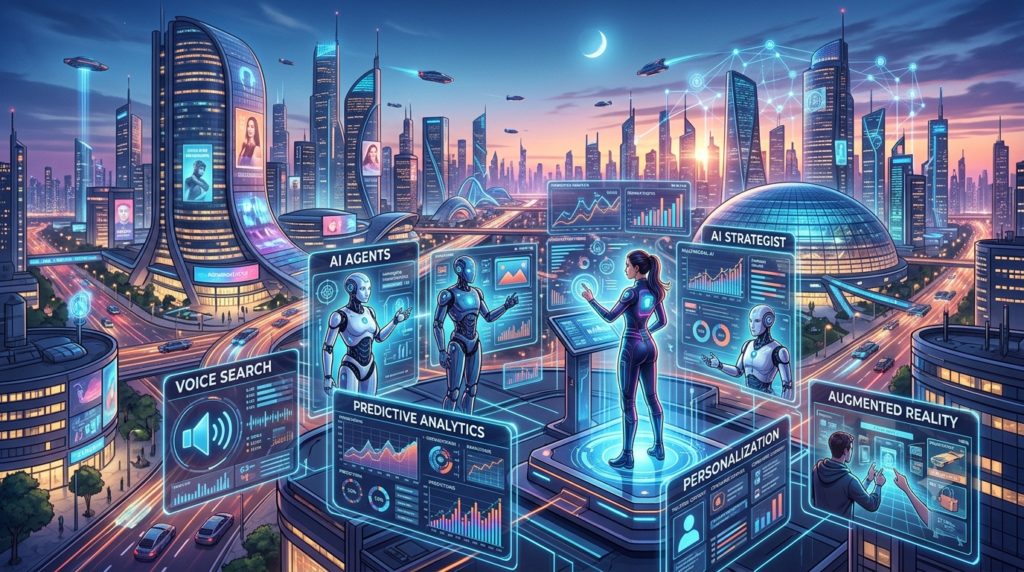
The Future of AI Marketing
Quick Answer
AI marketing will become increasingly predictive, personalised, and multimodal. Businesses that combine AI automation with human creativity and ethical data practices will be better positioned to compete in an AI-first search and marketing landscape.
Emerging Trends
- Hyper-personalised customer experiences
- AI-powered voice search optimization
- AI shopping assistants
- Autonomous marketing agents
- Predictive campaign optimization
- Generative video and image creation
- Conversational commerce
- AI-powered customer journey orchestration
- Privacy-first AI solutions
- Integration with large language models (LLMs)
What Businesses Should Do
- Continuously train marketing teams on AI.
- Review AI outputs before publishing.
- Monitor AI search platforms for visibility.
- Focus on original insights and first-hand expertise.
- Stay informed about evolving privacy regulations.
Frequently Asked Questions (FAQ)
1. What are AI marketing tools?
AI marketing tools are software solutions that use artificial intelligence to automate marketing tasks, analyse data, create content, personalise customer experiences, and improve campaign performance.
2. Which AI marketing tool is best for beginners?
ChatGPT, Canva AI, and Mailchimp are beginner-friendly choices because they offer intuitive interfaces and free plans.
3. Are AI marketing tools good for small businesses?
Yes. They help small businesses save time, reduce costs, automate repetitive work, and compete more effectively with larger brands.
4. Can AI replace digital marketers?
No. AI enhances productivity, but human creativity, strategic thinking, and relationship-building remain essential.
5. Are AI-generated articles good for SEO?
They can be, provided they are fact-checked, edited, and optimised for search intent, E-E-A-T, and user experience.
6. Which AI tool is best for SEO?
Popular options include Surfer SEO, Semrush, Ahrefs, and Frase, depending on your specific needs.
7. Which AI tool is best for social media?
Buffer AI, Hootsuite AI, and Later AI are widely used for scheduling, content planning, and analytics.
8. Is AI marketing expensive?
Not necessarily. Many platforms offer free plans, while premium features are available through affordable monthly subscriptions.
9. How do I choose the right AI marketing tool?
Identify your primary marketing challenge, compare features and pricing, and select a platform that integrates well with your existing workflow.
10. What is the future of AI in marketing?
The future lies in predictive analytics, advanced personalisation, multimodal content generation, and AI-assisted decision-making.
11. Can AI marketing tools improve SEO rankings?
AI marketing tools can streamline keyword research, optimise content, identify technical SEO issues, and suggest improvements based on search intent. While they cannot guarantee rankings, they help marketers create higher-quality, search-friendly content that follows SEO best practices.
12. Which AI marketing tool is best for ecommerce?
For ecommerce businesses, platforms like Klaviyo, Shopify Magic, ChatGPT, Canva AI, and Google Analytics 4 work well together. They help automate product marketing, personalise customer communication, and improve conversions.
13. Do AI marketing tools work for local businesses?
Yes. Local businesses can use AI for Google Business Profile optimisation, review responses, social media scheduling, email campaigns, customer support chatbots, and local SEO content creation.
14. Can AI generate social media content?
Yes. AI can create captions, hashtags, image ideas, content calendars, and post variations for platforms such as Facebook, Instagram, LinkedIn, X, and TikTok. Human review is still recommended to ensure brand consistency.
15. Are AI marketing tools safe to use?
Most reputable AI platforms are safe when used responsibly. Businesses should review each provider’s privacy policy, security practices, and compliance features before uploading sensitive customer information.
16. Can AI create marketing images and videos?
Yes. Modern AI tools can generate graphics, product images, promotional banners, presentations, and marketing videos using text prompts, templates, or existing brand assets.
17. How much do AI marketing tools cost?
Pricing varies widely. Many tools offer free plans with limited features, while premium subscriptions typically range from around $10 per month for basic plans to several hundred dollars per month for enterprise solutions.
18. Can AI replace a marketing agency?
No. AI improves productivity and automates repetitive work, but agencies still provide strategy, creativity, brand positioning, campaign management, and business expertise that AI alone cannot replace.
19. How often should I update my AI marketing stack?
Review your marketing tools every 6–12 months. As AI technology evolves rapidly, newer platforms or features may provide better performance, integrations, or cost savings.
20. What should I look for before buying an AI marketing tool?
Evaluate your business goals, budget, ease of use, available integrations, automation capabilities, customer support, scalability, security, and expected return on investment before making a decision.
21. Can AI help increase conversion rates?
Yes. AI can personalise customer experiences, optimise landing pages, improve ad targeting, recommend products, and automate follow-up emails, all of which can contribute to higher conversion rates.
22. Which AI marketing tool is best for startups?
Startups often benefit from a lightweight stack such as ChatGPT for content, Canva AI for design, Mailchimp for email marketing, Buffer for social scheduling, and Google Analytics 4 for performance tracking.
23. How does AI support content marketing?
AI helps generate ideas, create outlines, draft articles, optimise content for SEO, repurpose existing material, and analyse content performance, allowing marketers to publish more efficiently.
24. What are the biggest risks of using AI in marketing?
Common risks include publishing inaccurate information, losing brand voice, over-automation, data privacy concerns, and relying on AI without human review. A balanced human-AI workflow reduces these risks.
25. Is AI marketing the future of digital marketing?
AI is expected to become a core part of digital marketing, enabling smarter personalisation, predictive analytics, automation, and faster decision-making. Businesses that combine AI with human expertise are likely to gain a long-term competitive advantage.
Final Verdict
Quick Answer
AI
marketing tools are no longer optional for businesses aiming to grow efficiently in 2026. The right combination of AI-powered content creation, SEO, automation, analytics, and customer engagement can increase productivity, improve decision-making, and deliver better marketing outcomes.
Rather than testing every new AI platform, focus on building a practical set of tools that match your business goals. Begin with one or two tools that make a big difference, track your results, and add more as your needs change.
Keep in mind that AI works best alongside human expertise. Use it to handle repetitive tasks, find insights, and speed up your work, but still rely on people for strategy, creativity, and making the right decisions.
Key Takeaways
If you’re short on time, here are the most important insights from this guide:
- AI marketing tools help automate repetitive tasks, improve campaign performance, and enable data-driven decision-making.
- No single platform is best for everyone—choose tools based on your business goals, budget, and existing workflow.
- Combining AI with human creativity delivers better results than relying on automation alone.
- AI can improve content creation, SEO, email marketing, social media management, advertising, analytics, and customer engagement.
- Businesses should prioritise tools that integrate well with their current marketing stack.
- Regularly review AI-generated content for accuracy, originality, and brand consistency.
- Measuring KPIs such as traffic, conversions, ROI, and customer engagement is essential for evaluating AI tool performance.
- As AI technology evolves, marketers who continuously learn and adapt will gain a competitive advantage.
Quick Answer
The best AI marketing stack combines specialised tools that work together rather than relying on a single all-in-one platform. Below are practical recommendations for different types of businesses.
Beginner | ChatGPT + Canva AI + Mailchimp + Google Analytics 4 |
Freelancer | ChatGPT + Canva AI + Buffer + Grammarly |
Small Business | ChatGPT + Semrush + Canva AI + Brevo + GA4 |
Ecommerce Store | ChatGPT + Klaviyo + Shopify Magic + Semrush + GA4 |
Marketing Agency | ChatGPT + Jasper + Semrush + Surfer SEO + HubSpot + Buffer |
Enterprise | HubSpot AI + Salesforce Einstein + Adobe Experience Cloud + GA4 + Tableau |
Pro Tip
Start with 2–4 tools that solve your biggest challenges. As your business grows, expand your AI stack gradually instead of purchasing multiple overlapping platforms.
Resources & References
To stay updated with the latest AI marketing trends and best practices, regularly consult trusted industry resources, official product documentation, and independent research reports.
- Official documentation for leading AI marketing platforms
- Google Search Central – SEO documentation and search best practices.
- Think with Google – Consumer insights, AI marketing trends, and case studies.
- HubSpot State of Marketing Report – AI adoption and marketing performance insights.
- Semrush Research & Blog – SEO, keyword research, and content optimisation studies.
- McKinsey – The State of AI Report – Enterprise AI adoption and business impact.
Related Articles
Continue learning with these in-depth guides:
What’s Next?
AI marketing is changing fast, with new tools and features coming out every month. Save this guide and check back often to stay up to date on new technologies, recommendations, and best practices.
Whether you’re just starting with AI or already managing complex campaigns, keep learning and experimenting to get the most out of artificial intelligence.
Call to Action
Ready to take your marketing to the next level?
Start by identifying your biggest marketing challenge, then choose one AI tool that solves it effectively. As you gain experience, build a connected AI marketing ecosystem that streamlines workflows, improves customer experiences, and drives measurable business growth.
If you found this guide helpful, explore our other AI software reviews, comparison articles, and step-by-step tutorials to discover the best tools for SEO, content creation, ecommerce, automation, analytics, and more.
About the Author
AI Ecommerce Tools Editorial Team
This guide was researched, reviewed, and maintained by the AI Ecommerce Tools Editorial Team. Our mission is to help businesses, marketers, ecommerce brands, agencies, and content creators choose the best AI software through practical testing, unbiased comparisons, and regularly updated educational resources.
We evaluate AI tools based on usability, features, pricing, integrations, performance, and real-world marketing value. Our content is updated frequently to reflect new product releases, feature enhancements, pricing changes, and emerging industry trends.
Editorial Standards
- Independent and research-driven reviews
- Practical recommendations based on real use cases
- Regular content updates
- Focus on SEO, AEO, GEO, and E-E-A-T best practices.
- Commitment to accuracy, transparency, and user value
Editorial Note: This article was last reviewed in August 2026. We recommend revisiting this guide periodically, as AI marketing tools and features evolve rapidly.
Disclaimer
This content is provided for educational and informational purposes only. While we strive to keep all information accurate and up to date, AI software features, pricing, integrations, and availability may change over time. Always verify the latest information on the official website before making purchasing or business decisions.
How We Evaluate AI Tools
Every AI tool featured on AI Ecommerce Tools is evaluated using a consistent editorial methodology. We assess products based on:
- Features & capabilities
- Ease of use
- Pricing & overall value
- Integrations
- Customer support
- Security & privacy
- Real-world business use cases
- Performance and reliability
Our goal is to provide objective, research-based recommendations rather than promotional rankings.
Content Update Policy
We review this guide regularly to ensure accuracy. Whenever major AI platforms release new features, pricing updates, or significant improvements, this article is revised accordingly to keep readers informed with the latest information.
Share This Guide
If this guide was helpful, please share it with your colleagues, marketing team, or other business owners. Sharing reliable AI resources helps everyone make smarter choices about using artificial intelligence.
Thank you for reading!
We hope this guide helps you choose the best AI marketing tools for your business with confidence. As AI keeps changing, we’ll work to keep this resource accurate, practical, and current so you can make smart marketing decisions.