
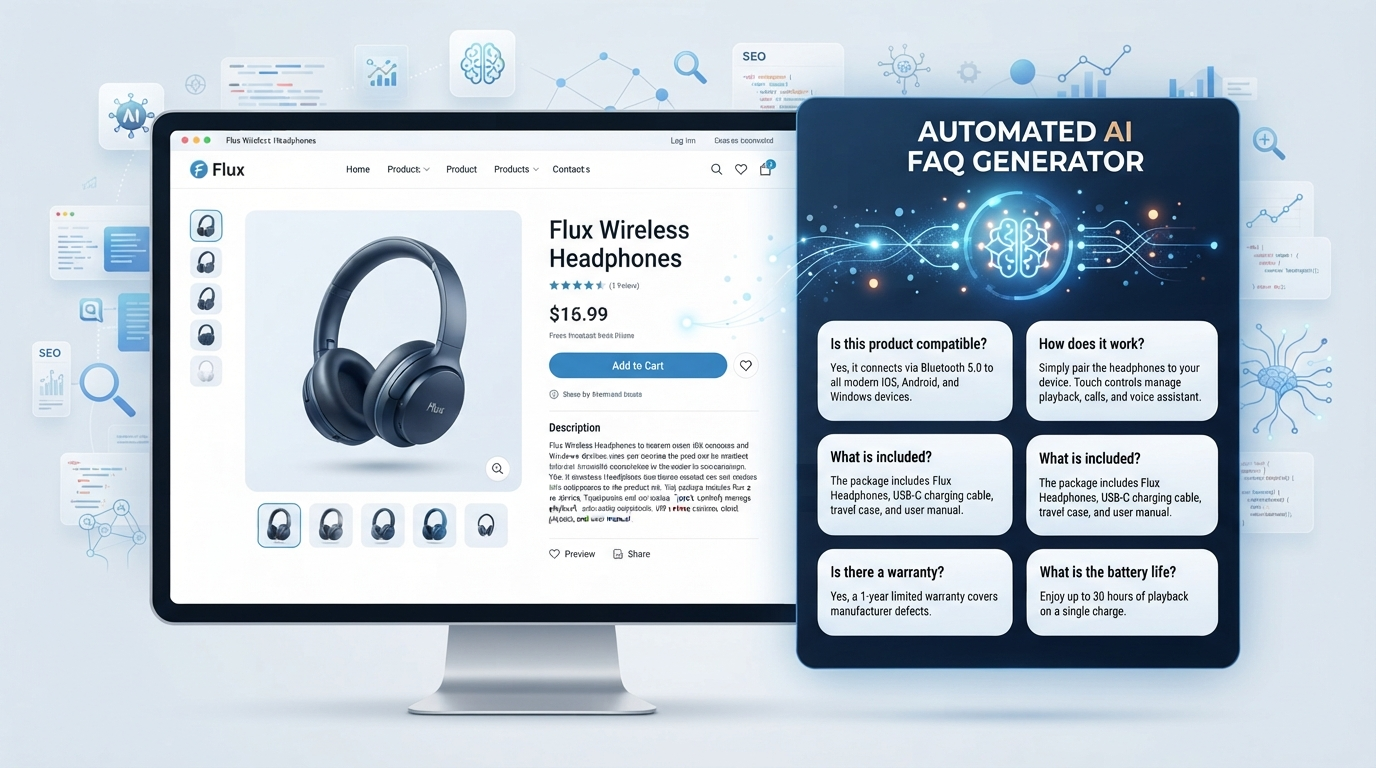
AI FAQ Generator for Ecommerce: Create Better Product FAQs in 2026
Ecommerce shoppers often have the same questions before buying: Does it fit? How does it work? Is it compatible? What is included? Can I return it? An AI FAQ generator for ecommerce can turn product information into clear, useful questions and answers in minutes. Instead of writing every FAQ manually, ecommerce teams can use AI to identify common customer questions, create draft answers, and organize them into product-specific FAQs.
But AI-generated FAQs should not simply be published without review. The best results come from combining AI-generated drafts with accurate product information and human editing.
This guide explains how an AI FAQ generator works, what types of questions it can create, how to optimize AI-generated FAQs for SEO, and how ecommerce businesses can use FAQs for AEO and GEO in 2026.
Table of Contents
- What Is an AI FAQ Generator for Ecommerce?
- How Does an AI FAQ Generator Work?
- Why Ecommerce Stores Need Better Product FAQs
- What Questions Can AI FAQ Tools Generate?
- Benefits of Automated Ecommerce FAQ Creation
- AI FAQ Generator vs Manual FAQ Creation
- How to Create Product FAQs With AI
- How to Optimize AI-Generated FAQs for SEO
- Using AI FAQs for AEO and GEO
- Common Mistakes to Avoid
- How to Automate Ecommerce FAQ Creation
- Real-World Product FAQ Example
- Who Should Use an AI FAQ Generator?
- Frequently Asked Questions
- Final Takeaway
What Is an AI FAQ Generator for Ecommerce?
Quick Answer
An AI FAQ generator for ecommerce is an AI-powered tool that creates frequently asked questions and answers from product information, customer queries, reviews, specifications, and other ecommerce data.
Instead of starting with a blank page, store owners can provide product details and let AI generate relevant questions such as:
- Is this product compatible with my device?
- What sizes are available?
- How long does delivery take?
- Is this product suitable for beginners?
- What materials is it made from?
- Does it come with a warranty?
- How should I use or maintain it?
The generated FAQs can then be reviewed, edited, and added to product pages, category pages, help centers, or knowledge bases.
What Does an Ecommerce FAQ Generator Do?
An AI FAQ tool can help ecommerce businesses:
- Generate product-specific questions
- Create concise answers
- Identify common customer concerns
- Convert product specifications into customer-friendly explanations
- Organize questions into FAQ sections
- Generate variations of similar customer questions
- Support large product catalogs
- Reduce repetitive manual writing
The quality of the output depends heavily on the information provided to the AI. Detailed and accurate product data generally produces more useful FAQ drafts.
For a deeper look at every tool covering copywriting, taglines, and catalog content, check out our full guide to AI Product Content Tools.
How Does an AI FAQ Generator Work?
Quick Answer
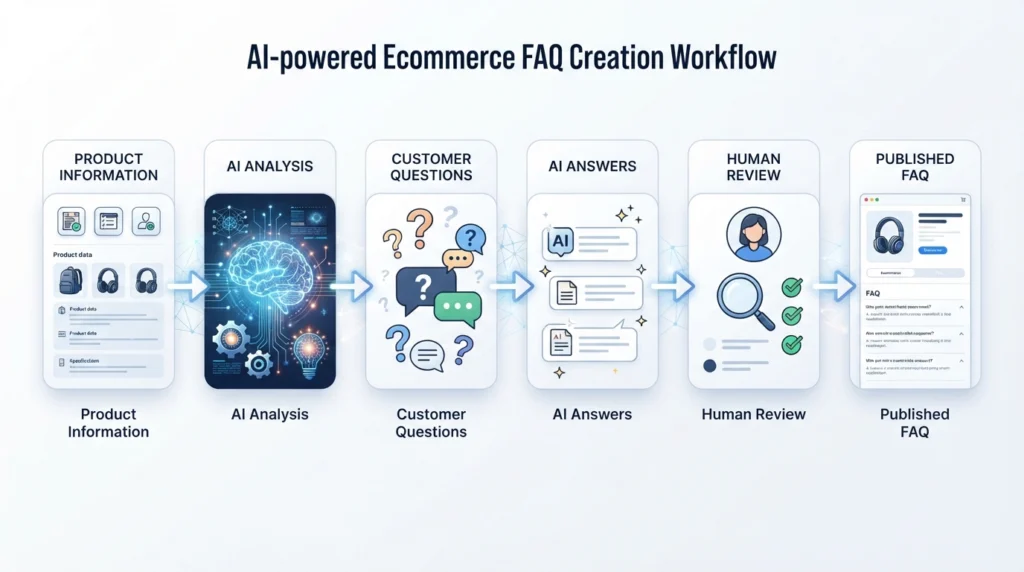
Most AI FAQ generators follow a simple process: input product information → identify likely questions → generate answers → review → publish.
A typical workflow looks like this:
1. Add product information
Provide information such as:
- Product name
- Features
- Specifications
- Materials
- Dimensions
- Compatibility
- Pricing information
- Warranty details
- Shipping information
- Return policy
2. AI analyzes the information.
The AI identifies important product attributes and potential customer concerns.
3. Questions are generated.
The tool creates questions based on the available information and likely shopping intent.
4. Answers are drafted.
AI turns the available information into short, conversational answers.
5. Human review
A person checks the answers for accuracy, clarity, missing information, and brand tone.
6. Publish
Approved FAQs can be added to product pages, support pages, or other relevant sections of the ecommerce website.
Why Ecommerce Stores Need Better Product FAQs
Quick Answer
Product FAQs can help shoppers understand important details before purchasing. Clear answers may reduce uncertainty and make product information easier to find.
Customers often leave product pages because they cannot quickly find an answer to a basic question.
For example, a shopper may want to know:
“Will this charger work with my phone?”
If that information is difficult to find, the shopper may search elsewhere or contact customer support.
A well-structured FAQ section can place that information directly on the product page.
FAQs Can Address Pre-Purchase Questions
Useful FAQs can cover areas such as:
- Compatibility
- Size and dimensions
- Materials
- Shipping
- Returns
- Warranty
- Installation
- Usage
- Maintenance
- Product limitations
The goal is not to add as many questions as possible. The goal is to answer the questions that are genuinely useful to customers.
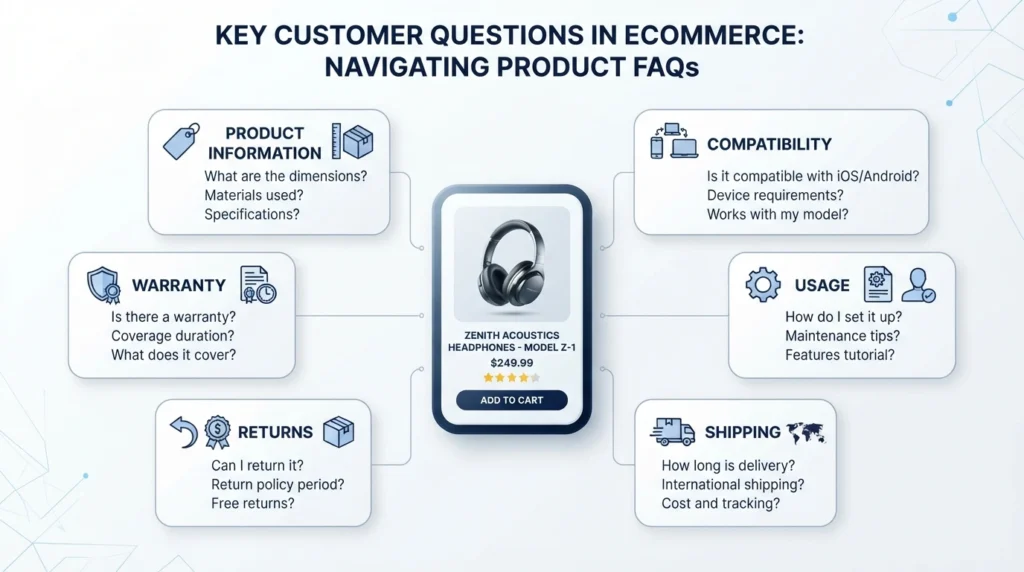
What Questions Can AI FAQ Tools Generate?
Quick Answer
AI FAQ tools can generate different types of ecommerce questions based on product information and customer intent.
Product Information Questions
These focus on basic product details.
Examples:
- What are the product dimensions?
- What materials are used?
- What colors are available?
- What is included in the package?
Compatibility Questions
These are especially useful for electronics, accessories, software, and replacement parts.
Examples:
- Is this compatible with Android devices?
- Does this work with Windows?
- Which models are supported?
- Is additional software required?
Usage Questions
These explain how customers can use the product.
Examples:
- How do I use this product?
- Is it suitable for beginners?
- How should I clean it?
- How often should it be maintained?
Shipping and Delivery Questions
Examples:
- How long does shipping take?
- Do you offer international delivery?
- Can I track my order?
- What shipping options are available?
Return and Warranty Questions
Examples:
- What is the return policy?
- Does the product include a warranty?
- How can I request a replacement?
- What happens if the product arrives damaged?
Pre-Purchase Questions
These address concerns that can influence a customer’s purchase decision.
Examples:
- Is this suitable for everyday use?
- What makes this product different?
- Who is this product designed for?
- What are the main features?
Benefits of Automated Ecommerce FAQ Creation
Quick Answer
Automating FAQ creation can save time, especially for ecommerce stores with many products. AI can generate initial drafts quickly, while humans can focus on reviewing and improving the final content.
1. Faster Content Creation
Creating FAQs manually for hundreds or thousands of products can take considerable time.
AI can create initial FAQ drafts much faster.
2. Product-Specific Questions
Instead of using the same generic questions across every product, AI can generate questions based on individual product information.
3. Consistent Formatting
An AI workflow can help maintain a consistent structure across product pages.
4. Better Customer Support Content
Frequently asked customer questions can be turned into useful FAQ content for both shoppers and support teams.
5. Scalable Ecommerce Content
Large stores can use automated workflows to create FAQ drafts across product catalogs.
However, automation should include human review to reduce inaccurate or incomplete information.
AI FAQ Generator vs Manual FAQ Creation
Quick Answer
AI and manual FAQ creation can serve different purposes. AI is useful for generating drafts quickly, while manual review helps ensure the final answers are accurate and relevant.
| Factor | AI FAQ Generator | Manual FAQ Creation |
|---|---|---|
| Speed | Fast | Slower |
| Scalability | High | Limited |
| Initial research | AI-assisted | Manual |
| Product customization | High with good input | High |
| Human judgment | Requires review | Built in |
| Consistency | High | Depends on the writer |
| Best use | Large-scale drafting | Accuracy and final editing |
A practical approach is to combine both—AI can draft the FAQs quickly, while a human reviews, verifies, and polishes the final answers.
How to Create Product FAQs With AI
Quick Answer
You can create useful product FAQs by giving an AI tool detailed product information and clear instructions about the type of questions and answers you need.
Step 1: Collect Product Information
Gather:
- Product title
- Product description
- Specifications
- Features
- Compatibility information
- Warranty details
- Shipping information
- Return policy
- Customer questions
- Customer reviews
Step 2: Identify Customer Intent
Think about what shoppers are likely to ask before purchasing.
For example:
Product: Wireless Bluetooth Speaker
Possible questions:
- How long does the battery last?
- Is it waterproof?
- Does it support Bluetooth?
- Can I use it for phone calls?
- How long does charging take?
Step 3: Generate the FAQ Draft
Give the AI tool the product information and ask it to create relevant questions and concise answers.
Step 4: Verify Every Answer
This step is important.
Check:
- Specifications
- Compatibility
- Warranty information
- Shipping information
- Return policies
- Pricing-related information
- Product limitations
Do not publish an AI-generated answer if you cannot verify it.
Step 5: Edit for Human Readers
Remove unnecessary wording and make the answers sound natural.
Instead of:
“This product is designed to provide users with an efficient and convenient solution for their daily requirements.”
Use:
“Yes. It is designed for everyday use and is easy to set up.”
Clear answers are generally easier for shoppers to understand.
Step 6: Publish and Monitor
Add the FAQs to the appropriate product page or help section.
Then monitor:
- Customer questions
- Search queries
- Product feedback
- Support tickets
- FAQ engagement
Update the FAQ when product information changes.
How to Optimize AI-Generated FAQs for SEO
Quick Answer
SEO-friendly FAQs should answer real customer questions naturally without repeating the same keyword unnecessarily.
Instead of forcing the exact phrase “AI FAQ Generator for Ecommerce” into every heading or question, use natural variations and related terms. Google Search Central SEO Starter Guide
Useful semantic phrases include:
- AI FAQ generator
- ecommerce FAQ generator
- AI FAQ tool
- product FAQ generator
- AI-generated FAQs
- ecommerce FAQ automation
- product question generator
- automated FAQ creation
- AI product FAQ
- ecommerce product questions
Use Question-Based Headings
Examples:
- What Is an AI FAQ Generator?
- How Can AI Create Product FAQs?
- What Questions Should Ecommerce FAQs Answer?
- How Do AI-Generated FAQs Support SEO?
Keep Answers Concise
FAQ answers should generally get to the point quickly.
For example:
Question: Does this product support Bluetooth?
Answer: Yes. It supports Bluetooth connectivity with compatible devices.
Avoid turning every FAQ into a long article.
Match Search Intent
The question should match what shoppers actually want to know.
For example:
Instead of:
What are the technological characteristics of this product?
Use:
Does this product work with iPhone devices?
The second question reflects a more natural customer search. Google’s link best practices
Using AI FAQs for AEO and GEO
Quick Answer
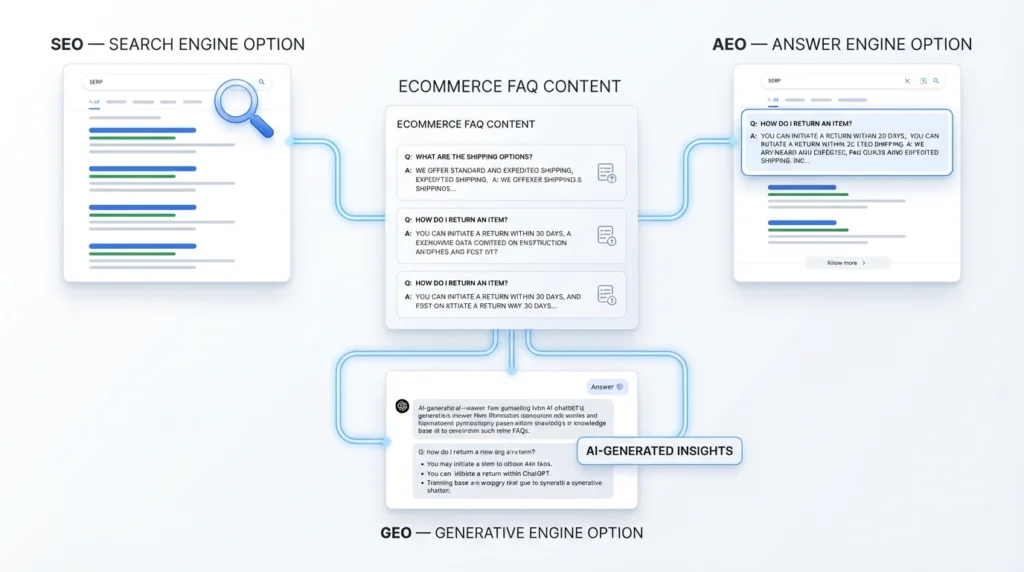
Well-structured FAQs can make important information easier for search engines and AI systems to identify, understand, and potentially use when answering user questions.
What Is AEO?
Answer Engine Optimization (AEO) focuses on making content useful for systems that provide direct answers to user questions.
FAQ content naturally fits this format because it uses:
Question → Direct Answer
For example:
Question: Does this wireless speaker support Bluetooth?
Answer: Yes. It supports Bluetooth connectivity with compatible devices.
What Is GEO?
Generative Engine Optimization (GEO) focuses on improving content visibility and usefulness within generative AI search experiences.
Clear, factual, well-structured answers can help AI systems understand the relationship between a question and its answer.
Tips for AEO and GEO-Friendly FAQs
Use:
- Clear questions
- Direct answers
- Specific product information
- Natural language
- Relevant entities and terminology
- Consistent product details
- Helpful supporting context
Avoid:
- Keyword stuffing
- Repetitive questions
- Unsupported claims
- Vague answers
- Automatically publishing unverified AI content
Common Mistakes to Avoid
Quick Answer
AI can speed up FAQ creation, but poor inputs and missing human review can create inaccurate, repetitive, or unhelpful content.
1. Publishing AI Content Without Review
AI can misunderstand product specifications or generate unsupported information.
Always verify important details.
2. Repeating the Same Keyword
Using the exact keyphrase in every heading and question can make content feel unnatural.
Use related terms and natural language instead.
3. Creating Generic FAQs
A generic FAQ that could apply to any product provides limited value.
Make questions specific to the actual product.
4. Writing Extremely Long Answers
Customers usually want quick answers from FAQ sections.
Keep answers concise unless additional explanation is genuinely useful.
5. Ignoring Customer Questions
Your existing customer support data can provide valuable FAQ ideas.
Review:
- Emails
- Live chat
- Support tickets
- Product reviews
- Search queries
These sources can reveal questions that AI may not identify from product specifications alone.
6. Failing to Update FAQs
Product specifications, policies, compatibility, and shipping information can change.
Review FAQ content whenever important product information changes.
How to Automate Ecommerce FAQ Creation
Quick Answer
Ecommerce businesses can build an FAQ workflow that combines product data, AI generation, human review, and publishing.
A basic workflow can look like this:
Product Data → AI FAQ Generation → Human Review → SEO Optimization → Publishing → Monitoring
For Small Stores
A simple workflow may be enough:
- Select a product.
- Copy the product information into an AI tool.
- Generate 5–10 relevant questions.
- Verify the answers.
- Add them to the product page.
For Larger Stores
Larger ecommerce websites may use:
- Product databases
- CMS integrations
- AI APIs
- Automation platforms
- Structured content templates
- Human approval workflows
The exact setup depends on the store’s platform and technical infrastructure.
Human Review Should Remain Part of the Workflow
Automation can improve speed, but human review remains important for:
- Accuracy
- Brand voice
- Product claims
- Compliance
- Customer clarity
- Outdated information
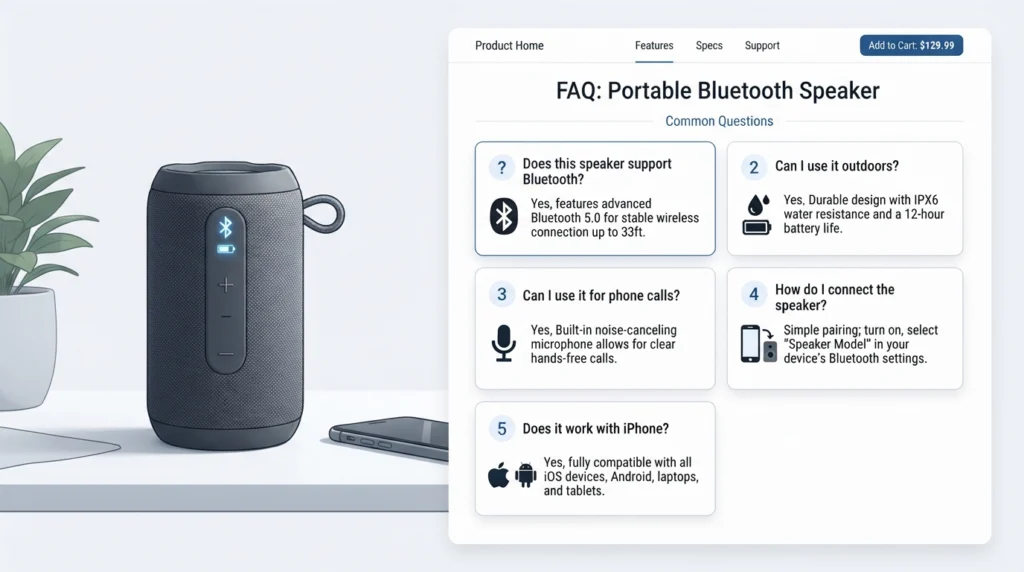
Real-World Product FAQ Example
Quick Answer
Consider a wireless Bluetooth speaker.
Instead of manually creating generic FAQs, an AI tool can turn the product specifications into customer-focused questions.
Product Information
Product: Portable Bluetooth Speaker
Features:
- Bluetooth connectivity
- Portable design
- Rechargeable battery
- Water-resistant construction
- Built-in microphone
Generated FAQ Examples
Q: Does this speaker support Bluetooth?
Yes. It supports Bluetooth connectivity with compatible devices.
Q: Can I use the speaker outdoors?
Yes, the speaker is designed for portable use. Its water-resistant construction can provide additional protection in suitable outdoor conditions.
Q: Can I use it for phone calls?
Yes, the built-in microphone allows compatible devices to use the speaker for calls.
Q: How do I connect the speaker?
Turn on Bluetooth on your compatible device, activate pairing mode on the speaker, and select the speaker from the available Bluetooth devices.
Q: Does it work with iPhone?
Yes—it connects to compatible Bluetooth-enabled devices, including compatible iPhone models.
This example shows how product specifications can be transformed into practical customer questions.
Who Should Use an AI FAQ Generator?
Quick Answer
AI FAQ generators can be useful for ecommerce businesses that manage multiple products or frequently answer similar customer questions.
They may be useful for:
- Online stores
- Shopify stores
- WooCommerce stores
- Amazon sellers
- Marketplace sellers
- SaaS companies
- Product manufacturers
- Digital product businesses
- Ecommerce agencies
- SEO teams
- Content teams
The biggest benefit is often scalability: businesses can create FAQ drafts for many products without starting from scratch each time.
Frequently Asked Questions
What is an AI FAQ generator for ecommerce?
An AI FAQ generator for ecommerce creates questions and answers from product information, customer queries, reviews, specifications, and other relevant data.
Can AI generate FAQs for product pages?
Yes. AI can generate product-specific questions and draft answers when provided with accurate product information.
Are AI-generated FAQs good for SEO?
AI-generated FAQs can support SEO when they are accurate, useful, naturally written, and aligned with real customer search intent. The content should be reviewed rather than published blindly.
Should I use the exact keyword in every FAQ?
No. Natural variation usually creates a more readable FAQ than repeating the exact same phrase in every question.
Can AI FAQs help with AEO?
Yes. Question-and-answer content can provide clear information in a format that is useful for answer-focused search experiences.
Can AI FAQ generators work with large ecommerce catalogs?
Yes. AI can help create FAQ drafts at scale, although larger catalogs usually benefit from structured workflows, product data integration, and human review.
Should AI-generated FAQs be reviewed by a human?
Yes. Human review helps verify product specifications, compatibility, policies, claims, and overall accuracy.
How many FAQs should a product page have?
There is no universal number. Focus on answering the most useful customer questions rather than reaching a specific FAQ count.
Final Takeaway
An AI FAQ generator for ecommerce can make FAQ creation faster and more scalable by turning product information into customer-focused questions and answers.
The strongest workflow is not simply
AI → Publish
Instead, use:
Product Information → AI Draft → Human Review → SEO/AEO Optimization → Publish → Update
AI provides speed and scalability, while human review helps maintain accuracy, usefulness, and a natural customer experience.
For ecommerce businesses in 2026, well-structured product FAQs can become a useful part of product content, customer support, SEO, AEO, and GEO strategies.
For related reading, see our guides on AI Product Content Tools in 2026: The Complete Guide & Best AI Product Description. Generator Tools and Free AI Product Description Generator Tools in 2026: 10 Free Tools & AI Product Title Generator Tools in 2026: 10 Best Tools for E-Commerce & AI Product Bullet Point Generator & AI Meta Description Generator for Ecommerce & AI Copywriting Tools for Ecommerce: 15+ Best Tool