
AI tools for small ecommerce businesses: Best Tools in 2026
Table of Contents
- What Are AI Tools for Small Ecommerce Businesses?
- Why Small Ecommerce Businesses Need AI in 2026
- Where AI Can Help a Small Ecommerce Store
- Best AI Tools for Small Ecommerce Businesses
- 15 Best AI Tools for Small Ecommerce Businesses in 2026
- AI Tools for Product Research
- AI Tools for Product Descriptions and Ecommerce Content
- AI Tools for Product Images
- AI Tools for Ecommerce SEO
- AI Tools for Marketing and Social Media
- AI Tools for Customer Support
- AI Tools for Email Marketing
- AI Tools for Analytics and Conversion Optimization
- AI Tools for Ecommerce Automation
- How to Choose AI Tools on a Small Business Budget
- A $0 AI Stack for a New Ecommerce Store
- A Low-Budget AI Stack for a Growing Store
- How to Calculate AI Tool ROI
- Common AI Mistakes Small Ecommerce Businesses Should Avoid
- A Practical AI Workflow for a One-Person Ecommerce Business
- 30-Day AI Implementation Plan
- Frequently Asked Questions
- Key Takeaways
- Final Recommendation
What Are AI Tools for Small Ecommerce Businesses?
AI tools for small ecommerce businesses are software solutions that help store owners handle repetitive work such as product research, content creation, SEO, marketing, customer support, analytics, and automation. They are particularly useful for solo founders and small teams that need to accomplish more without adding a large number of employees.
Running a small ecommerce store can feel like having five jobs at once.
One day you’re writing product descriptions. The next morning you’re answering customer questions, checking sales, creating social media posts, researching competitors, and trying to figure out why a product page isn’t getting traffic.
A large ecommerce company can divide those responsibilities among different departments. A small business usually can’t.
That’s where AI becomes practical.
The purpose isn’t to let AI run the entire store. Instead, it can take care of parts of the workload so the owner has more time for decisions that actually require human judgment.
For example, AI can help you:
- Research products and competitors
- Turn product specifications into content drafts
- Generate SEO ideas
- Create social media variations
- Organize customer questions
- Analyze business data
- Draft email campaigns
- Create supporting visual assets
- Connect repetitive workflows
AI works best as a productivity assistant, not a replacement for business judgment. That distinction matters.
A good AI workflow still has a person checking the final result.
Why Small Ecommerce Businesses Need AI in 2026
For a small ecommerce business, AI is most valuable when time, staff, and budget are limited. It can reduce repetitive work, speed up content production, support marketing, and help owners understand their data. The goal isn’t to use more AI; it’s to use AI where it creates measurable business value.
A small store has a simple problem: there are usually more tasks than hours in the day.
Consider a store with 50 products.
The owner may need to create product descriptions, update images, manage social media, answer customer questions, monitor competitors, write blog content, review sales, and send promotional emails.
Those are all reasonable tasks individually. Together, they can consume an enormous amount of time.
AI can reduce some of that workload.
But there’s an important difference between saving time and creating value.
If an AI tool lets you generate 100 social posts but none of them produces traffic or sales, you’ve increased output — not necessarily business performance.
A better question is:
What task is slowing my business down, and can AI improve it without reducing quality?
That’s the mindset small ecommerce owners should take into 2026.
When AI Is Most Useful
AI tends to work best when a task is:
- Repetitive
- Time-consuming
- Based on a predictable process
- Easy for a human to review
- Connected to a measurable outcome
Examples include drafting product descriptions, summarizing reviews, generating content ideas, organizing FAQs, and creating first drafts of email campaigns.
Tasks involving sensitive customer situations, major financial decisions, legal issues, or important product claims deserve much closer human supervision.
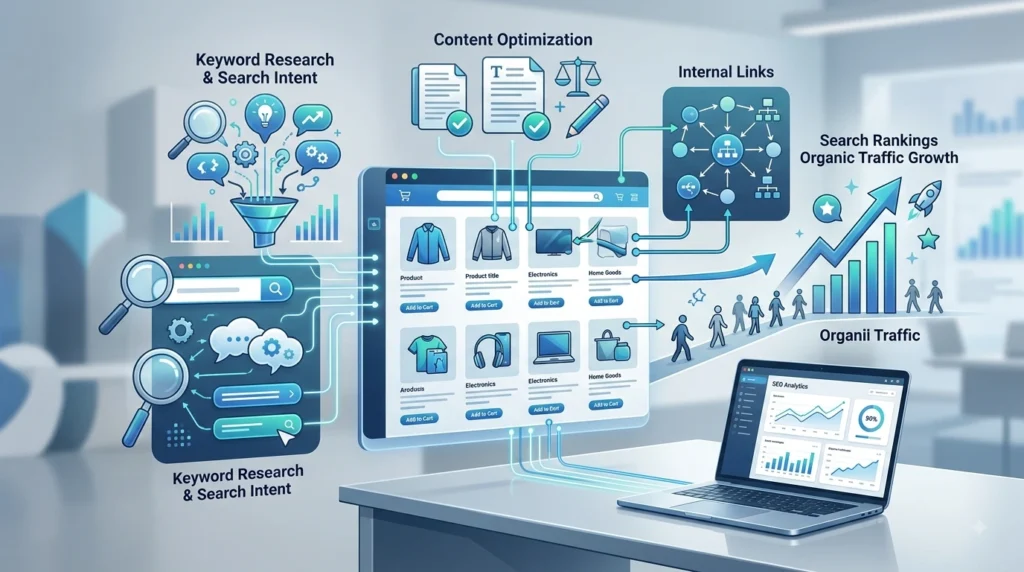
Where AI Can Help a Small Ecommerce Store
The strongest AI opportunities for a small online store are usually product research, content, SEO, marketing, customer support, email, analytics, and workflow automation. Start with one area that consumes significant time rather than buying several tools at once.
Before choosing software, identify the actual problem.
| Store Problem | AI Solution | Possible Benefit |
| Product research takes too long | AI research assistant | Faster analysis |
| Product pages are weak | AI writing support | Better drafts |
| Organic traffic is low | AI SEO tools | Better topic planning |
| Visual content is expensive | AI image tools | More creative options |
| Customer questions repeat | AI support | Less manual work |
| Marketing is inconsistent | AI marketing tools | Faster content production |
| Customers don’t return | AI email tools | Better retention campaigns |
| Reports are difficult to understand | AI analytics | Faster insights |
| Too many manual steps | Automation tools | More efficient workflows |
The best starting point is usually the biggest bottleneck, not the most popular AI tool.
Best AI Tools for Small Ecommerce Businesses
There is no single best AI tool for every small ecommerce business. The right choice depends on the store’s platform, budget, traffic, product range, and biggest operational problem. A new store may need only a general AI assistant and basic analytics, while a growing store may benefit from specialized SEO, email, support, and automation tools.
Instead of asking:
“What is the best AI tool?”
Ask:
“What is the most expensive or time-consuming problem in my store right now?”
That question leads to a much better tool-selection process.
If you’re new to AI-powered ecommerce, start with our AI Ecommerce Tool 2026: Complete Guide. It provides a broader overview of AI tools, strategies, and workflows that can help online stores choose the right technology for their business.
15 Best AI Tools for Small Ecommerce Businesses in 2026
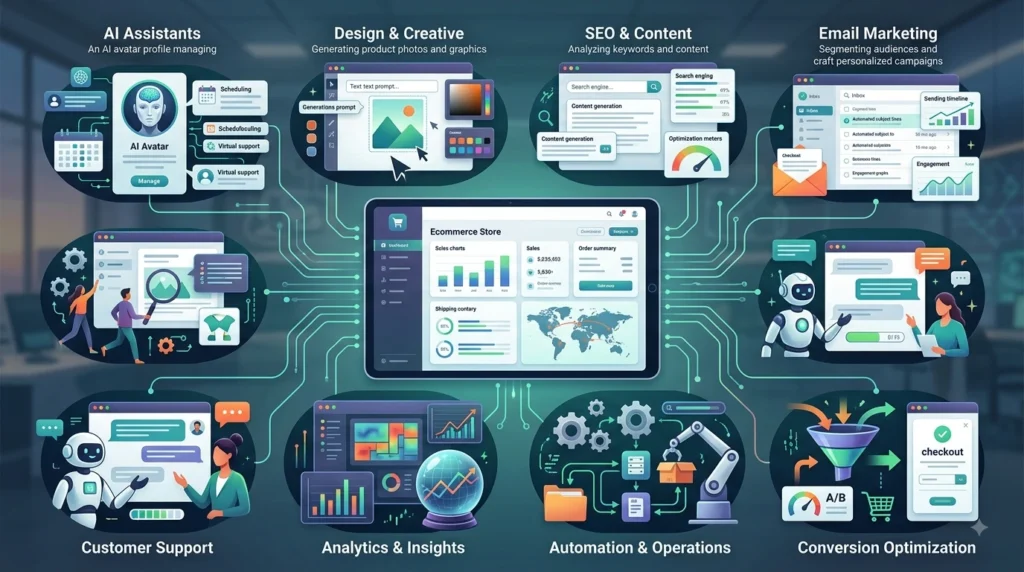
If you’re running a small ecommerce store, you don’t need dozens of AI subscriptions. The best approach is to choose tools based on the tasks that take the most time or have the biggest impact on sales, marketing, customer experience, and operations.
Here are 15 AI-powered tools worth considering in 2026, organized around common ecommerce needs.
| Tool | Best For | Why Small Stores May Use It |
|---|---|---|
| ChatGPT | Research and content | Helps with product research, content drafts, FAQs, ideas, and everyday business tasks |
| Canva | Visual content | Makes product graphics, social posts, banners, and marketing assets easier to create |
| Shopify Magic | Shopify store content | Helps Shopify merchants create and improve store content using built-in AI features |
| Jasper | Marketing content | Useful for creating and adapting marketing copy across different channels |
| Semrush | SEO and competitor research | Helps research keywords, competitors, content opportunities, and search performance |
| Surfer | Content optimization | Helps optimize content around search intent and related topics |
| Klaviyo | Email marketing | Supports ecommerce email campaigns, segmentation, personalization, and retention |
| Tidio | Customer support | Combines customer messaging with AI-assisted support for common questions |
| Hotjar | Customer behavior | Helps stores understand how visitors interact with pages and identify potential conversion problems |
| Microsoft Clarity | Website behavior analytics | Provides session recordings and behavioral insights to help identify user experience issues |
| Zapier | Workflow automation | Connects different apps and automates repetitive ecommerce tasks |
| Make | Advanced automation | Helps build more flexible multi-step workflows between ecommerce and business applications |
| Adobe Firefly | AI creative work | Helps create and edit supporting visual assets for marketing and campaigns |
| Copy.ai | Marketing workflows | Supports content creation and repeatable marketing workflows |
| VWO | Conversion optimization | Helps businesses test and improve website experiences and conversion performance |
How to choose from these tools
You don’t need all 15.
A new store may only need a general AI assistant, a design tool, analytics, and the AI features already included in its ecommerce platform.
A store struggling with organic traffic may benefit more from an SEO platform. A store with a growing customer list may get more value from email automation. If customer questions are consuming several hours each week, an AI support solution may be the better investment.
The right tool is the one that solves a real problem in your current workflow.
Best starting points by task
- Product research and general business tasks: ChatGPT
- Product graphics and social visuals: Canva
- Shopify content: Shopify Magic
- Marketing copy: Jasper or Copy.ai
- SEO research: Semrush
- Content optimization: Surfer
- Email marketing and retention: Klaviyo
- Customer support: Tidio
- Visitor behavior: Hotjar or Microsoft Clarity
- Workflow automation: Zapier or Make
- AI-generated creative assets: Adobe Firefly
- Conversion testing: VWO
Features, plans, pricing, and AI capabilities can change over time, so check the provider’s current offering before choosing a paid subscription.
The goal isn’t to collect the most AI tools. It’s to build a small, reliable stack that makes your ecommerce business easier to operate and more effective.
Match the tool to the business stage
New store
Focus on free or built-in tools.
Growing store
Add specialized tools when there’s enough activity to justify them.
Established small business
Consider automation, advanced analytics, customer segmentation, and more sophisticated workflows.
The tool stack should grow with the business, not ahead of it.
AI Tools for Product Research
AI can help small ecommerce owners analyze competitors, customer reviews, product features, pricing, complaints, and market opportunities. It should support product validation rather than make the final decision. Demand, margins, supplier quality, shipping costs, and customer feedback still need real-world evaluation.
Product research is one area where AI can save a small business owner a lot of manual work.
Suppose you’re considering selling reusable water bottles.
Instead of asking an AI tool:
“What is the next winning ecommerce product?”
give it actual research material.
You could provide customer reviews and ask it to identify:
- Common complaints
- Features customers appreciate
- Missing features
- Buying objections
- Frequently mentioned problems
- Opportunities for differentiation
That produces much more useful information than a generic list of “trending products.”
The same approach can be used with competitor listings and customer feedback — this kind of review analysis turns raw opinions into a clear list of product gaps and opportunities.
Before buying inventory, check:
- Demand
- Competition
- Product cost
- Selling price
- Shipping cost
- Expected margin
- Return risk
- Supplier reliability
- Customer complaints
- Differentiation opportunities
AI can help organize the research.
It cannot guarantee that a product will sell.
AI Tools for Product Descriptions and Ecommerce Content
AI can help small stores create first drafts of product descriptions, FAQs, category content, buying guides, blog posts, email copy, and social content. The best results come when the owner provides accurate product information and then edits the AI draft for accuracy, brand voice, and customer relevance.
Product descriptions are a particularly good starting point for AI because the process is repetitive.
Imagine adding 30 new products to your store.
Writing the first draft for every product manually can take days.
AI can turn structured product information into a useful starting draft.
Give it:
- Product specifications
- Main benefits
- Target customer
- Materials
- Dimensions
- Use cases
- Warranty information
- Shipping details
- Brand tone
Then review the result.
Don’t let AI invent product information
This is one of the most important rules.
If your product doesn’t have a feature, AI shouldn’t add it just because the feature sounds persuasive.
For ecommerce, accuracy matters more than impressive wording.
A strong product page should answer the questions a real customer is likely to ask:
- Who is this product for?
- What problem does it solve?
- What makes it different?
- What are the dimensions?
- How should it be used?
- What is included?
- How long does shipping take?
- What is the return policy?
That kind of practical information also gives your content more value than generic AI-generated copy.
AI Tools for Product Images
AI image tools can help small ecommerce businesses create supporting visuals, lifestyle scenes, backgrounds, promotional graphics, and campaign variations. They can reduce the need for a new photoshoot for every marketing asset, but the final image should accurately represent the real product.
Professional photography can become expensive when every campaign requires new visuals.
AI can help with supporting creative work such as:
- Background removal
- Lifestyle scenes
- Promotional banners
- Seasonal graphics
- Social media images
- Blog illustrations
- Campaign variations
However, don’t allow an AI-generated image to change the actual product.
If the real product is blue, the image shouldn’t make it look purple.
If a product has three compartments, don’t let AI create five.
For ecommerce, visual accuracy is part of customer trust.
Use AI to improve presentation — not to misrepresent the product.
AI Tools for Ecommerce SEO
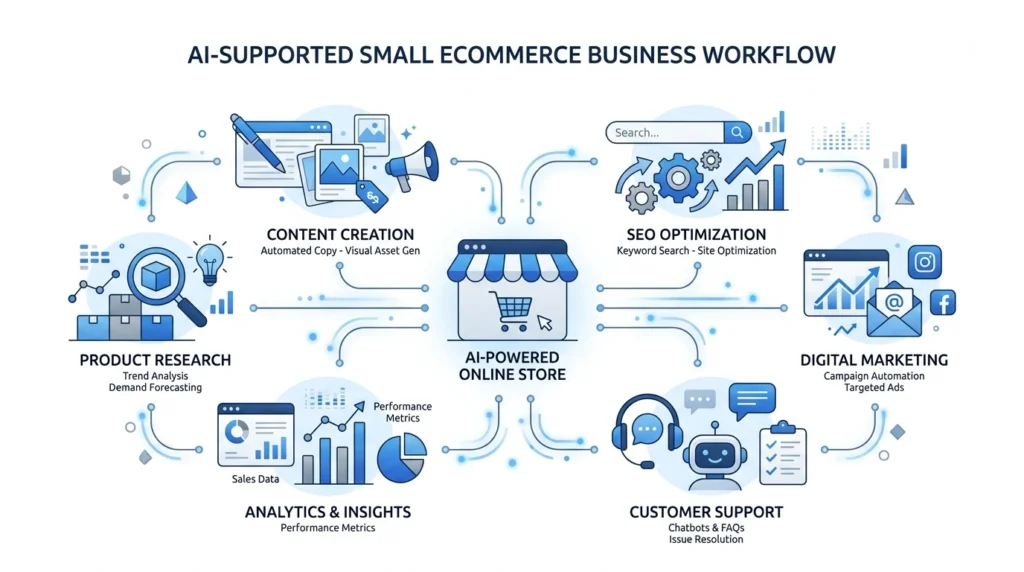
Quick answer: AI SEO tools can help small ecommerce businesses research keywords, group related topics, create content briefs, improve product pages, identify internal-link opportunities, and analyze competing content. AI should support SEO strategy rather than replace search-intent analysis, technical optimization, original information, or human editing.
SEO can be difficult for a small ecommerce business because there may be no dedicated SEO specialist.
AI can simplify some of the research and planning.
Useful AI SEO tasks
You can use AI to help with:
- Keyword clustering
- Search-intent analysis
- Content outlines
- Product-page ideas
- FAQ generation
- Internal-link suggestions
- Content gap analysis
- Meta title drafts
- Meta description drafts
But don’t create hundreds of pages just because AI makes content production easy.
Search engines and customers both benefit from useful content — not content volume for its own sake.
Use topic clusters
For example, instead of targeting only “running shoes,” you could build related content around:
- Best running shoes for beginners
- Running shoes for daily training
- Trail vs. road running shoes
- How to choose running shoes
- Running shoe sizing guide
- Running shoes for different use cases
Then connect those pages through contextual internal links.
That gives your site a clearer topical structure.
AI Tools for Marketing and Social Media
AI can help small ecommerce businesses plan campaigns, create captions, generate content variations, write ad drafts, build content calendars, and repurpose one idea across multiple channels. It works best when the prompt includes the target customer, product benefit, offer, brand voice, and campaign objective.
Small businesses often struggle with consistency.
You may have a good product but no time to create fresh marketing content every day.
AI can help turn one campaign idea into multiple assets. For example, one product launch can become:
- Social post
- Blog section
- Pinterest description
- Short video script
- Promotional banner
- FAQ
- Ad variations
This doesn’t mean publishing everything everywhere automatically.
It means you can create a content system instead of starting from a blank page every morning.
Give AI enough context
Instead of:
“Write a Facebook post.”
Try:
“Write a Facebook post for budget-conscious first-time buyers. Explain the product’s main benefit, avoid exaggerated claims, use a helpful tone, and finish with a simple CTA.”
The second prompt gives AI a real job to perform.
AI Tools for Customer Support
AI customer-support tools can handle repetitive questions about shipping, returns, products, orders, and store policies when reliable information is available. Complex complaints, exceptions, sensitive customers, and high-risk issues should be transferred to a human.
Customer support is one of the easiest places to identify repetitive work.
A store may receive the same questions every day:
- Where is my order?
- How long does shipping take?
- Can I return this?
- What size should I choose?
- Is this product compatible?
- How should I use it?
- Is this item available?
If the answers are already documented, AI can help customers find them quickly.
Use this simple rule
High volume + predictable + low risk = good automation candidate
Complex + sensitive + high risk = human review
This escalation rule is worth keeping in mind — it makes AI support genuinely practical instead of a blanket “AI can automate customer service” claim.
AI Tools for Email Marketing
AI can help small ecommerce stores create welcome emails, abandoned-cart campaigns, post-purchase messages, product recommendations, review requests, and win-back campaigns. The objective should be better customer communication rather than simply sending more emails.
A small store doesn’t necessarily need dozens of email campaigns.
Start with the journeys that matter most.
Useful automated flows
- Welcome email
- Abandoned cart
- Order follow-up
- Review request
- Cross-sell
- Replenishment reminder
- Win-back campaign
AI can help with:
- Subject lines
- Email drafts
- Personalization ideas
- Campaign variations
- Customer segmentation ideas
But the offer, product recommendation, and customer relationship should remain under your control.

AI Tools for Analytics and Conversion Optimization
AI analytics tools can help small ecommerce owners summarize customer behavior and identify possible problems without manually reviewing every report. Focus on business metrics such as conversion rate, average order value, customer acquisition cost, repeat purchases, returns, and profit rather than vanity metrics.
Analytics can be overwhelming when you’re running the rest of the business too.
Instead of staring at dozens of reports, focus on a few important numbers.
| Metric | What It Tells You |
| Conversion Rate | How effectively traffic becomes orders |
| Average Order Value | How much customers spend per order |
| Customer Acquisition Cost | What it costs to acquire customers |
| Repeat Purchase Rate | How well the store retains customers |
| Return Rate | Potential product or expectation problems |
| Gross Margin | Whether sales are actually profitable |
AI can summarize trends, but don’t let a summary replace the underlying data.
If revenue increased but profit fell because advertising and returns increased, that’s a very different situation.
The goal is to connect: Traffic → Orders → Revenue → Profit
AI tools for small ecommerce businesses Automation
Ecommerce automation connects repetitive tasks so small business owners don’t have to manually complete every step. Start with simple workflows such as order notifications, customer tagging, reporting, follow-up emails, and data synchronization before moving to more complicated automation.
Automation becomes powerful when several small tasks need to happen in sequence. For example:
- New order
- Customer record updated
- Order confirmation sent
- Fulfillment process starts
- Post-purchase message sent
- Review request scheduled
- Customer added to appropriate segment
A workflow like this can remove several manual steps.
But don’t automate a process just because automation is available.
First understand the process. Then improve it. Then automate it.
Otherwise, you’re simply making a bad process happen faster.
How to Choose AI Tools on a Small Business Budget
Choose an AI tool based on the problem it solves, the time or money it can save, how well it fits your current workflow, and whether the expected benefit justifies the cost. Free or built-in features should usually be tested before adding another monthly subscription.
Before paying for a new tool, ask:
- What problem does this solve?
- How often does the problem occur?
- How much time will it save?
- Does my current software already do this?
- Will it integrate with my store?
- What happens if it makes a mistake?
- Can I measure the result?
Don’t buy an AI platform because it has an impressive feature list.
A small store may use only five features from a tool with 100 features.
That’s not necessarily a good investment.
A $0 AI Stack for a New Ecommerce Store
A new ecommerce store can start using AI without building an expensive software stack. Begin with free tiers, existing ecommerce features, basic analytics, and simple design tools. The goal is to discover where AI creates real value before committing to multiple subscriptions.
A new store should keep things simple. Start with:
General AI assistant
Use it for research, brainstorming, drafts, FAQs, and planning.
Analytics
Track where visitors come from and what they do.
Basic design tools
Create social graphics, simple promotional assets, and banners.
Built-in ecommerce AI
Before purchasing another tool, check whether your ecommerce platform already provides the feature you need.
The goal isn’t to build the biggest AI stack. It’s to build the smallest useful stack.
A Low-Budget AI Stack for a Growing Store
As a store grows, specialized AI tools become more useful when the business has enough traffic, customers, and repetitive work to justify them. Add SEO, email, customer support, analytics, or automation tools according to actual bottlenecks rather than buying several overlapping subscriptions.
A sensible progression could look like this:
- Stage 1: General AI + analytics
- Stage 2: Email + design
- Stage 3: SEO + customer support
- Stage 4: Automation + advanced analytics
You don’t need to move through every stage.
If SEO is already performing well, for example, another SEO subscription may be unnecessary.
Spend money where the bottleneck is.
How to Calculate AI Tool ROI
AI tool ROI should be measured using business outcomes such as time saved, reduced costs, additional revenue, or improved customer retention. Compare those benefits with the tool’s full cost rather than judging the software by its number of features.
Suppose an AI tool costs $30 per month and saves you 10 hours every month.
If those 10 hours allow you to focus on tasks that generate significantly more value than $30, the tool may be worthwhile.
But also consider:
- Does it increase conversions?
- Does it reduce outsourcing?
- Does it reduce customer-support workload?
- Does it increase repeat purchases?
- Does it improve content production?
- Does it reduce operational errors?
Track before and after
| Time Required | Cost | Output | Error Rate | |
| Before AI | ||||
| After AI |
This gives you something much more useful than an AI tool’s marketing claims: your own business data.
Common AI Mistakes Small Ecommerce Businesses Should Avoid
Small ecommerce businesses often get poor results from AI when they buy too many tools, publish unverified content, automate poorly designed processes, or focus on output instead of business results. A smaller, well-managed AI stack is usually more useful than a large collection of overlapping tools.
Buying too many tools
Ten subscriptions don’t automatically create a better business. Start with one problem.
Publishing raw AI content
AI can produce fluent text that still contains incorrect or generic information. Review every important piece of content.
Automating too early
If your workflow isn’t working manually, automation won’t fix it. Improve the process first.
Ignoring customer data
Your customers already tell you what they want through:
- Reviews
- Support questions
- Search behavior
- Product feedback
- Purchase patterns
Use that information.
Measuring output instead of results
Publishing 50 posts isn’t necessarily better than publishing 10 useful ones.
Measure: traffic, conversions, revenue, profit, retention, and customer satisfaction.
A Practical AI Workflow for a One-Person Ecommerce Business
A solo ecommerce owner can use AI as a virtual assistant for research, content, marketing, support, and reporting. The most reliable workflow separates AI production from human approval: AI handles repetitive work, while the owner remains responsible for strategy, accuracy, customers, and important business decisions.
Imagine you’re running the store alone. A practical workflow could look like this:
Morning: Check the business
Use AI to summarize:
- Sales changes
- Best-selling products
- Low-performing products
- Customer questions
- Traffic changes
Midday: Create content
Use AI to assist with:
- Product updates
- Blog drafts
- Social content
- Email drafts
Afternoon: Handle customers
Let AI assist with predictable FAQs while you handle unusual or sensitive cases.
Evening: Prepare tomorrow’s marketing
Turn one campaign idea into:
- Social content
- Blog content
- Promotional copy
Then review everything before publication.
The core principle is simple: AI prepares. You decide.
That approach is especially useful for a one-person business because it increases capacity without giving up control.
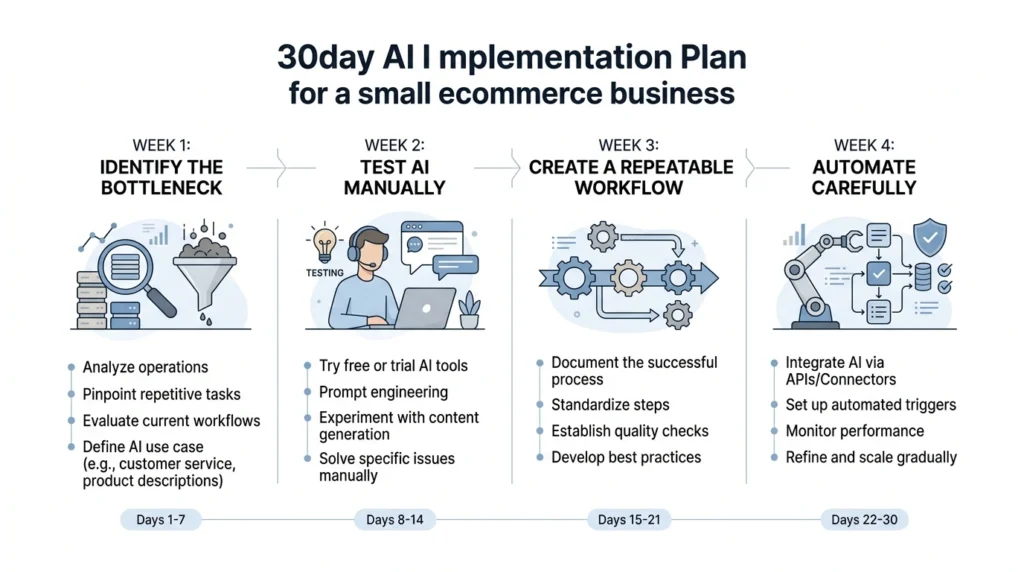
30-Day AI Implementation Plan
A 30-day AI implementation plan helps a small ecommerce business test AI without overspending. Identify one repetitive task, establish a baseline, test AI manually, create a repeatable workflow, measure the outcome, and automate only after the process works consistently.
Week 1: Find the bottleneck
List your recurring tasks. Then identify the three that consume the most time. Choose one. Don’t try to automate everything.
Week 2: Test AI manually
Record:
- Time before AI
- Time after AI
- Quality
- Errors
- Cost
This gives you a baseline.
Week 3: Create a repeatable system
Build:
- Prompt templates
- Brand guidelines
- Quality checklist
- Approval process
Now you’re creating a workflow rather than randomly using AI.
Week 4: Automate carefully
If the workflow is reliable, connect it with your store or marketing tools. Then monitor it.
At the end of the month, ask:
- Did AI save time?
- Did quality improve?
- Did the business benefit?
- Did costs decrease?
- Did customers get a better experience?
If the answer is no, improve the workflow before buying another tool.
Frequently Asked Questions
What are the best AI tools for small ecommerce businesses?
Quick Answer: The best AI tools depend on the store’s biggest bottleneck. General AI assistants can help with research and content, while specialized tools can support SEO, product imagery, customer service, email marketing, analytics, and automation. Start with the problem that has the clearest potential return.
Can a one-person ecommerce business use AI effectively?
Quick Answer: Yes. A solo store owner can use AI for product research, content creation, SEO planning, customer FAQs, marketing, email, analytics, and repetitive administrative tasks. The main benefit is leverage: one person can accomplish more without manually handling every repetitive task.
How much should a small ecommerce business spend on AI?
Quick Answer: There is no universal budget. A new store can start with free tools and built-in platform features. Paid software makes sense when it solves a specific problem and the expected time savings, revenue, or cost reduction justify the subscription.
What is the best free AI tool for ecommerce?
Quick Answer: There isn’t one universal winner. A general AI assistant may be enough for research and content, while ecommerce platforms and other software may provide useful built-in AI features. Choose based on your workflow rather than popularity.
Can AI write product descriptions?
Quick Answer: Yes. AI can create first drafts when you provide accurate product specifications, customer information, benefits, and brand guidelines. Always review the final copy for accuracy, originality, and brand voice before publishing.
Can AI help with ecommerce SEO?
Quick Answer: Yes. AI can assist with keyword research, topic clustering, content briefs, product-page optimization, FAQs, internal-link ideas, and competitor research. Human review remains important for search intent, technical SEO, accuracy, and original information.
Can AI reduce customer-support work?
Quick Answer: Yes. AI can answer predictable questions about shipping, returns, products, and orders when it has access to accurate information. Complex complaints and sensitive cases should be escalated to a human.
Should a new ecommerce store pay for AI tools?
Quick Answer: Not necessarily. Start with free tools and existing platform features. Once you identify a repetitive task that is costing significant time or money, consider a paid solution that directly addresses that problem.
How many AI tools does a small ecommerce business need?
Quick Answer: Most small businesses can start with only a few tools. A general AI assistant, analytics, design support, and existing ecommerce features may be enough initially. Add specialized tools only when they solve a clear problem.
Can AI replace ecommerce employees?
Quick Answer: AI can reduce repetitive workloads, but it shouldn’t automatically be viewed as a replacement for people. Human judgment remains important for strategy, customer relationships, creative decisions, product management, and complex support situations.
What ecommerce tasks should not be fully automated?
Quick Answer: Sensitive or high-risk decisions should retain human oversight. Examples include unusual refunds, legal complaints, safety-related issues, significant financial decisions, sensitive customer situations, and important product claims.
What is the biggest advantage of AI for small ecommerce businesses?
Quick Answer: The biggest advantage is leverage. AI can help a small team complete research, content, marketing, support, and analysis tasks faster, allowing owners to spend more time on products, customers, strategy, and growth.
Key Takeaways
Quick Answer: AI can give small ecommerce businesses more capacity without requiring a large technology budget. Start with one repetitive problem, test a free or existing solution, measure the result, and add specialized tools only when they provide measurable value.
The best AI strategy for a small ecommerce business isn’t:
“Use as much AI as possible.”
It’s:
“Use the right AI for the right problem at the right stage.”
Keep these principles in mind:
- Start with a real business bottleneck.
- Use AI for repetitive work.
- Keep human oversight where accuracy matters.
- Start with free or built-in features.
- Avoid unnecessary subscriptions.
- Use real customer information to improve your output.
- Add original insights to your ecommerce content.
- Measure business results, not AI-generated volume.
- Automate proven workflows.
- Expand your AI stack as the business grows.
AI works best as a force multiplier — not simply a collection of tools.
Building an effective AI stack starts with understanding which tools fit your business goals. For a broader look at AI-powered ecommerce strategies and tools, explore our AI Ecommerce Tool 2026: Complete Guide.
Final Recommendation
If you’re running a small ecommerce business with a limited budget, don’t start by purchasing ten AI subscriptions.
Start with one workflow. For example:
Product research → AI analysis → human validation → product page → SEO → social content → email → analytics
Measure what happens.
If the workflow saves time or improves results, keep refining it. Then move to the next bottleneck.
That’s a much more sustainable approach than constantly adding new software.
The real advantage of AI for a small ecommerce business isn’t having the biggest collection of tools. It’s being able to use a few well-chosen tools to do important work faster, more consistently, and with better information.
Ultimately, the strongest combination is:
AI + product quality + customer understanding + human judgment + useful content + reliable data + consistent execution.
That is what turns AI from another monthly subscription into a practical growth system.
About the Author
AI Ecommerce Tools Editorial Team
- Independent and research-driven reviews
- Practical recommendations based on real use cases
- Regular content updates
- Focus on SEO, AEO, GEO, and E-E-A-T best practices.
- Commitment to accuracy, transparency, and user value
Editorial Note: This article was last reviewed in August 2026. We recommend revisiting this guide periodically, as AI marketing tools and features evolve rapidly.
Disclaimer
This content is provided for educational and informational purposes only. While we strive to keep all information accurate and up to date, AI software features, pricing, integrations, and availability may change over time. Always verify the latest information on the official website before making purchasing or business decisions.
How We Evaluate AI Tools
Every AI tool featured on AI Ecommerce Tools is evaluated using a consistent editorial methodology. We assess products based on:
- Features & capabilities
- Ease of use
- Pricing & overall value
- Integrations
- Customer support
- Security & privacy
- Real-world business use cases
- Performance and reliability
Our goal is to provide objective, research-based recommendations rather than promotional rankings.
Content Update Policy
We review this guide regularly to ensure accuracy. Whenever major AI platforms release new features, pricing updates, or significant improvements, this article is revised accordingly to keep readers informed with the latest information.
Share This Guide
If this guide was helpful, please share it with your colleagues, marketing team, or other business owners. Sharing reliable AI resources helps everyone make smarter choices about using artificial intelligence.