Free AI Product Description Generator Tools in 2026: 10 Free Tools to Write Better Product Copy
Table of Contents
- What Is a Free AI Product Description Generator?
- Why Use AI to Write Product Descriptions?
- Best Free AI Product Description Generator Tools in 2026
- Comparison of Free AI Product Description Tools
- How AI Product Description Generators Work
- How to Write an SEO-Friendly Product Description With AI
- Best AI Product Description Generators for Shopify
- AI Product Descriptions for Amazon and Marketplaces
- How to Create High-Converting Product Descriptions
- How to Use AI Without Making Your Product Copy Generic
- Common Mistakes to Avoid
- AI Product Description Prompt Template
- Free vs Paid AI Product Description Generators
- Information Gain: A Better Product Description Workflow
- Frequently Asked Questions
- Final Verdict
What Is a Free AI Product Description Generator?
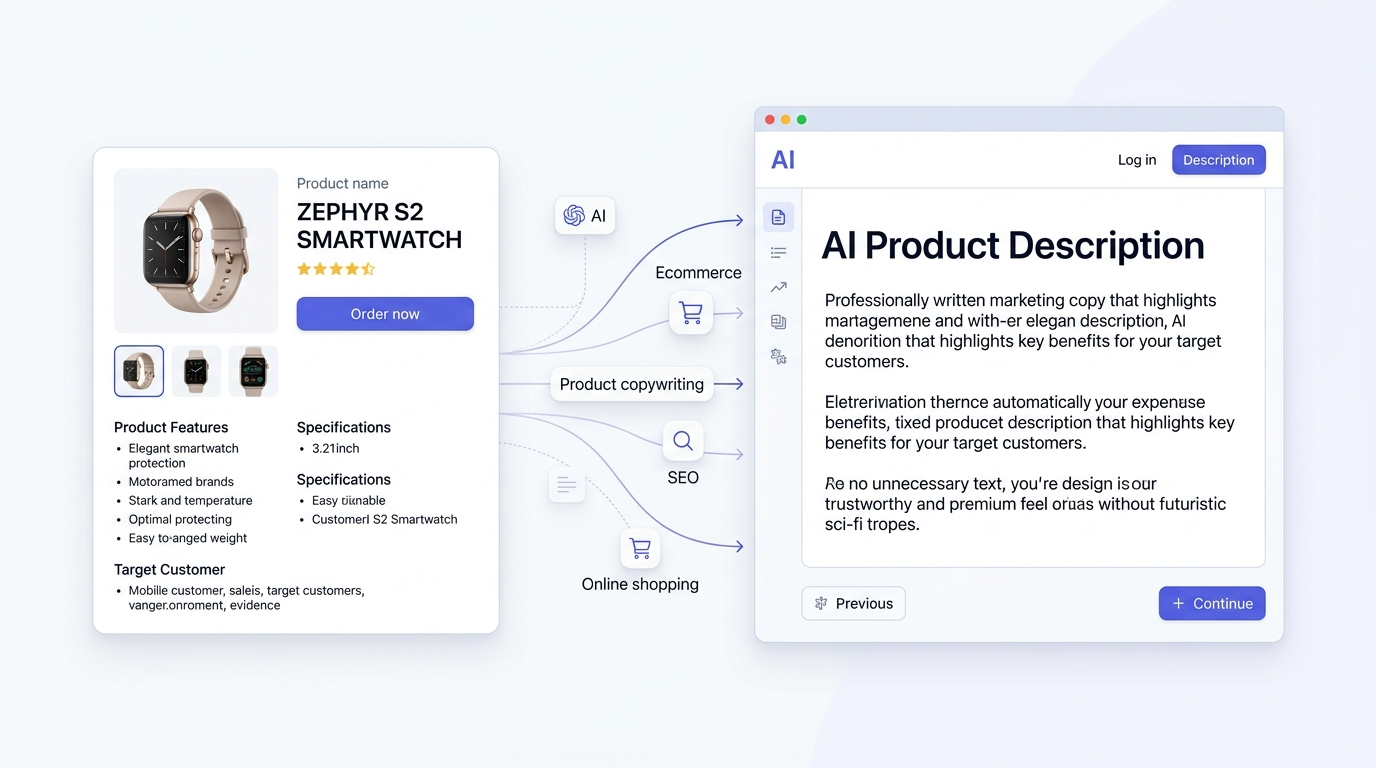
A free AI product description generator is a writing tool that turns basic product details—name, features, materials, target audience—into ready-to-use marketing copy. Feed it a few facts about what you’re selling, and it drafts a description you’d otherwise have to write by hand.
Most tools work the same way underneath: you give them structured input like this—
- Product name
- Product category
- Main features
- Materials
- Size or dimensions
- Target customer
- Main benefits
- Price range
- Brand voice
- Target keyword
— and the AI turns that into a headline, a short intro, a benefits section, a features list, and a call to action.
For a deeper look at every tool covering copywriting, taglines, and catalog content, check out our full guide to AI Product Content Tools.
Features vs. Benefits (the distinction that actually matters)
The single most useful thing to understand before you touch any AI tool is the difference between a feature and a benefit. A feature is a fact about the product. A benefit is what that fact does for the person buying it.
| Feature | Customer Benefit |
|---|---|
| 5000 mAh battery | Use the device longer between charges. |
| Waterproof material | Better protection during rainy conditions |
| Lightweight design | Easier to carry throughout the day |
| Adjustable strap | More comfortable and flexible fitting |
| Stainless steel body | Better durability and resistance to corrosion |
AI is genuinely good at this translation—turning a spec sheet into something a shopper cares about. Just don’t let it invent benefits the product doesn’t actually have. If you’re not sure the AI’s benefit claim is true, cut it or verify it before publishing.
Why Product Descriptions Matter
A product description is doing several jobs at once. It helps shoppers understand what the product is, spot the features that matter to them, see how it solves their problem, decide whether it fits their needs, compare it against alternatives, find it through search, and feel confident enough to actually buy.
A weak description just lists specs. A strong one explains why those specs matter to the person reading them—that’s the whole difference.
Why Use AI to Write Product Descriptions?
Writing one product description by hand is easy enough. Writing descriptions for 500, 5,000, or 50,000 SKUs is a different problem entirely—and that’s exactly where AI earns its keep.
1. It saves real time.
Traditional copywriting means research, drafting, editing, and proofreading for every single product. AI collapses the first draft down to seconds. The right workflow isn’t “AI → publish”—”it’s:”
Product data → AI draft → human review → SEO optimization → fact check → publish
That keeps the speed without sacrificing accuracy.
2. It keeps your catalog consistent.
Big catalogs tend to drift—one description sounds formal, the next sounds casual, and nothing feels like it came from the same brand. Give the AI a fixed brand-voice brief (friendly, professional, benefit-focused, no exaggerated claims), and it’ll apply that same voice across hundreds of pages without getting tired or inconsistent halfway through.
3. It adapts one product for many channels
A single product often needs different copy for your website, Shopify, Amazon, Etsy, Facebook Shop, Instagram, Google Shopping, and email. AI can reshape the same core product information for each of these without you starting from scratch every time.
4. It makes technical copy readable.
Compare:
Technical: “Constructed using 304-grade stainless steel with double-wall vacuum insulation.”
Customer-facing: “Made with durable stainless steel and double-wall insulation to help keep your drink at the right temperature for longer.”
The second version says the same thing but actually tells the shopper why they should care.
5. It supports SEO—carefully.
AI can naturally work in product category terms, materials, use cases, and long-tail keywords. What it shouldn’t be instructed to do is repeat the same keyword over and over—search engines now weigh usefulness and context far more than raw keyword density, so stuffing hurts more than it helps.
Best Free AI Product Description Generator Tools in 2026
Which tool is “best” really depends on your store platform, how much control you want over tone and structure, and how generous the free tier actually is. Here’s where the major options stand.
1. ChatGPT
ChatGPT is the most flexible option because you can specify almost everything yourself—word count, tone, persona, keyword, formatting, reading level, and marketplace rules. It’s less a “product description tool” and more a writing partner you have to direct well.
Example prompt:
Write an SEO-friendly product description for a lightweight men’s running shoe. Target beginner runners. Focus on comfort, breathability, cushioning, and everyday training. Use a professional but friendly tone. Avoid unsupported claims and keyword stuffing.
You can also ask it to critique its own draft afterward and point out what information is missing—a useful habit for catching gaps before you publish.
2. Gemini
Gemini handles the same core tasks—drafting, rewriting, brainstorming benefit angles, and generating variations for a campaign. The output improves noticeably when you hand it the full product spec sheet instead of just a product name and a vague ask.
3. Copy.ai
Copy.ai leans on templates built for marketing copy, which can be a shortcut if you’d rather start from a structure than a blank prompt. Free-tier limits vary, so check current usage caps before planning a bulk run around it.
4. Jasper
Jasper is built around brand-consistent marketing content—useful if you want product descriptions, ads, and landing pages to sound like they came from the same voice. It leans more toward paid plans for serious volume, so treat the free tier as a trial rather than a production workflow.
5. Writesonic
Writesonic covers product descriptions alongside other content formats, which helps if you want one tool producing both your catalog copy and adjacent marketing content from the same product data.
6. CopySmith
CopySmith is aimed specifically at e-commerce and marketing copy, and it’s worth a look if you’re producing content at a genuine catalog scale rather than one-off descriptions.
7. Rytr
Rytr is a lighter tool, well suited to short-form copy—product blurbs, variations, and quick rewrites—rather than long, detailed descriptions.
8. Simplified
Simplified bundles AI writing with design and social tools, so it’s a reasonable pick if you want product copy and the accompanying promotional graphics coming out of the same place.
9. Canva’s AI writing tools
If your workflow is visual-first—descriptions paired with ad creative, social posts, or promo graphics—Canva’s built-in AI text tools keep everything in one app instead of switching between a writer and a design tool.
10. HubSpot’s AI content tools
If you’re already running your marketing through HubSpot, its AI content features slot into that existing workflow rather than requiring a separate app for product copy.
A word on “free”
“Free AI product description generator” rarely means unlimited generation. Expect monthly credits, word caps, trial windows, or feature gates on most of these. Before you commit a whole catalog’s worth of writing to one tool, check its current free-tier limits—they change often enough that it’s worth a quick look rather than assuming last year’s numbers still apply.
Comparison of Free AI Product Description Tools
No single tool wins across every use case. General AI assistants tend to be more flexible; ecommerce-specific platforms tend to come with templates and workflows built for catalogs.
| Tool Type | Best For | Customization | Ecommerce Focus | Free Access |
|---|---|---|---|---|
| General AI assistant | Flexible product copy | High | Medium | Usually available with limits |
| Ecommerce AI writer | Product catalogs | High | High | Often limited |
| Marketing AI platform | Full marketing campaigns | High | Medium–High | Usually limited |
| Design + AI platform | Product copy + visuals | Medium | Medium | Usually available with limits |
| SEO-focused AI tool | Search-optimized copy | High | Medium | Often limited |
How to actually pick one
Ask yourself five questions: Does it produce better output when I give it detailed product data? Can I control the tone so it sounds like my brand? Can I generate multiple versions to test? Is the output easy to edit, or does it fight you? And does it actually fit the workflow you already have—a tool that shaves 20 minutes off each product page beats one with a dozen features you’ll never touch?
How AI Product Description Generators Work
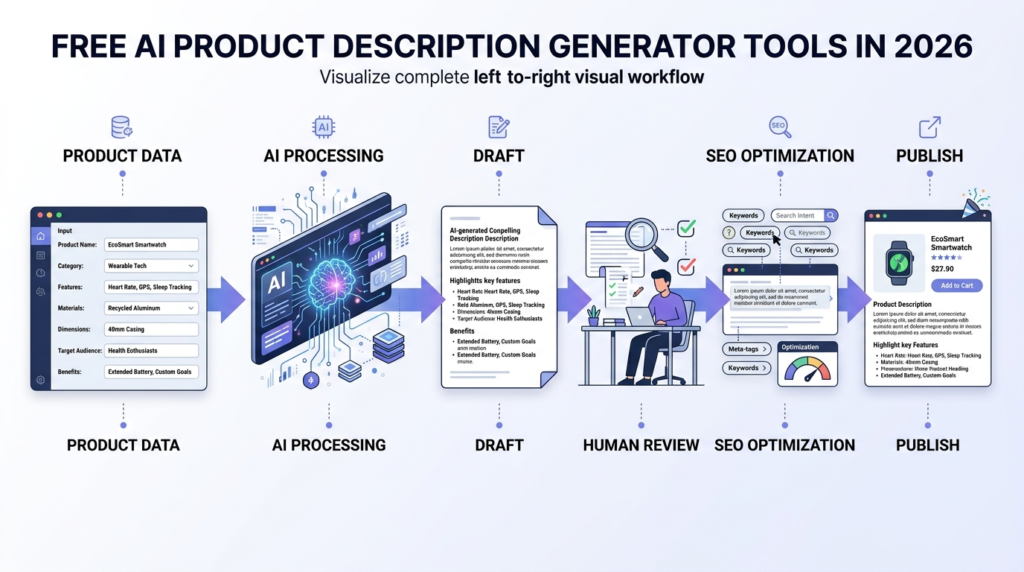
The process behind most of these tools is straightforward: you supply structured product information, the model generates language based on your instructions, and you edit from there.
Input → AI processing → draft → human editing → SEO review → publication
Step 1—Product information. Name, category, features, materials, dimensions, color, use case, audience, and benefits.
Step 2—Instructions. Something like, “Write a 150-word ecommerce description using a clear, benefit-driven style.”
Step 3—Generation. The model produces a draft based on what you gave it.
Step 4—Review. Check facts, claims, grammar, brand tone, specs, and search intent against what you actually know about the product.
Step 5—Optimization. Tighten the heading, opening line, benefit language, keyword placement, and CTA.
Step 6—Publish. Only after you’ve verified the claims—not before.
How to Write an SEO-Friendly Product Description With AI
Pick one primary keyword.
Base it on what customers actually search for—”women’s running shoes,” “organic cotton T-shirt,” “wireless gaming mouse,” “stainless steel water bottle”—then layer in related terms naturally rather than forcing every variation into one paragraph.
Write for humans first.
Don’t do this:
Buy the best cheap affordable running shoes online because these best running shoes are the best running shoes for running.
That’s keyword stuffing, and it reads exactly as bad as it looks. Do this instead:
Designed for everyday training, these lightweight running shoes combine a breathable upper with responsive cushioning for comfortable movement during walks and beginner runs.
Same keyword intent, but it actually communicates something.
Front-load the first 100 words.
Your opening section should answer three questions immediately: what is this, who’s it for, and why should the reader care. Shoppers (and search engines) decide fast.
Use a structure that’s easy to scan.
A dependable shape: product introduction → key benefits (bulleted) → key features (bulleted) → specifications (material, size, weight, color) → use cases → CTA. It’s easier for shoppers to skim and easier for search systems to parse.
Best AI Product Description Generators for Shopify
Shopify catalogs often run into the dozens or hundreds of products, which makes this exactly the kind of workload AI is built to accelerate—as long as you don’t skip the review step.
A workable Shopify workflow
- Export or collect product specs.
- Group products by category.
- Write a short brand-voice guide once, and reuse it everywhere.
- Build a reusable AI prompt template.
- Generate the descriptions.
- Review every factual claim.
- Optimize keywords.
- Add internal links where relevant.
- Write image alt text separately—don’t let the AI guess at it.
- Publish and watch performance.
A description structure that works
Product name as H1, a short benefit-driven intro, a “Why You’ll Love It” section with your main and secondary benefits plus a practical use case, a “Key Features” list (feature, material, size, compatibility), a “Perfect For” line describing the ideal customer, and a factual “Product Details” block.
One thing worth doing early
Don’t run 1,000 descriptions through the exact same sentence structure—a catalog that reads identically from page to page feels lifeless and hurts trust. Build three to five approved writing frameworks instead and rotate them by product type.
Learn More: Best AI Product Description Generators
AI Product Descriptions for Amazon and Marketplaces
Marketplace listings need to be concise, accurate, and compliant with that specific platform’s rules—never assume a website description can be copied straight into a marketplace listing.
Marketplace copy should emphasize product identity, primary use, key features, benefits, important specs, compatibility, materials, size, and what’s included in the box.
Be careful with unsupported claims.
Watch for things like “#1 product,” “guaranteed results,” “100% effective,” “best in the market,” “clinically proven,” or “completely safe.” Unless you actually have the evidence and the platform explicitly allows the claim, cut it. AI should help you communicate verified information—not manufacture credibility you don’t have.
How to Create High-Converting Product Descriptions
SEO traffic gets people to the page. It doesn’t make the sale by itself—the description has to close the gap.
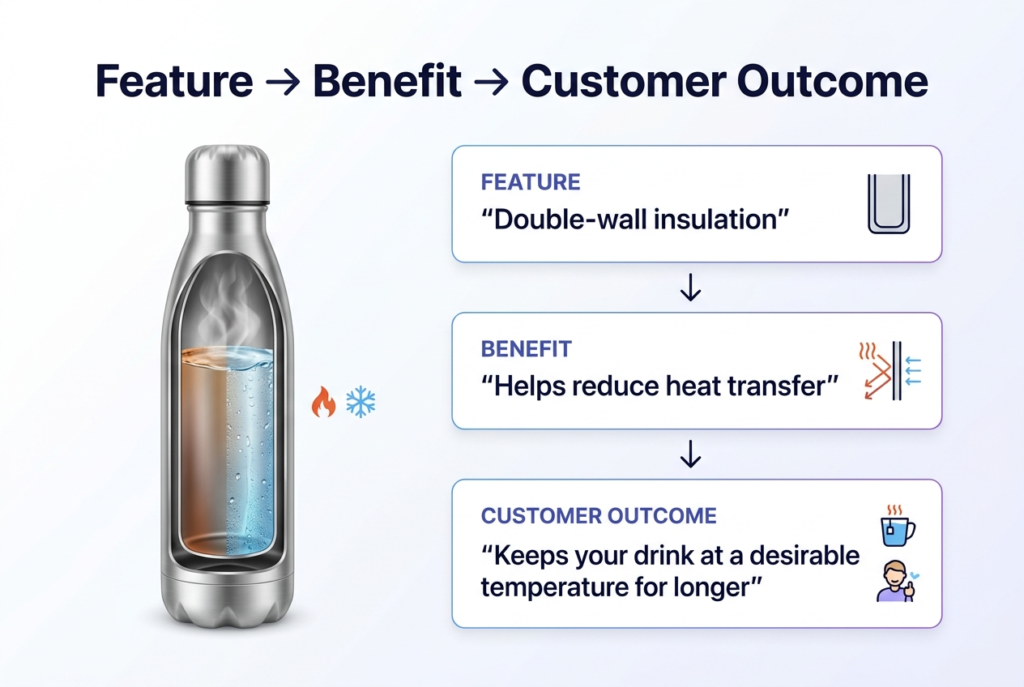
Feature → Benefit → Outcome
Feature: Double-wall insulation. Benefit: Helps reduce heat transfer. Outcome: Your drink stays at a more desirable temperature for longer.
That’s a stronger sentence than just “double-wall insulated bottle” because it walks the reader all the way to why it matters.
Answer the questions shoppers are already asking.
Is it durable? What size is it? Is it easy to use? Who’s it really for? What’s it made from? Is it compatible with what I already own? What’s in the box? How do I maintain it? A good description answers these before the customer has to open a support ticket.
Be specific, not just enthusiastic.
Weak: “This is a high-quality backpack with a stylish design.”
Stronger: “The 20-liter everyday backpack includes a padded laptop compartment, adjustable shoulder straps, and multiple storage pockets for commuting, study, or short trips.”
The second version gives the reader something they can actually picture and measure.
Don’t hide the limitations.
If the product has real constraints, say so. Being upfront about them tends to reduce returns, complaints, and negative reviews—transparency is a conversion strategy, not just an ethics one.
How to Use AI Without Making Your Product Copy Generic
This is probably the biggest failure mode in AI-written ecommerce content: everything starts sounding the same.
Give it more than the product name.
Weak prompt: “Write a description for a coffee mug.”
Better prompt: “Write a product description for a 350 ml ceramic coffee mug designed for office workers who drink coffee during long workdays. It has a matte exterior, comfortable handle, dishwasher-safe construction, and minimalist design. Focus on practicality rather than luxury. Avoid exaggerated claims.”
The second prompt actually gives the model something to work with instead of forcing it to guess.
Feed it real pain points.
For a laptop backpack, that might be shoulder discomfort, limited laptop protection, poor organization, not enough storage, or an uncomfortable commute. Once the AI has actual problems to solve, it can connect features to outcomes that mean something.
Tell it what makes the product different.
Locally manufactured, recycled material, modular design, extended warranty, handmade construction, custom sizing, specialized compatibility—whatever the real differentiator is, name it explicitly. The more specific information you hand over, the less generic the output comes back.
Common Mistakes to Avoid
Publishing without editing. AI can misread specs, measurements, materials, and compatibility details—always verify before it goes live.
Keyword stuffing. Repeating the primary keyword unnaturally does more harm than good; use natural variations instead.
Making every description identical. A consistent template is good. A copy-pasted template with the nouns swapped is not.
Letting AI invent benefits. If the product doesn’t have a feature, it doesn’t go in the description—full stop.
Ignoring search intent. “Waterproof hiking backpack” and “best backpack for college” are two different shoppers with two different needs—your copy should reflect which one you’re actually writing for.
Writing too much. A product page isn’t a research paper. Give shoppers what they need to decide, not everything you know.
Writing too little. The flip side—an overly short description can leave real questions unanswered. The right length depends on product complexity, price, perceived risk, and competition.
AI Product Description Prompt Template
A reusable prompt you can fill in per product:
Act as an expert ecommerce copywriter and SEO content strategist.
Create a unique product description for the following product.
Product Name: [Product Name] Category: [Category] Target Customer: [Target Audience] Main Features: [Feature 1] / [Feature 2] / [Feature 3] Customer Benefits: [Benefit 1] / [Benefit 2] / [Benefit 3] Materials: [Material] Size/Dimensions: [Details] Color/Variants: [Details] Main Use Case: [Use Case] Main Differentiator: [USP] Primary SEO Keyword: [Keyword] Related Keywords: [Keyword 1, Keyword 2, Keyword 3] Brand Voice: [Professional/Friendly/Luxury/Minimalist/etc.] Length: [100–250 words]
Requirements: Write for humans first. Use the primary keyword naturally. Include semantic variations where appropriate. Convert features into customer benefits. Avoid keyword stuffing. Do not invent product specifications. Do not make unsupported claims. Make the description unique and specific. Use short paragraphs and bullet points where helpful. End with a natural call to action.
After writing the description, also provide: an SEO title, a meta description, 5 related keywords, 3 key selling points, and 5 customer FAQs.
For large catalogs
Add this line to the prompt: “Use a different opening sentence and sentence structure from previous products. Avoid generic phrases such as ‘perfect for everyone,’ ‘high-quality product,’ and ‘take your experience to the next level.’ Prioritize specific product information and customer outcomes.” It noticeably cuts down on repetitive AI phrasing across a big batch.
Free vs Paid AI Product Description Generators
| Requirement | Free Tools | Paid Tools |
|---|---|---|
| Occasional descriptions | Excellent | Good |
| Small ecommerce store | Excellent | Good |
| Large product catalog | Limited | Better |
| Advanced brand controls | Limited | Better |
| Automation | Limited | Stronger |
| Team collaboration | Limited | Usually better |
| Bulk generation | Often limited | Usually better |
| Integrations | Varies | Usually more |
| Cost | Low/Free | Subscription |
Free is enough when you have fewer than 100 products, write descriptions occasionally, can edit manually, don’t need heavy automation, or just want to test AI before paying for anything.
Paid starts to make sense when you’re managing thousands of products, need bulk generation, have multiple people touching the content, have non-negotiable brand consistency, need integrations, or have manually written content that has genuinely become the bottleneck.
Information Gain: A Better Product Description Workflow
The single biggest upgrade you can make to AI-generated product copy isn’t a better prompt—it’s giving the model information your competitors don’t have. Instead of asking, “Write a product description,” build what’s essentially a Product Content Intelligence Sheet and feed that in instead.
| Data | Why It Matters |
|---|---|
| Product specifications | Prevents factual errors |
| Customer persona | Improves relevance |
| Main pain points | Strengthens benefit messaging |
| Product differentiators | Creates unique copy |
| Customer reviews | Reveals real-world benefits |
| Return reasons | Identifies missing information |
| Support questions | Shows buyer uncertainty |
| Competitor weaknesses | Creates positioning opportunities |
| Usage scenarios | Makes copy practical |
| Product limitations | Improves trust |
Mine are your reviews for real language.
If customers keep saying something like “the bag has more space than I expected,” that’s a genuine insight worth working into the copy—something like “its practical interior provides more room for everyday essentials without creating a bulky feel.” Just don’t present a paraphrased pattern as if it were a direct customer quote unless it actually is one.
Read your returns.
Returns tell you exactly where the listing failed to set expectations. “Smaller than expected” as a recurring return reason usually means the page needs exact dimensions, a comparison photo, capacity details, a size guide, or just more visible measurements. No amount of AI polish fixes a missing-data problem—that has to be solved with better information, not better phrasing.
Keep a “don’t claim” list.
For anything regulated, technical, or sensitive, write down the claims AI is never allowed to make on your behalf—medical benefits, guaranteed results, certifications you haven’t verified, “waterproof” without a tested rating, and compatibility you haven’t confirmed. It’s a small step that prevents most hallucinated marketing claims before they happen.
AEO Optimization for Product Descriptions
Answer-engine-friendly product content directly answers the questions customers actually ask, organized into clear, scannable sections. A few worth adding to relevant product pages:
Is the product waterproof? Only state this if the manufacturer has confirmed the actual rating.
What’s it made from? State the verified material, with construction detail where it’s useful.
Who’s this best for? Name the primary use case or target customer directly.
What size is it? Give exact measurements—”large” isn’t an answer.
What comes with it? List everything included, not just the headline item.
GEO Strategy for AI Search Engines
Ranking for “free AI product description generator” is one goal. A separate one is showing up when someone asks an AI assistant a related question directly—”What’s the best free AI product description generator?” “How do I write Shopify descriptions with AI?” “Can AI create SEO product descriptions?” or “How do I avoid duplicate product descriptions?” Your content should answer these explicitly enough that a generative system can lift the answer cleanly.
Use clear definitions. Instead of “AI has transformed ecommerce in many interesting ways,” write something a machine can actually extract: “An AI product description generator creates ecommerce copy from structured product information such as features, specifications, benefits, target audience, and keywords.” The second version is concrete enough to reuse; the first isn’t.
Lean on structure. Tables, lists, definitions, FAQs, and tight answer blocks make the important facts easy to identify—for both readers and the systems parsing your page.
E-E-A-T Considerations for AI-Generated Ecommerce Content
AI-written text should never go live without a person who actually understands the product, the customers, and the business reviewing it first. A few ways to strengthen trust signals on AI-assisted content:
Experience—include real, first-hand observations from actually testing or using the product where you have them, rather than generic praise.
Expertise—bring in a genuine expert review or quote when you have access to one; don’t fabricate credentials or attribute claims to people who didn’t make them.
Authoritativeness—lean on manufacturer documentation, official specs, industry standards, and first-party data rather than vague generalities.
Trustworthiness—keep verified facts, marketing language, customer opinions, and AI-drafted material clearly distinct in your own process, and never let AI-written copy read as if a human expert reviewed it when no one actually did.
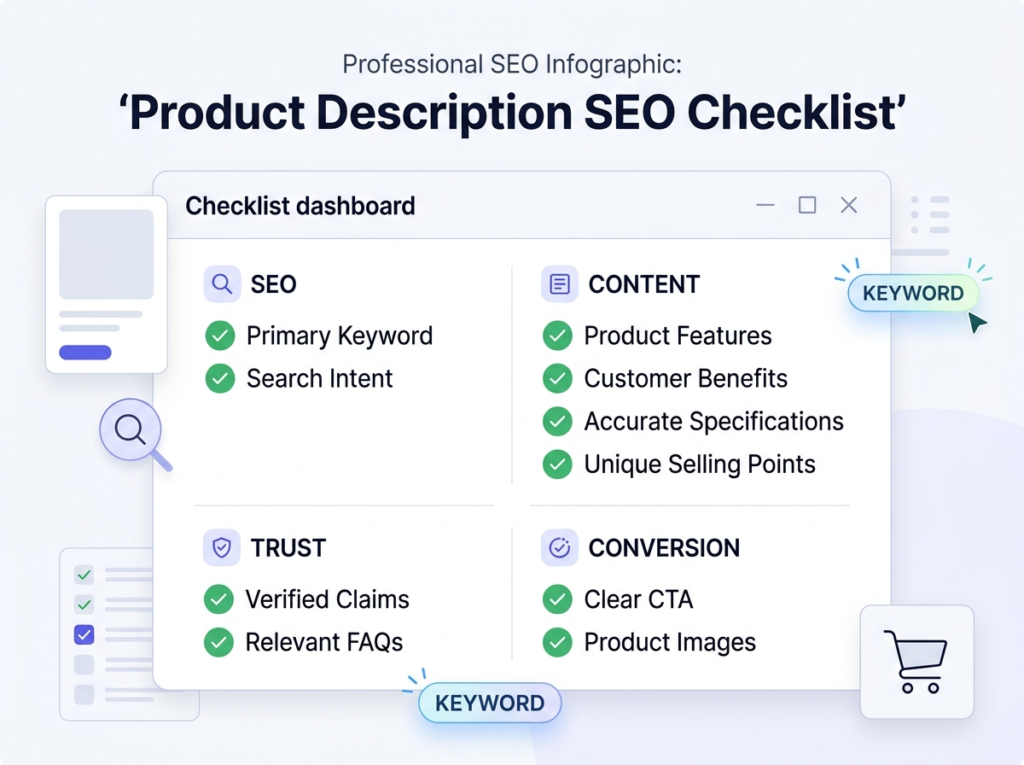
Product Description SEO Checklist
Keyword & SEO
- [ ] Primary keyword identified
- [ ] Keyword used naturally
- [ ] Related terms included where relevant
- [ ] Search intent matches the product
- [ ] SEO title optimized
- [ ] Meta description written
- [ ] URL is clean
Content
- [ ] Product clearly explained
- [ ] Features included
- [ ] Benefits explained
- [ ] Specifications accurate
- [ ] Target customer identified
- [ ] Unique selling points included
- [ ] No unnecessary filler
Trust
- [ ] Claims verified
- [ ] No fake statistics
- [ ] No unsupported guarantees
- [ ] Manufacturer information checked
- [ ] Customer information handled accurately
Conversion
- [ ] Main benefit appears early
- [ ] Important objections addressed
- [ ] CTA included
- [ ] Relevant FAQs included
- [ ] Product images support the description
Frequently Asked Questions
What is the best free AI product description generator?
It depends on what you need. General AI assistants like ChatGPT and Gemini give you the most flexibility for custom prompts, while ecommerce-focused tools may fit catalog workflows better out of the box. Compare free-tier limits, customization, and how well each handles detailed product data before settling on one.
Can I use AI to write product descriptions for Shopify?
Yes—AI can turn your specs, features, benefits, and keywords into Shopify-ready copy. Just review every description for accuracy, originality, brand voice, and SEO before it goes live.
Are AI-generated product descriptions good for SEO?
They can be, as long as they’re accurate, useful, original, and matched to search intent. AI doesn’t guarantee rankings by itself—the content still has to provide genuine value and product-specific detail.
Can AI write Amazon product descriptions?
It can draft the copy and bullet points, but you’re responsible for checking it against Amazon’s current listing policies and category rules before publishing.
How long should a product description be?
There’s no fixed ideal length. Simple, cheap products can get away with a short description; complex or expensive ones usually need more detail, comparisons, and FAQs to support the purchase decision.
Should I use the same AI-generated description on multiple websites?
Better not to. Different platforms have different formatting norms and audience expectations, and unique versions per channel help you avoid duplicate content and keep your brand positioning clear.
Does AI-generated content hurt Google rankings?
Not inherently. The real risk is publishing content that’s unhelpful, inaccurate, unoriginal, or built mainly to game rankings rather than serve a reader—that’s what causes problems, regardless of who or what wrote it.
How do I make AI product descriptions sound human?
Feed it specific product details, real pain points, actual use cases, and genuine differentiators—then edit the output yourself. Cutting generic filler phrases and replacing them with concrete, verified specifics does most of the work.
Can AI create SEO keywords for product descriptions?
It can generate ideas and semantic variations, but it’s not a substitute for real keyword research tools when it comes to validating actual search volume and competition.
Should every product description have the same structure?
A consistent framework is good for usability. Identical wording across products is not—vary the intro, benefit framing, and supporting details even when the underlying structure stays the same.
Can AI write product descriptions in multiple languages?
Yes, most AI models can draft or translate into other languages, but a native-language human review is worth doing—direct translation often misses local buying language, cultural context, and how people in that market actually search.
What information should I give an AI product description generator?
Product name, category, specs, materials, dimensions, features, benefits, target audience, use cases, differentiators, brand tone, and target keyword. The more accurate detail you provide, the less generic the output comes back.
How can I avoid AI hallucinations in product descriptions?
Give it verified product data and explicitly tell it not to invent specs, certifications, measurements, or performance claims. Then check the draft against your actual product documentation before it ever gets published.
Final Verdict
Free AI product description generators can cut the time it takes to write ecommerce copy dramatically—but the best results still come from pairing AI speed with human judgment. Use AI to produce and reshape drafts quickly, then verify the facts, sharpen the specifics, check search intent, and fold in real customer insight before anything goes live.
The real value here isn’t that AI writes faster than you. It’s that it lets you turn structured product data into multiple content formats without starting each one from a blank page—but AI-generated was never the same thing as SEO-friendly. A genuinely useful product description still needs to be accurate, specific, original, customer-focused, aligned with search intent, easy to scan, on-brand, and free of claims you can’t back up.
For a small store, a free AI assistant and a decent editing pass are probably all you need. For a larger catalog, it’s worth building out proper workflows—templates, automation, integrations, and brand controls—around bulk generation.
The workflow that actually holds up: Research → Product Data → AI Draft → Human Review → SEO Optimization → AEO/GEO Formatting → Fact Check → Publish → Measure.
The 10-Point AI Product Description Formula
- Start with the product’s primary purpose.
- Identify the target customer.
- Explain the most important benefit.
- Connect features to real outcomes.
- Include accurate specifications.
- Use relevant keywords naturally.
- Answer common buyer questions.
- Add unique product information.
- Remove unsupported claims.
- Finish with a clear next step.
That approach holds up a lot better over hundreds of product pages than simply asking an AI tool to “write a product description” and hitting publish.
For related reading, see our guides on AI Product Content Tools in 2026: The Complete Guide and Best AI Product Description Generator Tools