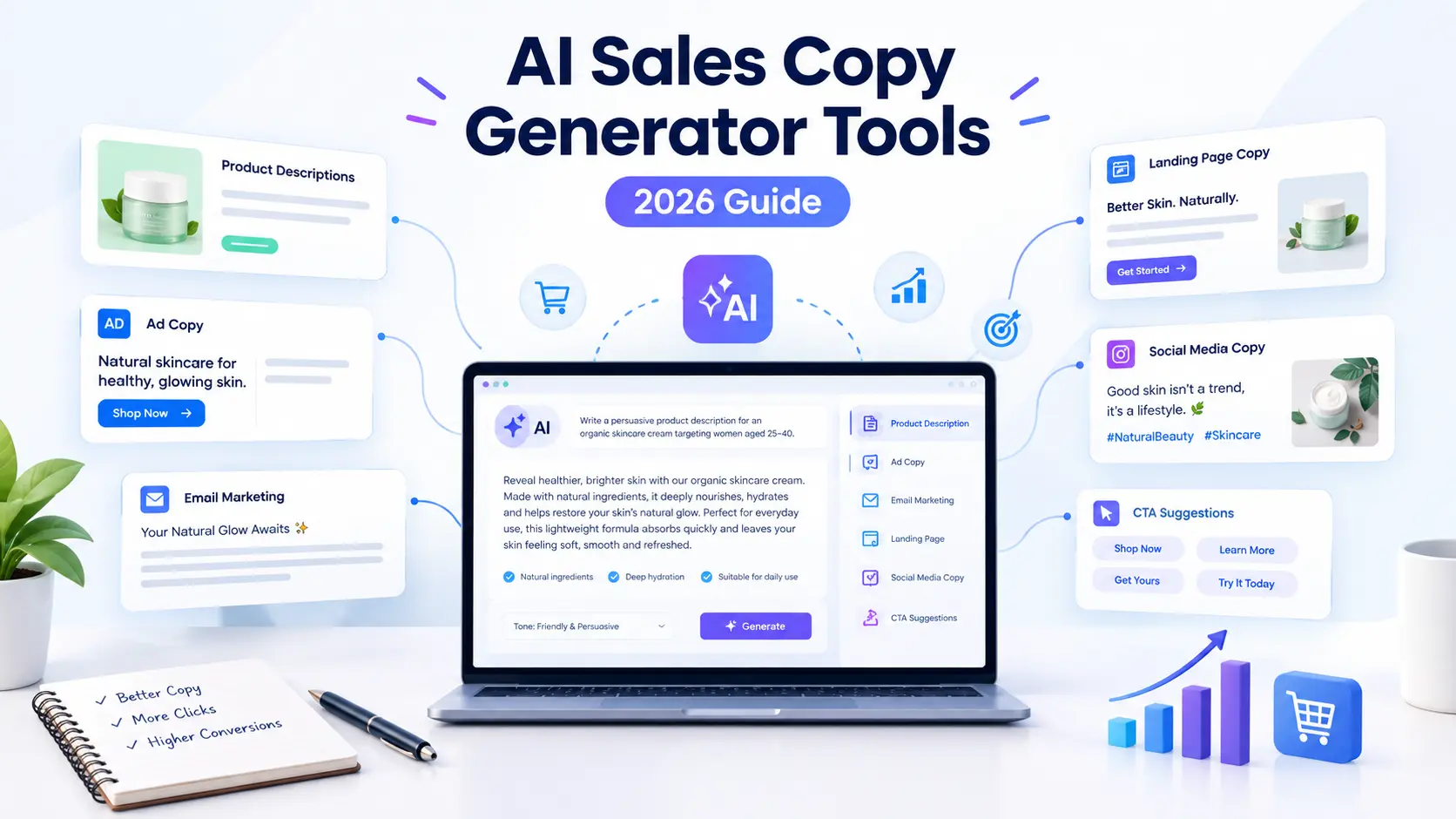
AI Sales Copy Generator Tools: 15 Options for 2026
Writing sales copy sounds simple until you actually have to do it—dozens of headlines, product messages, ad variations, emails, landing pages, and calls to action that all need to feel different from one another. That’s where AI sales copy generator tools come in.
Modern AI writing platforms can turn a product brief, audience description, or campaign idea into several versions of persuasive copy in seconds. But speed alone doesn’t make copy effective. The real value comes from feeding the AI enough context, then reviewing what it produces with actual human judgment.
This guide covers 15 AI-powered tools for sales copywriting, what each is best used for, what to check before choosing one, and how to get better results out of AI-generated marketing copy.
AI sales copy generator tools use artificial intelligence to write persuasive marketing text—ads, landing pages, emails, product pages, social posts, and more. They’re genuinely useful for generating ideas and variations fast, but the strongest results still require human editing, fact-checking, audience research, and brand-specific context.
For a deeper look at every tool covering copywriting, taglines, and catalog content, check out our full guide to AI Product Content Tools.
Table of Contents
- What Is an AI Sales Copy Generator?
- How AI Copywriting Tools Create Sales Content
- 15 AI Sales Copywriting Tools to Consider in 2026
- Comparison of AI Sales Copy Generators
- Best Tools for Different AI Sales Copy Generator Tasks
- How to Choose AI Copywriting Software
- How to Write Better Prompts for Sales Copy
- Common Mistakes With AI-Generated Sales Copy
- How to Humanize AI Sales Content
- AI Sales Copy and SEO, AEO & GEO
- Information Gain: How to Make AI Sales Content More Valuable
- Pros and Cons of AI Sales Copy Generators
- A Practical AI Sales Copy Workflow
- Frequently Asked Questions
- Final Takeaway
What Is an AI Sales Copy Generator?
An AI sales copy generator is software that uses generative AI to produce marketing messages designed to persuade a specific audience to take action. Depending on the platform, it can write ads, headlines, product descriptions, emails, landing-page copy, social posts, calls to action, and more.
Traditional copywriting starts with research, positioning, brainstorming, drafting, editing, and testing. AI can speed up several of those steps—but not all of them.
Instead of staring at a blank page, a marketer can feed the tool information like
- Product or service
- Target audience
- Main customer problem
- Key benefits
- Unique selling proposition
- Offer or promotion
- Desired tone
- Marketing channel
- Call to action
The AI then generates one or more versions of the copy.
What these tools don’t automatically know matters just as much. An AI writer doesn’t know your customers the way you do. It can misread product specs, invent details that sound plausible but aren’t true, default to generic language, or make claims your business can’t actually back up. In practice, that means treating AI as a copywriting assistant—not a replacement for strategy and editorial judgment.
AI Copywriting vs. Traditional Copywriting
| Traditional Workflow | AI-Assisted Workflow |
|---|---|
| Research | Research |
| Audience analysis | Audience analysis |
| Manual brainstorming | AI-assisted ideation |
| Manual first draft | AI-generated first draft |
| Human editing | Human editing |
| Testing | Testing |
| Optimization | Optimization |
The biggest difference is production speed—not the disappearance of strategy. Every step that requires judgment about your customers still needs a human.
How AI Copywriting Tools Create Sales Content
Most AI copywriting systems combine your instructions with a language model to produce text matched to the objective, audience, format, and tone you specify. Better inputs lead to better outputs—brand context, product information, and human review are what keep the copy from sounding generic or drifting into inaccuracy.
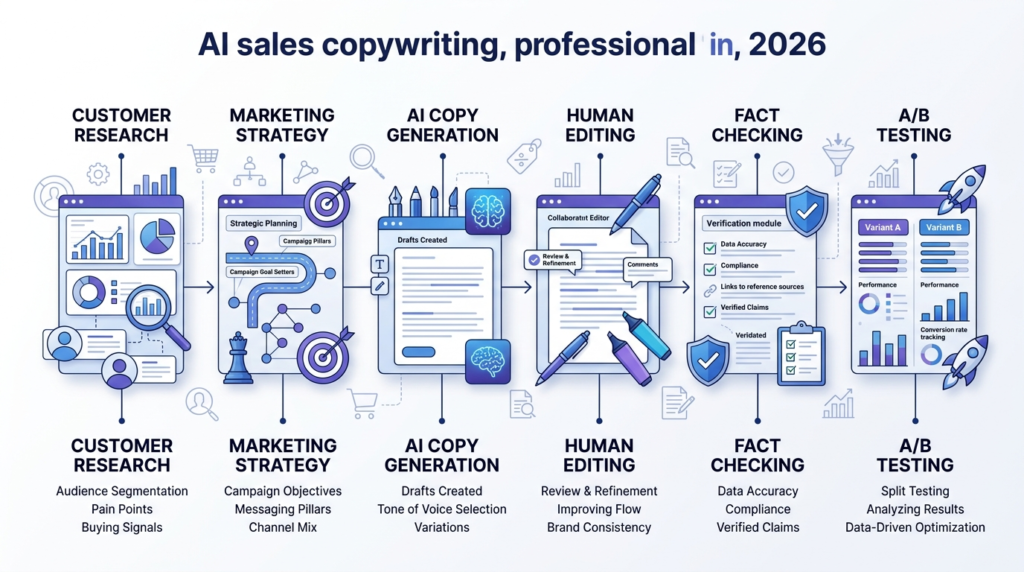
A typical workflow looks like this: Input → Context → Generation → Editing → Testing
1. Define the objective.
Decide what the copy needs to accomplish—generate leads, sell a product, increase email clicks, promote a discount, get a demo booked, drive an app download, or introduce a new service.
2. Describe the audience.
Instead of saying:
“Write an ad for my product.”
Give the AI more to work with:
“Write a Facebook ad for an AI inventory management platform targeting small Shopify store owners who spend several hours a week manually updating stock.”
The second prompt gives the model something concrete to write toward.
3. Add the value proposition.
Tell the AI why someone should care—it saves time, reduces repetitive work, simplifies reporting, improves workflow, helps manage multiple stores, or cuts down manual data entry.
4. Specify the format.
Ask for exactly what you need: Facebook ad, Google ad, email, landing page, product description, sales page, LinkedIn message, CTA, headline, and meta description.
5. Generate variations
One version is rarely enough. Ask for a few different angles—benefit-focused, problem-focused, curiosity-driven, emotional, direct-response, and trust-focused—and see which one actually fits your audience.
6. Edit and verify
This step shouldn’t be skipped. Check facts, claims, grammar, brand voice, legal requirements, pricing, product specs, customer promises, and tone before anything goes live.
15 AI Sales Copywriting Tools to Consider in 2026
The AI copywriting market spans general-purpose writing platforms and marketing-focused systems built specifically for sales content. The tools below cover different use cases—sales messaging, ads, landing pages, product content, email campaigns, and brand-focused copy. Features and pricing change often, so it’s worth checking each provider’s current plans before buying.
1. Jasper
Jasper is built around marketing and copywriting workflows specifically. Its platform includes brand voice controls, knowledge features, and specialized agents for tasks like landing pages and product descriptions.
Useful for marketing teams, sales pages, advertising copy, product messaging, brand-controlled content, and campaign workflows.
Its strongest advantage is staying on-brand across a campaign rather than treating every request as a one-off generic text generation.
Best fit: businesses that need structured, brand-aware marketing content at scale.
2. Copy.ai
Copy.ai has moved beyond simple copy generation and now positions itself around go-to-market and sales workflows, with playbooks covering activities like prospecting and sales enablement.
Useful for: sales messaging, prospecting, outreach, go-to-market workflows, and lead-generation content.
Ideal for: sales and revenue teams that want AI built into a broader sales process, not just a writing tool on the side.
3. Anyword
Anyword leans heavily into marketing performance and copy optimization, supporting ad copy, website content, social posts, and emails, with predictive performance features and audience-focused generation.
Useful for: ad variations, marketing copy, landing pages, email campaigns, and audience-specific messaging.
Good choice for: marketers who want to generate and evaluate multiple messages against each other rather than settling on one draft.
4. Writesonic
Writesonic is a broader AI content platform that also handles marketing and copywriting tasks.
Useful for: blog content, landing-page copy, marketing copy, product content, and SEO content.
Works well for: users who want one platform for both content and copy rather than a sales-only tool.
5. Rytr
Rytr focuses on generating short-form and long-form marketing content without a lot of setup overhead.
Useful for: emails, ads, product descriptions, social posts, and short marketing copy.
Most useful for: freelancers and smaller businesses that want a straightforward AI writing workflow.
6. ChatGPT
ChatGPT works well as a flexible sales copywriting assistant once you give it enough context—sales emails, product descriptions, headlines, ad variations, landing-page copy, CTAs, sales scripts, and objection-handling messages.
Its biggest advantage is flexibility: you can ask it to critique, rewrite, shorten, expand, compare, or transform copy you already have, not just generate from scratch.
Best fit: marketers who’d rather have one flexible assistant than a tool locked into specific templates.
7. Google Gemini
Gemini is useful for brainstorming, rewriting, summarizing customer research, developing messaging angles, and drafting marketing copy—particularly if your workflow already lives inside Google’s ecosystem.
Good choice for: marketers who want a general AI assistant for research and copy development side by side.
8. Claude
Claude is strong for long-form copy development, editing, message refinement, and working through large amounts of text at once. You can feed it customer reviews, competitor messaging, existing website copy, product documentation, or brand guidelines, then ask it to pull out common pain points and turn them into messaging ideas.
Works well for: research-heavy copywriting workflows where you’re synthesizing a lot of source material before you draft.
9. CopySmith
CopySmith has historically focused on ecommerce and marketing copy specifically.
Useful for: product descriptions, ecommerce content, marketing copy, and product catalog workflows.
Ideal for: ecommerce businesses managing large volumes of product content.
10. Hypotenuse AI
Hypotenuse AI is built around content creation for ecommerce and general business use.
Useful for: product descriptions, marketing content, ecommerce copy, blog content.
Most useful for: ecommerce teams that need content at scale without hiring more writers.
11. Simplified
Simplified bundles of AI writing with other marketing and content creation tools in one place.
Useful for: social media copy, ads, marketing content, captions, and campaign content.
Good choice for: small businesses and creators who want several marketing functions in one subscription.
12. SmartWriter
SmartWriter is built specifically for personalized outbound and sales messaging.
Useful for: cold outreach, sales emails, personalized messaging, and prospecting.
Best fit: sales professionals who need personalized copy at outbound volume.
13. Wordtune
Wordtune is primarily a rewriting tool rather than a from-scratch generator. You can use it to rewrite sentences, change tone, improve clarity, shorten text, or expand ideas that already exist.
Works well for: marketers who already have drafts and want them clearer and more natural, not tools to write from zero.
14. Grammarly
Grammarly isn’t a sales copy generator, but it earns its place in the editing stage—grammar, clarity, tone, conciseness, and rewriting suggestions on copy you’ve already written.
Ideal for: final editing and polishing before anything ships.
15. Canva AI
Canva is primarily a design platform, but its AI features assist with copy alongside graphics—useful for social ads, promotional graphics, presentation copy, and visual sales content where design and copy need to ship together.
Good choice for: designers and marketers who want copy and visuals produced in the same workflow.
Comparison of AI Sales Copy Generators
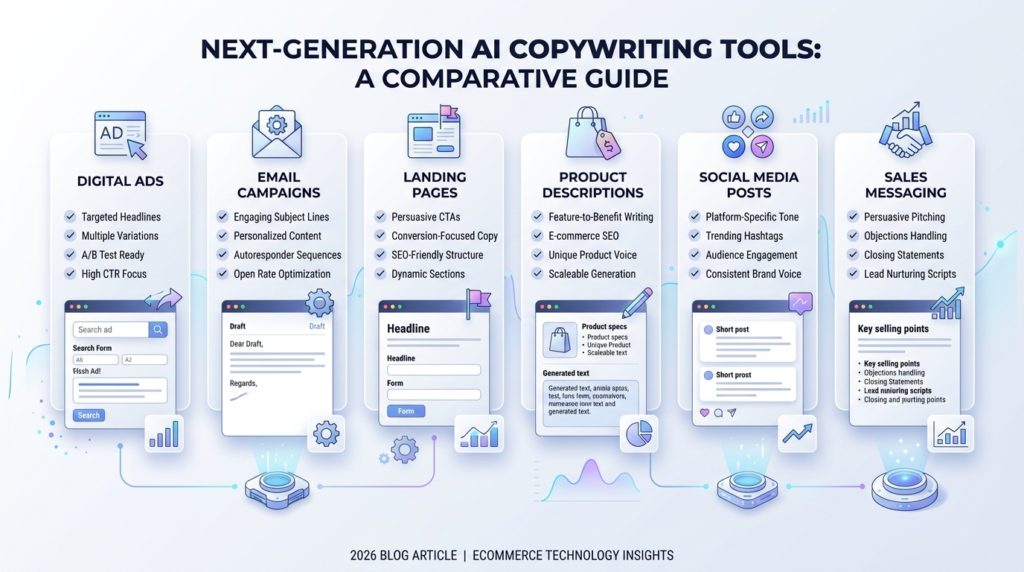
Different platforms specialize in different tasks. Some are built for marketing teams and brand consistency; others for general writing, sales outreach, ecommerce content, or editing. The right choice depends on your actual workflow more than the number of features on the pricing page.
| Tool | Main Strength | Useful For | Ideal User |
|---|---|---|---|
| Jasper | Marketing-focused AI | Campaigns, sales pages, brand copy | Marketing teams |
| Copy.ai | Sales/GTM workflows | Prospecting, sales content | Sales teams |
| Anyword | Performance-focused copy | Ads, marketing campaigns | Performance marketers |
| Writesonic | Broad AI content platform | SEO + marketing | Content marketers |
| Rytr | Simple, budget AI writing | Short-form copy | Freelancers |
| ChatGPT | Flexible generation | Almost any copy task | Marketers & creators |
| Gemini | General AI assistance | Research + writing | Marketers |
| Claude | Long-form reasoning/editing | Research + copy refinement | Content teams |
| CopySmith | Ecommerce content suite | Product copy | Ecommerce businesses |
| Hypotenuse AI | Ecommerce product data and content | Product descriptions, catalog images | Ecommerce brands with large catalogs |
| Simplified | All-in-one content workflow | Social + marketing | Small businesses |
| SmartWriter | Personalized outreach research | Cold outreach copy | Sales teams |
| Wordtune | Rewriting | Editing | Writers |
| Grammarly | Editing | Grammar + clarity | Professionals |
| Canva AI | Copy + design | Visual campaigns | Designers |
This table is a practical use-case comparison, not a ranking. Check each provider’s current documentation before purchasing—features, limits, and pricing shift often.
Best Tools for Different AI Sales Copy Generator Tasks
The best platform depends on what you’re actually creating. Sales outreach, ecommerce product copy, advertising, landing pages, and editing each have different requirements—instead of hunting for one tool that does everything, it’s usually faster to identify your highest-volume task and pick software that handles that one well.
- For sales emails, look for personalization, multiple variations, prospect research, follow-up sequences, and tone control.
- For ecommerce product copy, prioritize product-data inputs, benefit-focused writing, bulk generation, brand consistency, and SEO-friendly descriptions.
- For advertising, look for multiple headline variations, short-form copy, audience targeting, platform-specific formats, and testing workflows.
- For landing pages, the important features are headlines, subheadings, value propositions, benefits, objection handling, and CTAs.
- For freelancers, a flexible general-purpose assistant is often more useful than a complex enterprise platform, since freelance work usually spans several industries and content types at once.
How to Choose AI Copywriting Software
Choose based on your actual workflow, audience, content volume, brand requirements, integrations, editing needs, and budget. A tool with fewer features can be more practical than a bloated one if it produces usable drafts quickly and slots into your existing process.
Before subscribing, work through these questions.
1. What type of copy do you create most often?
Product descriptions → prioritize ecommerce features. Ads → prioritize variation and campaign features. Sales emails → prioritize personalization. Landing pages → prioritize conversion-focused templates. Blog content → prioritize long-form and SEO features.
2. Can you control brand voice?
Generic AI copy tends to sound the same from one paragraph to the next. A useful platform lets you define tone, vocabulary, audience, brand personality, formatting preferences, and messaging guidelines—and actually sticks to them.
3. Does it support multiple variations?
Good marketing requires testing. Instead of generating one headline, you want a process closer to: 10 headlines → shortlist 3 → test → analyze → improve.
4. Can you feed it product knowledge?
For businesses, context matters more than raw model quality. The more accurately a tool can work with your approved product information, the fewer unsupported claims you’ll have to catch in editing.
5. Does it fit your existing workflow?
Check whether it connects to your CMS, email platform, advertising workflow, CRM, social media tools, analytics, or content management system—or whether you’ll be copy-pasting everything by hand.
How to Write Better Prompts for Sales Copy
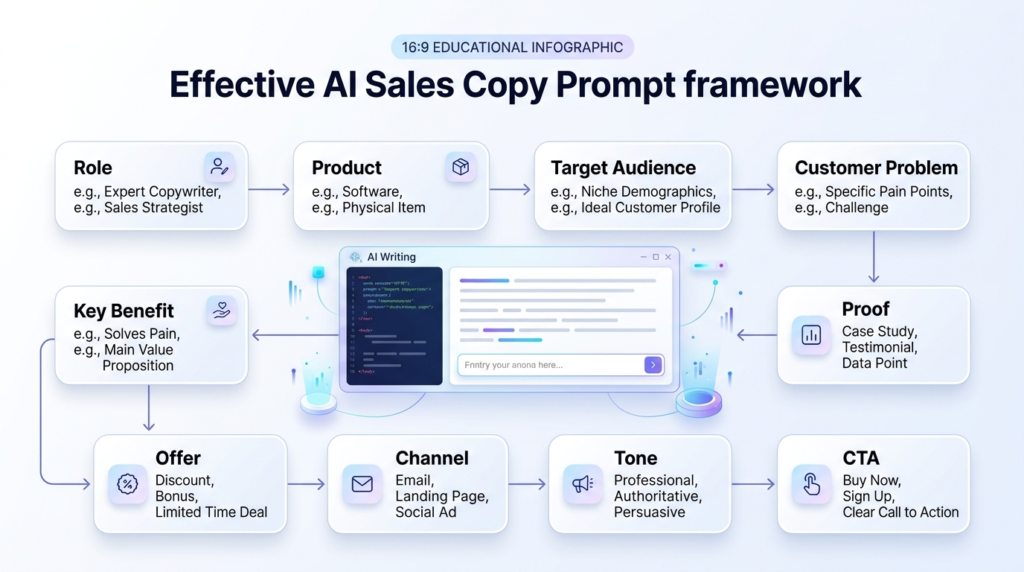
Strong prompts define the product, audience, problem, benefit, offer, tone, channel, desired action, and any constraints. Instead of asking for “persuasive copy,” give the AI enough to understand who the customer actually is and why the offer matters to them.
A useful framework: Role + Product + Audience + Problem + Benefit + Proof + Offer + Channel + Tone + CTA
Example prompt
Act as a direct-response copywriter.
Write 5 Facebook ad variations for an AI inventory management tool designed for small ecommerce stores.Audience: Shopify store owners with growing product catalogs.
Problem: Manual inventory tracking takes too much time.
Main benefit: Automates repetitive inventory tasks.
Tone: Clear, practical, trustworthy.
Avoid exaggerated claims.
Each variation should include a short headline, primary text, and CTA.
That’s a lot more useful than “write a Facebook ad for my product.”
Use the “Why Should I Care?” Test
After generating copy, ask, “Why should the customer care?” If the answer isn’t obvious, rewrite it.
Feature: “AI-powered reporting dashboard.”
Benefit: “See important store performance data without manually combining reports.”
Customer outcome: “Spend less time building reports and more time making decisions.”
The third version is the one that actually sounds customer-centered.
Common Mistakes With AI-Generated Sales Copy
The most common problems are generic language, unsupported claims, repetitive wording, weak differentiation, excessive hype, and not enough editing. AI accelerates drafting, but someone still has to verify the important stuff and adapt every message to real customers and a real brand.
Mistake 1: Using the first output. The first draft is a starting point, not a final answer—always ask for alternatives.
Mistake 2: Giving too little context. “Write sales copy for my software” produces generic output. “Write sales copy for a cloud accounting platform designed for small businesses that need simple invoicing and expense tracking that produces something usable.
Mistake 3: Overusing hype. Words like “revolutionary,” “game-changing,” “incredible,” “unbeatable,” and “guaranteed” make copy sound artificial fast when there’s nothing behind them.
Mistake 4: Making unsupported claims. Never let AI invent customer numbers, awards, statistics, reviews, certifications, performance claims, or medical/financial claims—these need to come from real, verifiable sources.
Mistake 5: Ignoring the customer. Sales copy shouldn’t just describe the product. It needs to connect problem → solution → benefit → proof → action.

How to Humanize AI Sales Content
Humanizing AI copy means adding real customer language, specific product details, authentic examples, brand personality, and actual proof—instead of publishing the first draft, editing it for clarity, specificity, credibility, and natural rhythm so it sounds like your business, not a generic content generator.
Replace generic statements.
AI-style: “Our innovative solution empowers businesses to maximize productivity.”
More natural: “Instead of updating five spreadsheets every week, your team can manage the whole workflow from one dashboard.”
The second version is specific—it describes an actual before-and-after instead of a vague claim.
Add real customer language.
Go back through customer emails, reviews, support tickets, sales calls, and survey responses, and pull out the exact phrases customers use to describe their problem. Those phrases usually make better copy than anything a model will generate on its own.
Add proof.
Where you can, include case studies, customer testimonials, product demonstrations, verified statistics, certifications, or expert commentary. If you don’t have a real result to cite yet, it’s better to leave the claim out entirely than to let AI fill the gap with something invented—a fabricated stat or quote is the fastest way to lose trust once someone checks it.
AI Sales Copy and SEO, AEO & GEO
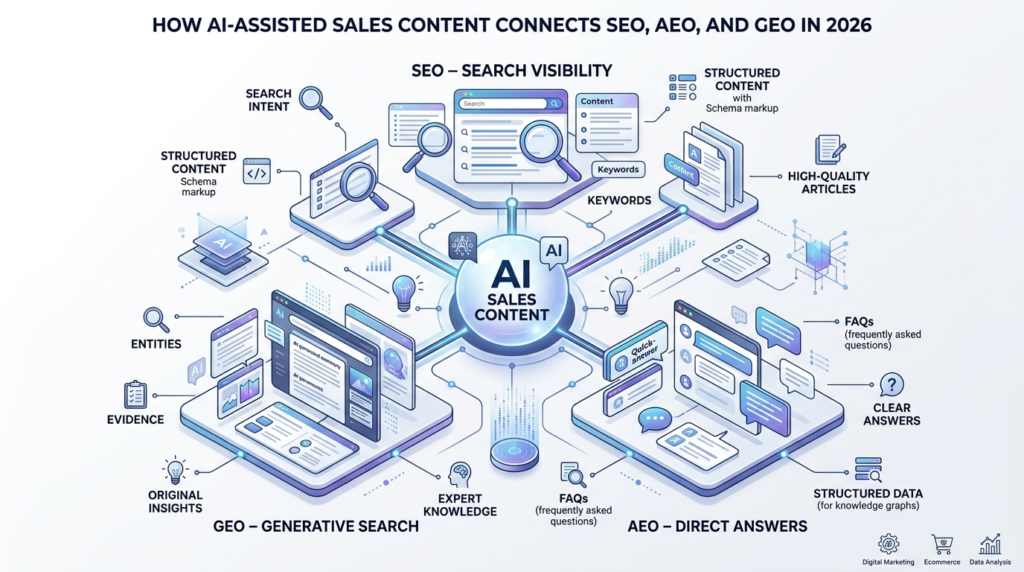
AI-generated sales copy can support SEO, AEO, and GEO when it’s useful, original, factually accurate, well structured, and matched to search intent. Producing more AI text on its own doesn’t guarantee rankings or citations—what works is combining first-hand information, clear answers, relevant entities, evidence, and human editorial review.
Sales copy and search optimization aren’t quite the same job. A product landing page needs to persuade a visitor; an informational article needs to answer a question clearly. The strongest content strategy does both.
- For SEO: search intent, relevant keywords, helpful headings, internal links, descriptive titles, meta descriptions, useful content, and page experience.
- For AEO: make the important information easy to extract—direct answers, question-based headings, short definitions, lists, tables, FAQs, and clear explanations.
- For GEO: original insights, first-hand experience, clear factual statements, strong topical coverage, author credibility, reliable sources, structured information, and consistent entity information across the web.
The underlying principle doesn’t really change: write for humans first, structure the information clearly, and make the important claims easy to verify.
Information Gain: How to Make AI Sales Content More Valuable
Information gain means giving readers something beyond generic advice—tested messaging frameworks, real customer language, before-and-after examples, decision criteria, original observations, or documented performance data that actually helps them decide.
This is where a lot of AI-generated articles fall flat. “AI can save time” isn’t useful on its own. A framework the reader can apply is.
Example: Build a message matrix.
| Customer Concern | Message Angle | Example |
|---|---|---|
| Too expensive | Cost efficiency | Reduce repetitive manual work. |
| Too complicated | Simplicity | Set up the workflow without technical expertise. |
| Doesn’t trust AI | Accuracy | Review and approve every output |
| No time | Productivity | Generate multiple variations faster. |
| Generic messaging | Personalization | Adapt the copy to different audiences. |
That’s a framework the reader can actually apply to their own product.
Don’t ask AI for “persuasive” copy alone.
Ask for a specific persuasion angle instead—pain-point focused, benefit focused, objection handling, social proof, comparison, educational, urgency, risk reduction, cost savings, or convenience. Naming the angle usually produces more usable variations than a vague request.
Pros and Cons of AI Sales Copy Generators
AI copy generators cut drafting time, produce many variations quickly, and help marketers push past writer’s block. Their limits are generic language, factual errors, weak differentiation, and the risk of publishing something unedited. The best results still come from combining AI generation with human strategy, editing, and verification.
| Advantages | Limitations |
|---|---|
| Faster brainstorming | Can produce generic copy |
| Multiple variations | May misunderstand context |
| Helps overcome writer’s block | Can make factual mistakes |
| Useful for repetitive copy | May sound repetitive |
| Supports many formats | Requires human review |
| Can scale content production | Does not replace customer research |
| Useful for testing ideas | Does not guarantee conversions |
A Practical AI Sales Copy Workflow
A reliable process matters more than which AI model you pick. Start with customer research, define the offer, give the AI product context, generate several messaging angles, edit the strongest version, verify every claim, and test the final copy with real audiences.
Step 1: Research the customer—pain points, goals, objections, buying triggers, and existing alternatives.
Step 2: Define the offer—product, main benefit, price, differentiator, guarantee if applicable, and proof.
Step 3: Give the AI context—your brand and product information, not a bare prompt.
Step 4: Generate multiple angles—don’t settle for one version.
Step 5: Select the strongest ideas—combine the best parts of a few drafts.
Step 6: Human-edit the copy—strip out empty hype, repetition, unsupported claims, and awkward wording.
Step 7: Test—compare different headlines, CTAs, offers, value propositions, and opening sentences against real traffic.
Frequently Asked Questions
What are AI sales copy generator tools?
AI sales copy generator tools are software applications that use generative AI to create promotional and persuasive text. They help marketers produce ads, emails, landing pages, product descriptions, headlines, CTAs, and other sales-focused content faster.
Can AI write sales copy?
Yes. AI can generate sales copy for ads, emails, websites, product pages, landing pages, and social media. The output still needs review for accuracy, brand voice, customer relevance, and unsupported claims before it goes live.
Is AI-generated sales copy good for ecommerce?
It’s particularly useful for ecommerce, since stores often need large volumes of product and promotional copy fast. AI can help with descriptions, benefits, headlines, ads, and email variations while keeping a consistent structure across hundreds of SKUs.
Can AI sales copy improve conversions?
AI helps you create and test more variations, but generating text on its own doesn’t increase conversions. That still depends on the offer, audience, positioning, product, user experience, and how rigorously you test.
What should I include in an AI sales copy prompt?
Product, target customer, customer problem, key benefits, unique selling proposition, tone, marketing channel, desired action, and any factual or stylistic restrictions. More relevant context almost always produces a more usable draft.
Which AI tool is best for sales copy?
There’s no single best tool for every workflow. Marketing teams may prioritize brand and campaign controls, sales teams need prospecting workflows, and ecommerce businesses often prioritize product-content generation at scale.
Can AI replace a professional copywriter?
AI can automate parts of the writing process, but professional copywriting also involves research, positioning, customer psychology, brand strategy, editing, testing, and judgment calls AI can’t make on its own. It’s a stronger assistant than a replacement.
Is AI copy good for SEO?
AI-generated content can work fine in an SEO workflow, but quality matters more than the fact that AI wrote it. Content still needs to satisfy search intent, provide real information, demonstrate expertise, avoid unsupported claims, and offer genuine value.
How do I make AI copy sound human?
Give it real brand context, use actual customer language, include specific examples, cut generic marketing phrases, vary sentence structure, and edit the final draft yourself. Real customer insight makes the biggest difference of anything on this list.
Should I publish AI-generated sales copy without editing?
No—review and edit it first. Check product information, prices, claims, testimonials, statistics, legal requirements, and brand voice. AI tools occasionally produce inaccurate or unsuitable content, and it’s cheaper to catch that before it publishes than after.
Final Takeaway
AI sales copy generator tools are most useful when they speed up a well-defined copywriting process, not when they replace it. Give the AI strong customer and product context, generate multiple angles, edit the strongest draft, verify every important claim, and test the final message with real users.
The biggest mistake is treating AI as a “write and publish” machine. A better approach:
Research → Strategy → AI Draft → Human Editing → Verification → Testing
That workflow gives you the speed of AI while keeping the strategic and creative judgment that actually makes sales copy work.
If you’re choosing a tool in 2026, the useful question isn’t “which AI writer has the most features?” It’s “which tool fits the type of sales content I create, the audience I serve, and the workflow I actually use?” That’s a much better way to decide.
For related reading, see our guides on AI Product Content Tools in 2026: The Complete Guide & Best AI Product Description. Generator Tools and Free AI Product Description Generator Tools in 2026: 10 Free Tools & AI Product Title Generator Tools in 2026: 10 Best Tools for E-Commerce & AI Product Bullet Point Generator & AI Meta Description Generator for Ecommerce & AI Copywriting Tools for Ecommerce: 15+ Best Tool