

AI Meta Description Generator for Ecommerce Products: Complete 2026 Guide
Writing unique, persuasive meta descriptions for hundreds of ecommerce products can take a lot of time. An AI meta description generator for ecommerce products can speed up the process by turning product information into concise, relevant search snippets.
This guide explains how AI-generated meta descriptions work, how to use them effectively, what makes a strong ecommerce snippet, and which mistakes can reduce their SEO value.
Table of Contents
- What Is an AI Meta Description Generator for Ecommerce?
- How AI Creates Product Meta Descriptions
- Why Ecommerce Stores Need Better Meta Descriptions
- Key Elements of a High-Quality Product Meta Description
- How to Generate SEO Meta Descriptions With AI
- Best AI Tools for Ecommerce Meta Descriptions
- AI-Generated vs. Manually Written Meta Descriptions
- Common Mistakes to Avoid
- Practical Tips for Better Search Snippets
- How to Optimize Meta Descriptions at Scale
- Measuring the Performance of Product Snippets
- Frequently Asked Questions
- Final Takeaway
What Is an AI Meta Description Generator for Ecommerce?
An AI meta description generator creates short search-result descriptions from product information such as titles, features, benefits, and keywords. For ecommerce websites, it can produce optimized descriptions at scale while keeping the messaging consistent across a large catalog. Even so, the final text should always be reviewed for accuracy, uniqueness, brand alignment, and natural language before it goes live.
A meta description is a short HTML description that can appear below a page title in search engine results.
For an ecommerce product page, it can summarize:
- What the product is
- Its main benefit
- Important features
- A relevant keyword
- A reason to click
- A simple call to action
AI can automate much of this writing process. Instead of manually creating hundreds of descriptions, store owners can provide product information and ask an AI system to generate several variations to choose from.
Example
Suppose an online store sells a wireless security camera.
Product information:
- 2K video
- Night vision
- Motion detection
- Two-way audio
- Indoor/outdoor use
A generated description might read:
Shop a 2K wireless security camera with night vision, motion detection, and two-way audio. Explore features and find the right camera for your home.
The important point is that AI should assist the optimization process rather than replace human review.
For a deeper look at every tool covering copywriting, taglines, and catalog content, check out our full guide to AI Product Content Tools.
How AI Generates Ecommerce Product Descriptions
AI systems analyze product details, search intent, keywords, benefits, and writing instructions to generate a concise description. Better results come from feeding the system accurate product information and clear constraints—and the output should still be checked for factual accuracy, duplication, tone, and search intent before publication.
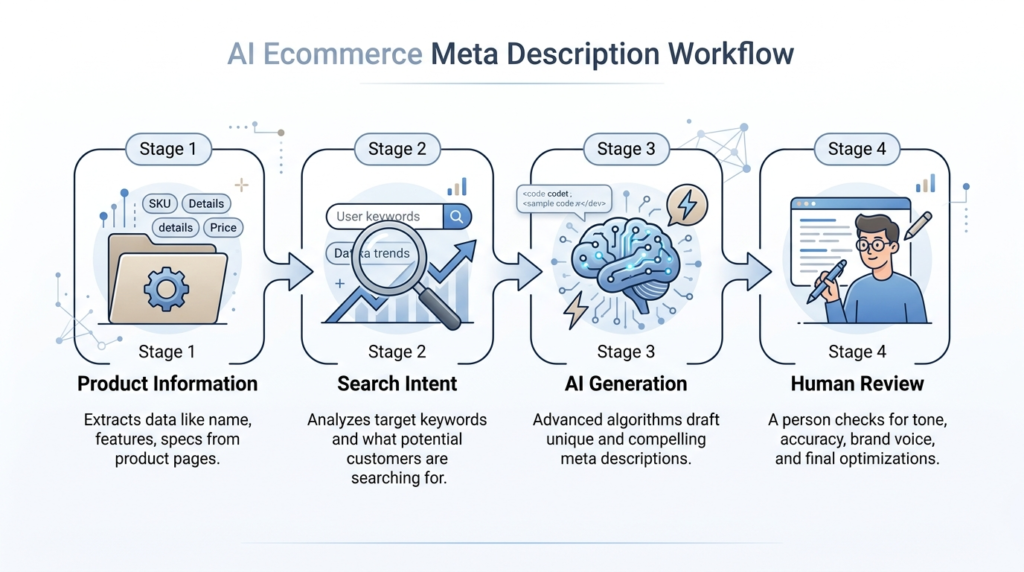
The process generally follows four steps.
1. Product Information Analysis
The AI first examines information such as
- Product name
- Product category
- Product features
- Specifications
- Customer benefits
- Target audience
- Brand voice
More useful input generally produces more useful output.
2. Search Intent Analysis
The description should match what the searcher actually wants.
For example:
Informational intent: “best wireless security camera for home”
Commercial intent: “wireless security camera with night vision”
Transactional intent: “buy wireless security camera”
The meta description should support the intent of the product page rather than simply repeating keywords.
3. Natural-Language Generation
The AI combines the product information into a concise snippet. A good description should sound like something a real ecommerce brand would write—not like a list of keywords strung together.
4. Human Review
This step matters more than it might seem. AI can sometimes:
- Add unsupported claims
- Repeat phrases
- Use generic language
- Misunderstand specifications
- Create descriptions that sound too similar to each other
Reviewing the final text before publishing helps catch these problems early.
Why Ecommerce Stores Need Optimized Meta Descriptions
Ecommerce websites often contain hundreds or thousands of product pages, which makes manual optimization difficult. Well-written meta descriptions can communicate product value, reinforce search intent, and encourage users to visit the page. They don’t guarantee higher rankings on their own, but they can make search results noticeably more useful and compelling.
A large ecommerce website may have:
- Hundreds of products
- Multiple product categories
- Product variations
- Seasonal collections
- Frequently changing inventory
Creating unique descriptions manually for all of this can become repetitive fast, which is where AI automation helps reduce the workload.
Faster Content Production
Instead of starting every description from scratch, marketers can generate a first draft and edit it—cutting the time spent per product significantly.
Greater Consistency
AI-assisted templates can help maintain a consistent:
- Tone
- Structure
- Brand message
- Call-to-action style
Easier Bulk Optimization
If a store has thousands of product pages with missing or weak meta descriptions, AI can create a solid starting point for optimization instead of leaving those fields empty.
Key Elements of a High-Quality Product Meta Description
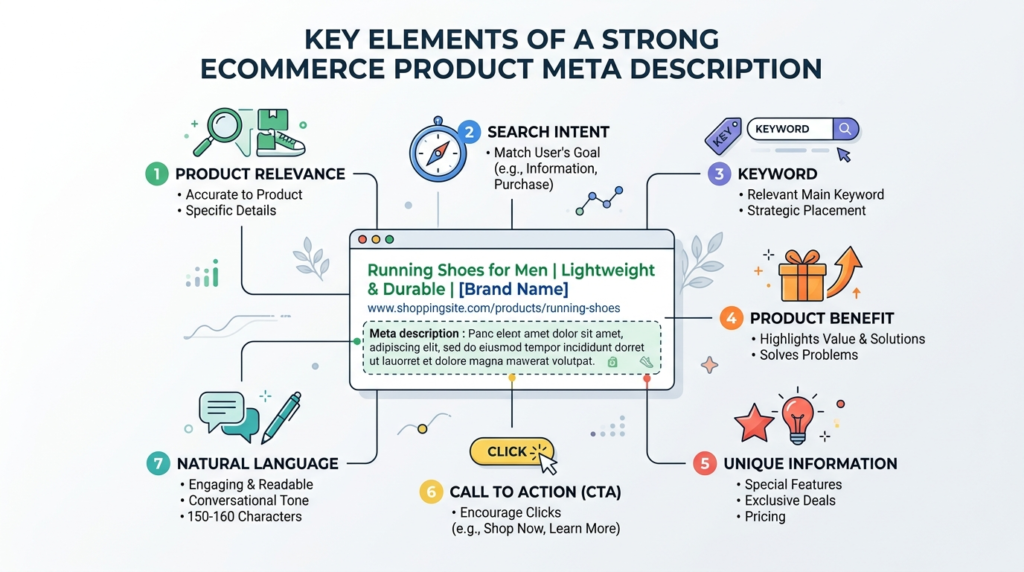
A strong product meta description should clearly communicate the page’s value, reflect the product accurately, and match search intent. It should include the primary topic naturally where it fits, highlight a meaningful benefit, and use a compelling call to action — while avoiding keyword stuffing, exaggerated claims, and identical descriptions across multiple products.
| Element | Purpose |
|---|---|
| Product relevance | Makes the snippet match the landing page |
| Search intent | Aligns with what users are looking for |
| Main keyword | Reinforces topical relevance naturally |
| Product benefit | Gives users a reason to click |
| Unique information | Differentiates the page |
| CTA | Encourages the next action |
| Natural language | Improves readability and trust |
Include the Main Topic Naturally
If the target phrase fits naturally, include it. There’s no need to force an exact-match keyword into every sentence.
Highlight a Real Benefit
Instead of saying:
Buy our amazing product today.
Consider:
Compare key features, explore available options, and find the right product for your needs.
The second version gives the searcher a clearer reason to visit.
Use a Relevant CTA
Useful CTAs include:
- Explore the product
- Compare features
- Shop now
- Discover more
- See available options
- Find the right solution
The CTA should fit the page naturally rather than being tacked on automatically.
How to Generate SEO Meta Descriptions With AI
Start with the product title, features, benefits, target audience, primary keyword, and search intent. Ask AI to create several concise variations using natural language, then select the strongest version, verify every product claim, remove unnecessary keyword repetition, and check how the description appears alongside the page title.
Step 1: Collect Product Information
Prepare:
- Product name
- Primary keyword
- Product category
- Main features
- Key benefits
- Target customer
- Unique selling point
- Relevant CTA
Step 2: Define the Search Intent
Ask: What is the user trying to accomplish?
For example:
Find an affordable AI product description generator for an online store.
The resulting description should address that purpose directly.
Step 3: Create an AI Prompt
A practical prompt could be
Write 3 unique meta descriptions for this ecommerce product page. Keep them concise, natural, and persuasive. Include the primary keyword only when it fits naturally. Highlight the main product benefit and add a relevant CTA. Do not invent specifications or make unsupported claims.
Step 4: Compare Multiple Versions
Generate several alternatives instead of publishing the first result automatically. Look for:
- Clarity
- Relevance
- Uniqueness
- Readability
- Accurate product information
- Strong value proposition
Step 5: Perform a Human Edit
Replace generic AI phrases with specific product information.
For example:
Generic:
Discover the best solution for your needs with our high-quality product.
More useful:
Explore a compact wireless camera with 2K video, night vision, and motion detection for everyday home security.
The second description actually communicates something.
Best AI Tools for Ecommerce Meta Descriptions
Several AI writing platforms can generate meta descriptions alongside product titles and descriptions, but they’re built for different workflows. The right choice depends on your catalog size, your CMS, and how much editorial control you want to keep.
Describely.ai—Built specifically for ecommerce, it generates product titles, descriptions, bullet points, and meta tags together and can fill in missing attributes when catalog data is thin. It supports bulk generation and connects with Shopify, WooCommerce, CSV files, and PIM systems, which makes it a reasonable fit for stores optimizing metadata across large catalogs.
Hypotenuse AI—Aimed at ecommerce and marketing teams, it covers product metadata, category pages, and blog content from one platform, with brand-voice controls and bulk generation for larger stores.
Shopify Magic—Built into Shopify itself, it’s a free, low-friction option for merchants who just need workable first drafts without adding another tool to the stack. It’s better suited to smaller catalogs than to heavy bulk optimization.
Copy.ai and Jasper AI—general-purpose AI writing platforms with dedicated templates for product and meta descriptions. Both work well if your team already uses them for other marketing copy, though neither is built primarily for catalog-scale bulk operations or PIM/CSV workflows.
Whichever tool you use, treat its output the same way: a first draft that still needs a human pass for accuracy, tone, and duplication before it goes live. Pricing, feature sets, and integrations for these tools can change, so it’s worth checking each platform’s current plans before committing.
AI-Generated vs. Manually Written Meta Descriptions
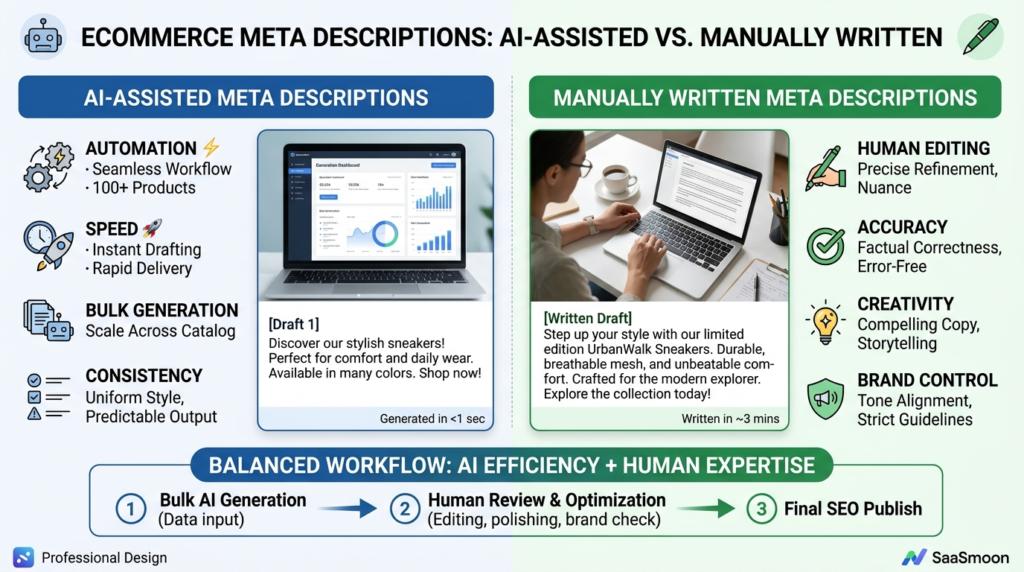
AI-generated and manually written meta descriptions can both work well. AI is particularly helpful for speed, consistency, and large product catalogs, while manual writing gives more control over messaging and brand voice. In practice, a workflow that combines AI-generated drafts with human editing and quality checks tends to work best for most stores.
| Factor | AI-Assisted | Manual |
|---|---|---|
| Speed | High | Lower |
| Bulk production | Strong | Time-consuming |
| Consistency | Strong with templates | Depends on the writer |
| Brand nuance | Requires guidance | More direct control |
| Human creativity | Limited | Strong |
| Quality control | Requires review | Writer-controlled |
| Scalability | Excellent | More difficult |
For many stores, a human + AI workflow is more practical than relying entirely on either method.
Common Mistakes to Avoid
The most common ecommerce metadata mistakes include keyword stuffing, duplicate descriptions, unsupported claims, generic wording, missing product context, and publishing AI output without review. These issues weaken the connection between the search query, the product page, and what the user actually expected to find.
1. Keyword Stuffing
Avoid writing:
Buy running shoes, best running shoes, cheap running shoes, running shoes online…
It sounds unnatural and provides little value to the reader.
2. Using the Same Description Everywhere
Every important product page should have a description relevant to that specific page—not a copy-pasted template with the product name swapped in.
3. Making Unsupported Claims
AI should never invent:
- Discounts
- Certifications
- Guarantees
- Product specifications
- Performance claims
- Awards
4. Making Every Description Sound Identical
Templates can improve consistency, but excessive repetition can make a large catalog feel automated and generic.
5. Ignoring Search Intent
A product page shouldn’t have a description that reads like a general informational article.
6. Publishing AI Output Without Review
AI-generated content should be treated as a draft that requires quality control, not a finished asset.
Practical Tips for Better Search Snippets
Focus each meta description on one product page and one clear search intent. Put useful product information early, emphasize a genuine benefit, and avoid filler. Create unique descriptions where possible, review AI output manually, and test important pages based on real search performance rather than relying only on automated recommendations.
Tip 1: Put Important Information Early
Search snippets may be truncated depending on device and display width, so place the most useful information toward the beginning.
Tip 2: Write for People First
Ask yourself: if I saw this result in Google, would I understand why I should click? If the answer is no, rewrite it.
Tip 3: Use Specific Product Benefits
Specific information usually communicates more value than generic marketing language.
Tip 4: Match the Product Page
The description should accurately represent what users will find after clicking.
Tip 5: Don’t Chase an Exact Character Count
Search engines can rewrite snippets, so there’s no universal character limit that guarantees the entire description will always appear. Focus on clarity, relevance, and usefulness instead.
How to Optimize Product Metadata at Scale
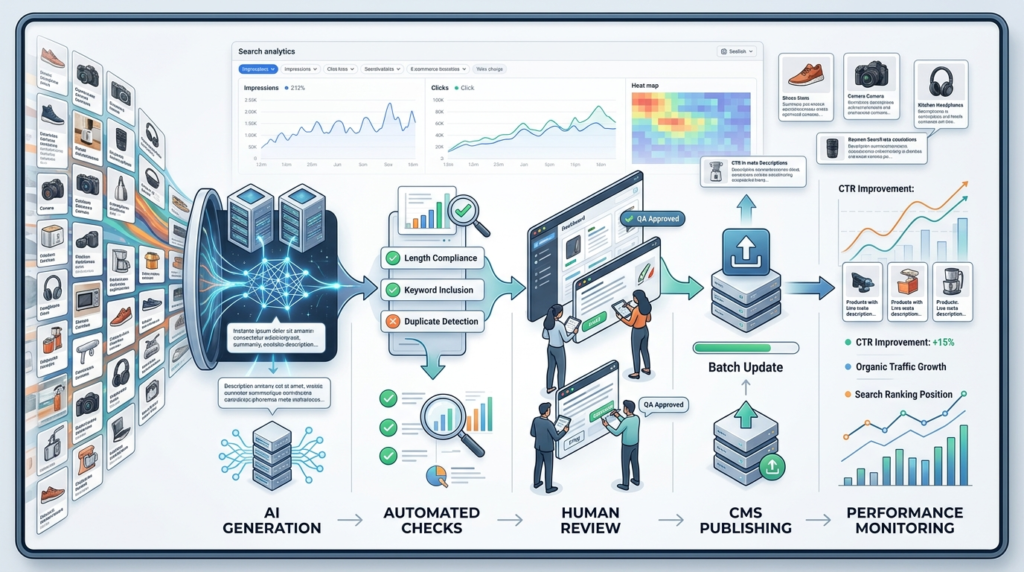
Large ecommerce websites can combine product databases, AI templates, SEO rules, and human quality checks to optimize metadata efficiently. Start with high-value product pages, create structured prompts, generate descriptions in batches, validate the output, and monitor search performance after publishing.
A scalable workflow can look like this:
Product database → AI generation → automated checks → human review → CMS publishing → performance monitoring
Build a Structured Template
For example:
Product name + primary benefit + key feature + differentiator + CTA
Not every product needs exactly the same structure, but a repeatable framework makes large-scale optimization far more manageable.
Prioritize Important Pages
Instead of optimizing every page at once, start with:
- High-traffic products
- High-conversion products
- Important category pages
- Pages with missing metadata
- Pages with weak existing snippets
Measuring the Performance of Product Snippets
Meta description performance should be evaluated using search impressions, clicks, click-through rate, and page-level search data—rather than rankings alone. Compare similar pages over time and account for changes in search demand, titles, rankings, and seasonality before attributing a performance change to the description alone.
| Metric | What It Can Tell You |
|---|---|
| Impressions | How often pages appear in search |
| Clicks | How many visits come from search? |
| CTR | How often impressions result in clicks |
| Average position | Approximate search visibility |
| Organic conversions | Business impact |
Google can sometimes generate a different search snippet than the one stored in your CMS, so testing should look at the actual snippet shown in search results, not just the metadata you saved.
A Simple Testing Approach
- Identify pages with significant impressions.
- Review their current snippets.
- Improve clarity and relevance.
- Record the change date.
- Monitor search performance.
- Compare against similar pages where possible.
Avoid assuming that every CTR change comes from the meta description alone—other factors move at the same time.
Expert Insight and Trust Signals
AI-generated ecommerce metadata should be backed by accurate product information and checked against reliable sources. For technical, medical, financial, safety, or performance claims, lean on authoritative documentation rather than AI-generated text alone. This kind of review matters most for products where incorrect information could actually affect a purchasing decision.
Search marketers who work with large catalogs generally agree on one thing: AI speeds up the first draft, but it’s the human review pass—checking claims, tightening language, and cutting anything generic—that actually makes the metadata worth publishing.
For product-specific claims, consider referencing:
- Manufacturer documentation
- Official product specifications
- Industry standards
- Original research
- Reliable third-party testing
- Expert commentary
References should support claims that genuinely need evidence, not exist purely as an SEO checkbox.
Information Gain: A Better AI Workflow for Ecommerce Metadata
The biggest advantage of AI metadata generation isn’t just producing text faster—it’s building a workflow that uses structured product data, search intent, unique selling points, and quality checks to create descriptions that are more useful than a generic template. The best results come from combining automation with product-specific human judgment.
Here are a few practical improvements that make an AI workflow more effective.
Create a Product Fact Sheet
Before generating metadata, organize product information into structured fields, for example:
| Field | Example |
|---|---|
| Product | Wireless Security Camera |
| Main benefit | Remote home monitoring |
| Resolution | 2K |
| Night vision | Yes. |
| Motion detection | Yes. |
| Audience | Homeowners |
| CTA | Explore features |
This gives the AI cleaner information to work with.
Create a Forbidden-Claims List
For sensitive product categories, tell the AI explicitly what it must not claim. For example:
Do not invent certifications, guarantees, medical benefits, test results, discounts, or specifications.
Generate Variations
Instead of creating one description, generate a few different approaches:
- Benefit-focused
- Feature-focused
- Problem-solution
- Product-specific
- Comparison-oriented
Then select the version that fits the page best.
Frequently Asked Questions
What is an AI meta description generator for ecommerce products?
An AI meta description generator creates concise search-result descriptions using product information, keywords, benefits, and search intent. It helps ecommerce businesses produce metadata faster, particularly when managing large product catalogs.
Can AI write SEO-friendly meta descriptions?
Yes. AI can produce useful SEO-focused drafts when given accurate product information and clear instructions. The output should still be reviewed for accuracy, uniqueness, relevance, and brand voice before publishing.
How long should an ecommerce meta description be?
There’s no fixed length that guarantees a description will display completely in Google. Snippets can be truncated or rewritten, so the better approach is to keep the description concise and put the most important information first.
Should every product page have a unique meta description?
Unique, relevant descriptions are generally preferable for important ecommerce pages—they let each page communicate its specific value to searchers instead of blending together. For very large catalogs, prioritizing high-traffic and high-conversion pages first is usually more realistic than aiming for 100% uniqueness on day one.
Should I put the exact keyword in every meta description?
No. Use the primary keyword when it fits naturally and accurately describes the page. Repeating an exact keyword unnecessarily just makes the text sound unnatural.
Can AI-generated meta descriptions improve Google rankings?
A meta description itself isn’t a direct ranking factor. Its main role is to describe the page in search results and influence user behavior—search visibility depends on many other factors.
Does Google always use the meta description I provide?
No. Google can generate or rewrite search snippets based on the search query and page content when it decides another excerpt might answer the searcher’s needs better.
Can I generate meta descriptions for thousands of products?
Yes. AI is particularly useful for large catalogs, but bulk generation should still include structured product data, validation rules, duplicate checks, and human review for important pages.
Are AI-generated meta descriptions safe to publish automatically?
Not really. Automatic publishing can introduce factual errors, repetitive language, or unsupported claims, so a review process is recommended—especially for important or technically complex products.
What information should I give an AI tool?
Provide the product name, features, benefits, target audience, primary topic or keyword, unique selling points, search intent, and any claims the tool must avoid.
Final Takeaway
An AI meta description generator for ecommerce products can save significant time when optimizing large product catalogs. The real value comes from using AI as part of a structured SEO workflow—not from publishing every generated sentence automatically.
Start with accurate product information, define the search intent, generate several variations, review the output, and monitor real search performance.
The goal is simple: make every product snippet useful, accurate, relevant, and compelling enough to earn the searcher’s attention.
For related reading, see our guides on AI Product Content Tools in 2026: The Complete Guide & Best AI Product Description. Generator Tools and Free AI Product Description Generator Tools in 2026: 10 Free Tools & AI Product Title Generator Tools in 2026: 10 Best Tools for E-Commerce & AI Product Bullet Point Generator