AI Copywriting Tools for Ecommerce: 15+ Best Tools to Create Better Store Content in 2026
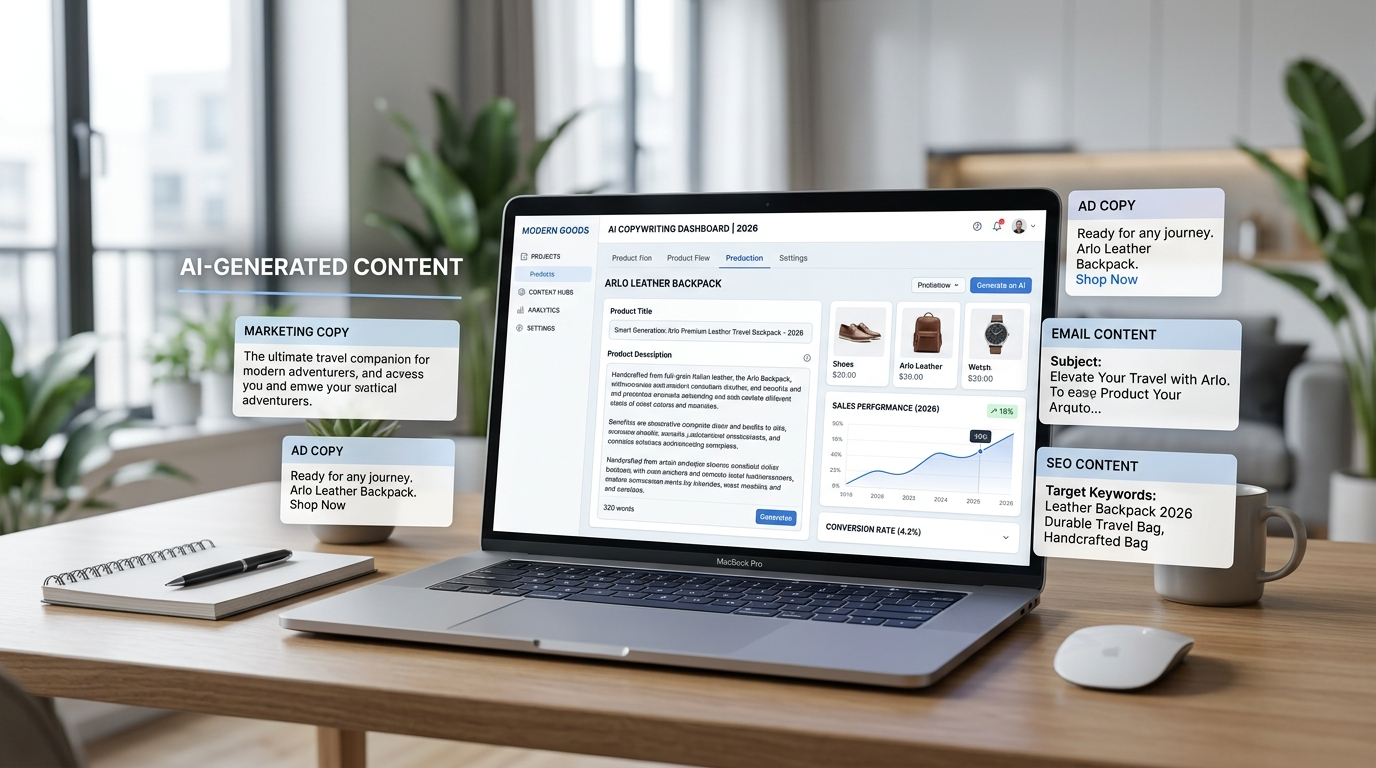
AI copywriting tools for ecommerce help online stores create product descriptions, ad copy, email campaigns, landing-page content, social posts, and other marketing copy faster. The best tools can reduce repetitive writing work while helping brands maintain a consistent voice, improve clarity, and produce content tailored to different stages of the customer journey. Below, you’ll find 15 real tools compared side by side—grouped by what each is actually built to do (product descriptions, ads, email, SEO, or general-purpose) rather than ranked on a single score—plus a practical workflow for using any of them without ending up with generic, AI-sounding copy.
Table of Contents
- What Are AI Copywriting Tools for Ecommerce?
- Why Ecommerce Businesses Use AI Copywriting Tools
- 15 AI Copywriting Tools for Ecommerce in 2026 Compared
- AI Product Copywriting Tools
- AI Tools for Ecommerce Ad Copy
- AI Ecommerce Tools for Email Marketing
- AI Copywriting Tools for SEO Product Content
- How to Choose an AI Writing Tool for Your Online Store
- How to Use AI Copywriting for Ecommerce Effectively
- Common AI Copywriting Mistakes Ecommerce Brands Should Avoid
- AI Copywriting Workflow for Ecommerce Stores
- AI Copywriting vs Human Copywriting
- Getting More Out of the Prompt: Real Inputs Beat Clever Instructions
- The Future of AI Ecommerce Copywriting
- Frequently Asked Questions
- Final Takeaway
What Are AI Copywriting Tools for Ecommerce?
AI copywriting tools for ecommerce are software applications that use large language models to generate or improve marketing content for online stores—product descriptions, ads, emails, website copy, social captions, and other sales-focused text. Give one product information and instructions, and it drafts the copy for you.
Common uses include:
- Product descriptions and titles
- Product bullet points
- Meta titles and descriptions
- Google, Facebook, and Instagram ad copy
- Email campaigns
- Landing pages and category-page content
- Blog posts and social captions
- SMS marketing copy
- Marketplace listings
- Product comparison content
Instead of starting with a blank page, a store owner provides product information and asks the tool for a first draft.
How AI Ecommerce Copywriting Works
Most tools follow the same basic flow:
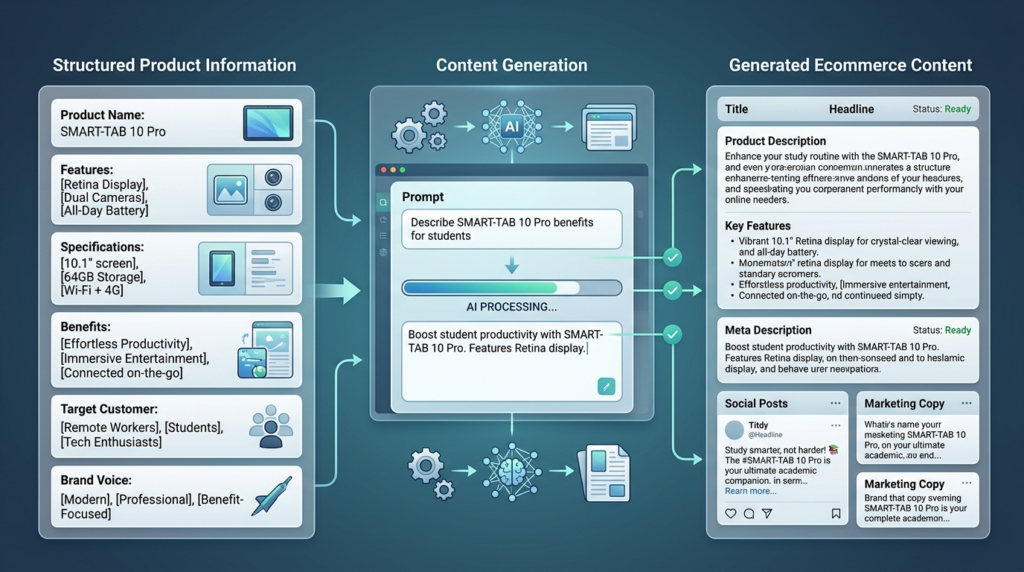
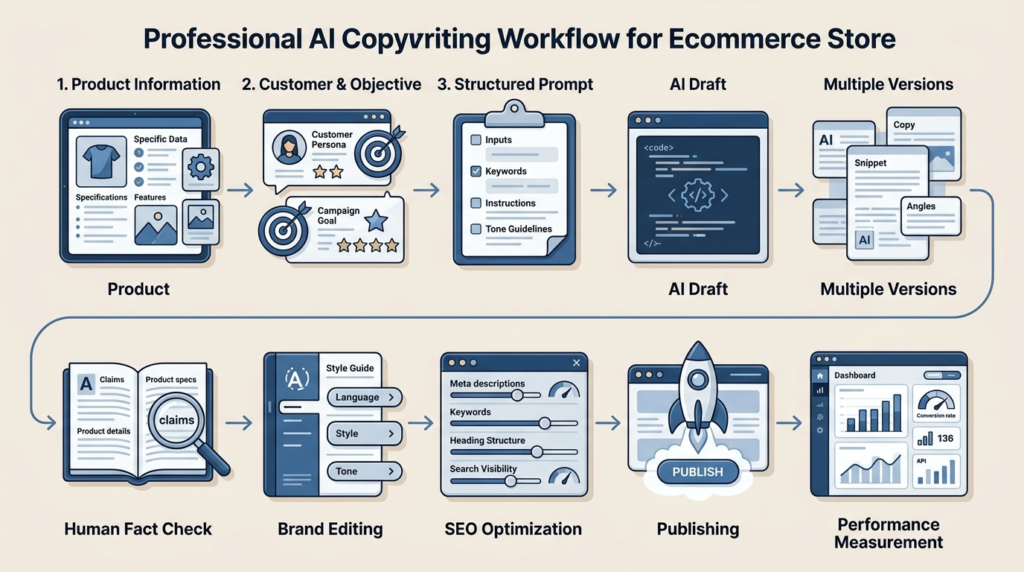
Product information → instructions → generated copy → human review → publishing
You’d typically feed in the product name, features, target customer, main benefits, price, brand voice, and important keywords. The tool turns that into a draft.
Worth remembering: treat AI-generated copy as a draft, not finished content. A human still needs to check facts, brand voice, differentiation, and compliance before it goes live.
For a deeper look at every tool covering copywriting, taglines, and catalog content, check out our full guide to AI Product Content Tools.
Why Ecommerce Businesses Use AI Copywriting Tools
Running an online store can mean writing hundreds or thousands of pieces of copy—for the website, Google Shopping, marketplaces, paid ads, email, social, blog content, and product feeds. Doing all of that manually eats time fast, and AI is good at absorbing the repetitive part of it.
Benefits of AI Writing Tools for Online Stores
| Benefit | How It Helps Ecommerce |
|---|---|
| Faster production | Creates first drafts quickly |
| Content variations | Produces multiple versions of similar copy |
| Consistency | Helps maintain a defined brand voice |
| Scalability | Useful for large product catalogs |
| Ideation | Generates headlines, angles, and campaign ideas |
| Localization | Can help adapt copy for different markets |
| Optimization | Can rewrite content for clarity or a specific channel |
| Workflow support | Reduces repetitive writing tasks |
The Real Advantage Is Scale, Not “Better” Writing
AI doesn’t necessarily write better than a skilled copywriter. What it does well is let a small team produce and iterate on far more content in far less time. A store with 5,000 SKUs doesn’t need 5,000 completely original creative concepts—it needs a scalable system for turning reliable product data into usable drafts.
15 AI Copywriting Tools for Ecommerce in 2026, Compared
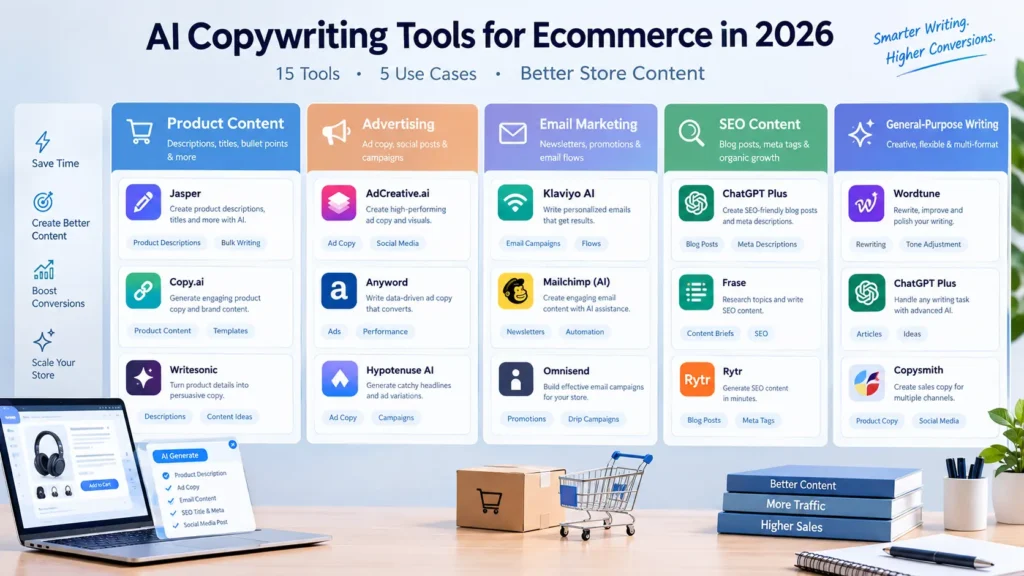
There’s no single “best” AI writing platform for every store—the right pick depends on your catalog size, channels, budget, and workflow. The list below isn’t a 1-to-15 ranking; it’s organized by what each tool is actually built to do well, so you can match it to the specific job (product copy, ads, email, SEO, or general use) rather than picking whichever one is ranked highest.
| Tool | Best For | Notes |
|---|---|---|
| Jasper | Brand consistency across a marketing team | Strong brand-voice training and campaign workflows; more of a full marketing suite than a single-purpose product-copy tool |
| Copy.ai | Marketing copy plus bulk product descriptions | Advertises spreadsheet-upload bulk generation (product names/features in, descriptions out) and a large template library—confirm this is still current on their site before you write it up as a feature. |
| Writesonic | SEO-driven content on a budget | Handles short-form copy (FAQs, ad copy, and product descriptions) well; long-form blog content is a weaker spot. |
| Hypotenuse AI | Bulk product content at scale | Positions itself as an e-commerce/PXM tool that connects to a PIM, ERP, or store platform to enrich product data and generate titles/descriptions at scale—verify exactly which integrations are live before publishing specifics. |
| Describely | Catalog-heavy Shopify stores | Focused purely on ecommerce product descriptions rather than general marketing copy |
Anyword | Data-driven ad and PDP copy | Markets a predictive performance score meant to estimate how copy will perform before you publish; also lists a free entry tier—double-check current tier names and limits, since free-plan details change often. |
| AdCreative.ai | Paid ad copy and creative | Purpose-built for ad campaigns if paid acquisition is your main channel |
| Shopify Magic | Quick, native product-page edits | Built into Shopify itself, free to use, and convenient for fast touch-ups—but output tends to sound generic if used without editing. |
| Wordtune | Polishing an existing draft | Less a generator, more a rewriting/clarity tool—useful once you already have a draft and want to tighten tone and readability. |
| ChatGPT Plus | General-purpose flexibility | Not ecommerce-specific, but a capable, affordable all-rounder if you’re willing to write your own prompts and structure |
| Rytr | Low-cost brand-voice copy | Budget-friendly option for solo sellers and small stores |
| Frase | SEO research and content briefs | More of a research/brief tool than a drafting tool—useful earlier in the workflow, before writing |
| AdZis | Done-for-you catalog copy | Offers a more hands-off service model (their team/AI produces copy for you) alongside self-serve options; has a Shopify app |
| Copysmith | Ecommerce descriptions and bulk listings | The company is reported to have split into separate focused products (Frase for SEO research, Rytr for brand-voice copy, and Describely for product descriptions)—verify the current structure before writing this up as fact. |
| Wordsmith | Data-to-text automation | Suited to highly structured, repetitive output (spec sheets, feed-driven listings) rather than creative copy |
| Klaviyo AI | Ecommerce-native email and SMS copy | Built directly into Klaviyo’s email/SMS platform, so it’s generating copy inside the same tool that sends and tracks the campaign—a natural fit if Klaviyo is already your ecommerce email stack. |
A note before you publish this table: the feature and integration details above reflect how each tool positions itself as of this draft. Tool features, integrations, and pricing tiers change often—confirm the specific claims (Copy.ai’s bulk upload, Hypotenuse AI’s integrations, Anyword’s scoring model, and Copysmith’s product split) against each vendor’s current site before treating them as settled fact on the published page.
What to Compare Before Choosing
- Output quality on your actual products, not the demo examples
- Ecommerce-specific templates
- Brand voice controls
- SEO features
- Product data handling and integrations (Shopify, WooCommerce, PIM/ERP)
- Bulk generation
- Export options
- Pricing and usage limits—check each vendor’s current pricing page, since plans and free tiers change often
Test Before Committing
Don’t judge a tool from its homepage. Give two or three of them the exact same product information and prompt, then compare accuracy, originality, readability, brand alignment, and how much editing each draft actually needs. That last one — editing time — is usually the most honest metric you’ll get.
AI Product Copywriting Tools
Product content is the most common use case for AI writing in ecommerce. A good description answers the buyer’s real questions while explaining why the product is worth it.
What AI Can Create for Product Pages
- Product titles
- Short and long descriptions
- Feature bullets and feature-to-benefit explanations
- Calls to action
- FAQ content
- Meta descriptions
- Image alt-text drafts
Example: Weak Input vs. Strong Input
A thin prompt like “Write a description for this backpack” gets you a thin description. Compare that to giving the tool structured facts:
Product: 25L waterproof hiking backpack Material: Recycled polyester Capacity: 25 liters Target customer: Day hikers and commuters Features: Laptop sleeve, waterproof zipper, chest strap Tone: Practical and trustworthy CTA: Encourage shoppers to explore the product.
The second version gives the model something to actually work with—who it’s for, what problem it solves, and what makes it different—instead of forcing it to invent detail.
AI Tools for Ecommerce Ad Copy
Ad copy needs constant experimentation: different messaging for new customers, returning customers, price-sensitive shoppers, premium buyers, seasonal pushes, and retargeting audiences. Tools like Anyword and AdCreative.ai lean specifically into this—Anyword for scoring how copy is likely to perform, and AdCreative.ai for generating and testing ad variations at volume.
Ecommerce Ad Copy Angles
Problem → Solution “Struggling to keep your workspace organized? This compact desk organizer keeps everyday essentials within reach.”
Benefit-focused “Keep your desk cleaner and your essentials easier to find.”
Feature-focused “Five compartments, durable construction, and a compact footprint.”
Urgency-focused “Refresh your workspace before the new season starts.”
These angles need to be tested against real performance data, not assumed to work equally well.
Generate Angles, Not Just Variations
Rather than asking for 20 versions of the same sentence, ask for 4–5 different messaging angles—convenience, cost savings, quality, problem-solving, and lifestyle. That creates real creative diversity instead of the same idea reworded.
AI Ecommerce Tools for Email Marketing
Email needs both persuasive copy and relevance to the specific customer. AI can help draft subject lines, preview text, welcome sequences, abandoned-cart messages, product launch emails, seasonal campaigns, re-engagement emails, and post-purchase follow-ups. General tools like Copy.ai, Jasper, and Writesonic all cover this reasonably well, since email copy structure is fairly template-friendly.
A Simple Ecommerce Email Structure
Subject: A practical upgrade for your daily routine Opening: Name the customer’s situation. Problem: Call out a relevant pain point. Solution: Introduce the product. Benefits: Explain why it matters. CTA: One clear next step.
AI can produce the first draft; the marketer makes sure it reflects the actual offer, audience, and current promotion.
AI Copywriting Tools for SEO Product Content
SEO-focused writing needs a different mindset from general copy—the goal isn’t repeating the target keyword as often as possible; it’s clearly addressing what the searcher actually wants to know.
Useful Ecommerce SEO Content Elements
SEO titles, meta descriptions, H1/H2 structure, product and category descriptions, FAQs, internal-link ideas, and semantic keyword variations. Frase is built specifically for this research-and-brief stage, while Writesonic and Copy.ai both have SEO-aware modes for drafting the actual content.
Avoid Keyword Stuffing
Repeating “AI copywriting tools for ecommerce” in every sentence doesn’t help—natural variation reads better and still signals relevance:
- AI writing software for online stores
- Ecommerce content generators
- AI product description tools
- Automated product copywriting
- AI marketing writing assistants
How to Choose an AI Writing Tool for Your Online Store
1. Identify Your Main Content Need
Product descriptions, SEO content, ad copy, email, social—or all of the above at bulk-catalog scale? A specialized tool (Describely, Hypotenuse AI) often beats a general-purpose one for a narrow, repetitive job; a broader tool (Jasper, Copy.ai) makes more sense if you need one system for everything.
2. Check Brand Voice Features
Your store shouldn’t read like every other AI-generated site in the niche. Look for controls over tone, vocabulary, sentence style, target audience, and words to avoid.
3. Consider Bulk Content Generation
If you’re managing hundreds or thousands of SKUs, bulk processing (Copy.ai’s spreadsheet upload, Hypotenuse AI’s PIM integration) is far more scalable than pasting products into a chat window one at a time.
4. Evaluate Integrations
Shopify, WooCommerce, your CMS, PIM/ERP systems, email platforms, ad platforms, spreadsheets, and API access — check what actually connects to your stack before you commit.
5. Test Before Committing
Give two or three shortlisted tools the same product info and prompt, then compare output quality and, especially, how much editing each one needs.
How to Use AI Copywriting for Ecommerce Effectively
A practical workflow:
- Gather product information
- Define the customer
- Define the objective
- Give the tool structured instructions
- Generate a few versions
- Fact-check the output
- Add human brand insight
- Optimize for the channel
- Publish
- Measure results
The 80/20 Approach
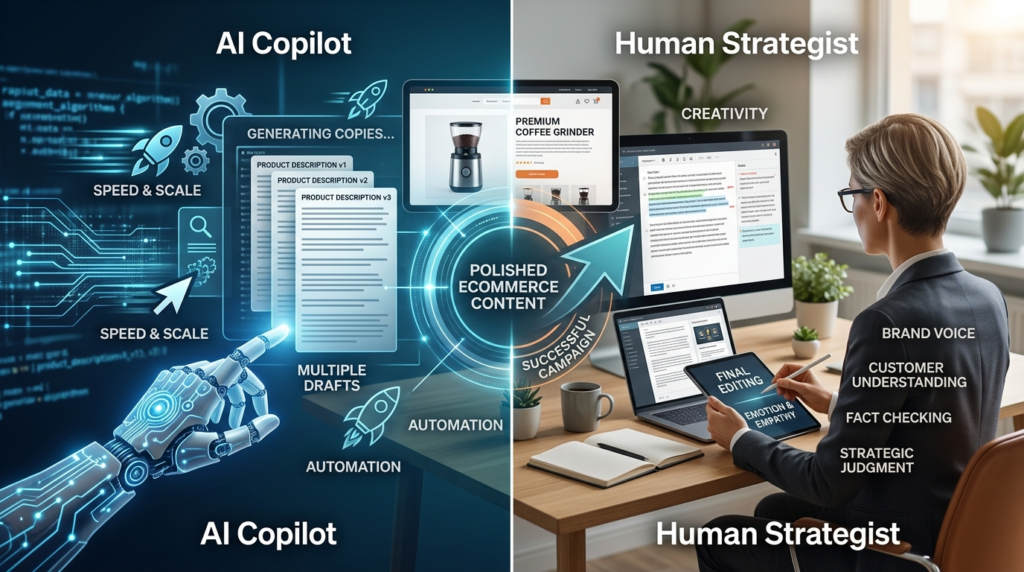
Let AI handle the repetitive 80% of the process. Spend your own attention on the 20% that actually needs it: brand judgment, customer understanding, product expertise, original ideas, differentiation, compliance, and final editing. Trying to fully automate the whole thing tends to produce copy that’s technically finished but doesn’t convert any better than a template.
Common AI Copywriting Mistakes Ecommerce Brands Should Avoid
Mistake 1: Publishing AI Output Without Review
AI writes convincing sentences that aren’t always accurate. Always verify measurements, materials, compatibility, prices, warranty terms, and performance claims before publishing.
Mistake 2: Using Generic Product Descriptions
If your description could describe 50 competing products, it isn’t doing its job. Add real differentiators, specific use cases, customer concerns, and brand-specific detail.
Mistake 3: Overusing Keywords
SEO copy should still read naturally—don’t sacrifice readability to hit a keyword-density number nobody’s actually checking.
Mistake 4: Making Unsupported Claims
Be careful with phrases like “best on the market,” “guaranteed results,” “100% effective,” or “the world’s #1 product. “Don’t add these just because the AI suggested them—they need to be true and defensible.
Mistake 5: Making Every Page Sound the Same
Repeating the same prompt and structure across hundreds of products produces obviously repetitive content. Vary the openings, benefit priorities, use cases, and sentence structure, and feed in genuinely product-specific information each time.
AI Copywriting Workflow for Ecommerce Stores
For larger catalogs, build a repeatable system instead of improvising each time.
Step 1: Create a Product Data Sheet
| Field | Example |
|---|---|
| Product name | TrailPro Backpack |
| Category | Hiking Backpack |
| Material | Recycled Polyester |
| Capacity | 25L |
| Features | Laptop sleeve, chest strap |
| Customer | Hikers and commuters |
| Main benefit | Convenient everyday carrying |
| Tone | Practical |
| Keywords | Hiking backpack, 25L backpack |
Step 2: Create a Standard Prompt
Specify the target customer, content type, desired length, brand tone, product facts, SEO requirements, restrictions, and CTA every time—consistency in the prompt is what keeps output consistent across hundreds of products.
Step 3: Generate Multiple Drafts
Don’t default to the first version. Generate two or three and combine the strongest elements.
Step 4: Human Quality Assurance
Check in this order: accuracy → originality → brand voice → search intent → readability → compliance.
Step 5: Measure Results
Track organic clicks, impressions, CTR, add-to-cart rate, conversion rate, revenue, email clicks, and ad performance—then feed what works back into your standard prompt.
AI Copywriting vs Human Copywriting
| Area | AI Copywriting | Human Copywriting |
|---|---|---|
| Speed | Very high | Lower |
| Scale | Excellent | Limited by time |
| First drafts | Strong | Strong |
| Repetitive content | Excellent | Time-consuming |
| Brand strategy | Needs direction | Strong |
| Product expertise | Depends on input | Can be strong |
| Original creative thinking | Variable | Strong |
| Fact verification | Requires review | Requires review |
| Final judgment | Limited | Strong |
The more useful question isn’t “Should AI replace human copywriters?”—it”‘s “Which parts of my copywriting workflow should AI actually handle?” That framing leads to better tool choices and a better final product.
Getting More Out of the Prompt: Real Inputs Beat Clever Instructions
The biggest jump in AI copy quality usually comes from better inputs, not a cleverer prompt. Feeding the model real customer questions, objections, and language gives it information it can’t reliably invent on its own.
Add Real Customer Questions
Will this fit a 15-inch laptop? Is it suitable for airline travel? Can it be washed? How long does the battery last? Is installation required?
These make genuinely useful FAQ and product-page content.
Add Real Customer Objections
- Is it worth the price?
- Is it durable? Is it hard to use?
- Does it work with my existing setup?
Addressing objections directly makes copy more persuasive without relying on exaggerated claims.
Use Real Customer Language
Reviews, support tickets, and past sales conversations show you how customers actually describe their problems—that language is worth feeding back into headlines, benefit statements, FAQs, and ad angles. No AI tool has this on its own; you have to bring it in. It’s a small extra step, but it’s usually why one store’s copy sounds like every other AI page and another’s doesn’t.
The Future of AI Ecommerce Copywriting
Ecommerce copywriting is moving beyond simple text generation toward workflows connected directly to product data, customer behavior, search systems, ad platforms, and marketing automation—structured product data, brand-controlled generation, automated content testing, personalization, multilingual content, and cross-channel adaptation. The advantage increasingly comes not from having access to an AI writer, but from how well a business combines that tool with its own product data, customer insight, and performance history.
Frequently Asked Questions
What are AI copywriting tools for ecommerce?
Software platforms that use AI to create or improve online-store content—product descriptions, ads, emails, landing pages, social content, metadata, and other marketing materials.
Can AI write product descriptions for ecommerce?
Yes. Give it structured product information—features, specs, benefits, target customer, and brand guidelines—and it can generate a solid first draft. Always verify claims and specs before publishing.
Are AI writing tools good for Shopify stores?
Yes, particularly for stores producing large amounts of product and marketing content. Shopify Magic is built directly into the platform; Describely, Copy.ai, and Hypotenuse AI all integrate with Shopify as well.
Can AI-generated ecommerce content rank on Google?
It can, but there’s no guarantee. Content still needs to be useful, accurate, relevant to search intent, and backed by a solid overall site and SEO strategy.
Should I use AI for product descriptions?
It’s useful for first drafts and variations at scale—but important product details should be verified by a person before publishing.
Can AI copywriting improve ecommerce conversions?
It can help you test more messaging variations and improve clarity, but conversion depends on the product, offer, price, audience, page experience, and traffic quality—not the copy alone.
What is the best AI copywriting tool for ecommerce?
There’s no single best option—it depends on the job. Hypotenuse AI and Describely lean hardest into ecommerce-specific product content; Jasper and Copy.ai cover broader marketing needs. Anyword and AdCreative. AI is strongest for ad copy; Klaviyo AI makes sense if email/SMS is your main channel, and ChatGPT Plus is the most flexible general-purpose option if you’re comfortable writing your own prompts. If you only have a budget or time for one tool, start by picking the channel that eats up the most of your week and choose the tool built for that, rather than the one with the highest name recognition.
Can AI write SEO product descriptions?
Yes—tools can structure content around search intent and semantic topics, but the copy should still prioritize shoppers over keyword repetition.
How can I prevent AI product descriptions from sounding generic?
Feed in detailed product information, real customer questions and objections, brand guidelines, and use cases—then edit the draft to add genuine product-specific insight.
Is AI copywriting better than human copywriting?
They’re different tools for different jobs. AI wins on speed, scale, and drafting; humans win on strategic judgment, product knowledge, creativity, and quality control.
How much does AI copywriting software cost?
It varies a lot—some tools have free or limited plans, others charge by seat, credits, or monthly usage. Check each vendor’s current pricing page before deciding, since tiers and free plans change often.
Can AI create ecommerce ad copy?
Yes—headlines, primary text, descriptions, hooks, and CTA variations. Anyword and AdCreative.ai are built specifically for this; still review claims and test variations against real performance.
Can AI create ecommerce email campaigns?
Yes—subject lines, promotional emails, abandoned-cart messages, launches, welcome sequences, and re-engagement campaigns. Human review keeps the final message matched to the actual offer and audience.
Does AI copywriting replace SEO?
No. Copy is one part of SEO—technical SEO, site architecture, internal linking, search intent, authority, and user experience all matter just as much.
Final Takeaway
The value of AI copywriting for ecommerce isn’t just writing more words faster—it’s building a better content workflow. Use AI to generate first drafts, create variations, repurpose content, structure product information, explore messaging angles, and scale the repetitive parts. Use human judgment to verify facts, sharpen differentiation, add real brand personality, understand customers, cut unsupported claims, and make the final call.
For most ecommerce businesses, AI-assisted copywriting—not AI-only copywriting—is still the strongest approach: accurate product data, real customer insight, solid SEO practice, human editing, and performance testing, all working together.
For related reading, see our guides on AI Product Content Tools in 2026: The Complete Guide & Best AI Product Description. Generator Tools and Free AI Product Description Generator Tools in 2026: 10 Free Tools & AI Product Title Generator Tools in 2026: 10 Best Tools for E-Commerce & AI Product Bullet Point Generator & AI Meta Description Generator for Ecommerce