AI Product Title Generator Tools in 2026: 10 Best Tools for E-Commerce
Table of Contents
- What Is an AI Product Title Generator?
- How AI Product Title Generator Tools Work
- Why Use an AI Product Title Generator for E-Commerce?
- 10 Best AI Product Title Generator Tools in 2026
- AI Product Title Generators Compared
- How to Create SEO-Friendly Product Titles With AI
- AI Product Title Optimization for Amazon, Shopify, and Google Shopping
- Common Product Title Mistakes to Avoid
- How to Get Better Results From AI Product Title Generators
- AI Product Title Generator vs. Manual Writing
- Building a Smarter AI Title Workflow
- Trust and Editorial Standards for AI-Generated Titles
- The Future of AI Product Title Generation
- Frequently Asked Questions
Writing product titles feels simple right up until you have a few hundred SKUs to publish in a week.
A good title has to do a lot at once: say what the product actually is, work the right search terms in, stay readable, and fit whatever character limits the platform enforces. Doing that by hand for an entire catalog gets old fast—and that’s usually where mistakes creep in, too.
That’s the gap AI Product Title Generator Tools are built to close.
These tools take raw product info—name, features, category, and a few keywords—and turn it into a structured, search-friendly title. Depending on the tool, they can handle Shopify listings, Amazon catalogs, marketplace feeds, or social commerce.
This guide walks through how these generators actually work, what separates a good title from a lazy one, the 10 tools worth considering in 2026, and how to avoid the generic, keyword-stuffed titles AI tends to produce when you don’t guide it well.
For a deeper look at every tool covering copywriting, taglines, and catalog content, check out our full guide to AI Product Content Tools.
What Is an AI Product Title Generator?
Quick answer: AI product title generator tools that turn product details—name, features, material, category, keywords—into a finished listing title. It works from structured input rather than a blank page, which is what makes it usable across a full catalog instead of one product at a time.
Instead of writing every title from scratch, you feed the AI what you already know about the product.
Input:
Women’s oversized cotton hoodie, black, soft fleece, casual winter sweatshirt, sizes S–XL.
Output might look like
Women’s Oversized Cotton Hoodie – Soft Fleece Casual Sweatshirt, Black
Notice the goal isn’t length. It’s organizing the information that actually matters—to a shopper scanning search results and to whatever ranking system is reading it.
What Information Can You Feed It?
Most tools work better with:
- Product name
- Category
- Main features
- Material
- Color
- Size
- Brand
- Target audience
- Primary keyword
- Secondary keywords
- Product description
- Selling platform
- Country or market
The more of this you provide, the less the AI has to guess.
How AI Product Title Generator Tools Work
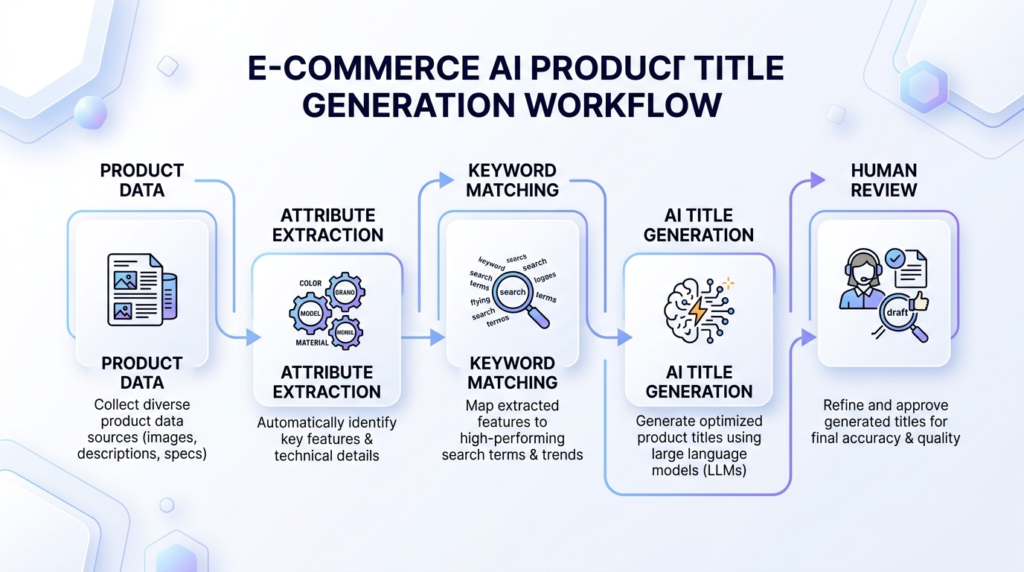
Quick answer: These tools extract a product’s key attributes, match them against relevant search terms, and arrange the result into a title shaped by whatever rules or platform you specify. The process runs from raw product data to a human review step—it isn’t meant to publish unattended.
The rough pipeline looks like this:
Product data → Attribute extraction → Keyword matching → Title generation → Human review
Step 1: It Reads the Product Data
Say your input is:
Stainless steel water bottle, 750ml, insulated, leak-proof, reusable, black.
The system pulls out:
- Product type: water bottle
- Material: stainless steel
- Capacity: 750 ml
- Feature: insulated, leak-proof
- Use case: reusable
- Color: black
Step 2: It Flags Relevant Keywords—Carefully
This is where a lot of tools go wrong if you let them run unsupervised. A title like
Water Bottle Stainless Steel Water Bottle Insulated Water Bottle Reusable Water Bottle Black
technically hits every keyword and reads terribly. Compare that to:
Insulated Stainless Steel Water Bottle – 750ml Leak-Proof Reusable Bottle, Black
Same information, one version a human would actually click.
Step 3: It Generates More Than One Version
Better tools give you several angles to choose from—keyword-first, benefit-first, product-type-first, a short version for mobile, and a marketplace-specific one. Treat these as drafts to pick from, not a single final answer.
Step 4: You Review It
This step doesn’t go away no matter how good the tool is. Check for accuracy, grammar, keyword relevance, correct attributes, platform compliance, brand voice, and how it reads to an actual shopper.
Why Use an AI Product Title Generator for E-Commerce?
Quick answer: The honest case for these tools isn’t that they write better titles than a skilled human—it’s that they save the hours a large catalog demands and keep naming consistent across hundreds of listings. The bigger the catalog, the more the time savings compound.
It’s Faster
Writing 500 titles by hand eats an entire week. AI drafts get you most of the way there in minutes, freeing that time for things that actually move revenue: product research, conversion work, and merchandising.
Catalogs Stay Consistent
Without a system, you end up with one listing that says “Men’s Running Shoes Black” and another that says “Black Athletic Sneakers for Men—Running”—same store, no consistency. A shared AI workflow forces a naming pattern.
Keywords Fit More Naturally
Used well, AI can slot in the terms customers actually search for. The key word there is “relevant”—frequency isn’t the goal.
It Scales With Your Catalog
The bigger the catalog—hundreds of SKUs, multiple variants, several marketplaces, several languages—the more this pays off.
Localization Gets Faster Too
Some tools can adapt titles for other markets and languages. Just don’t skip having someone who actually knows that market review the output before it goes live.
10 Best AI Product Title Generator Tools in 2026
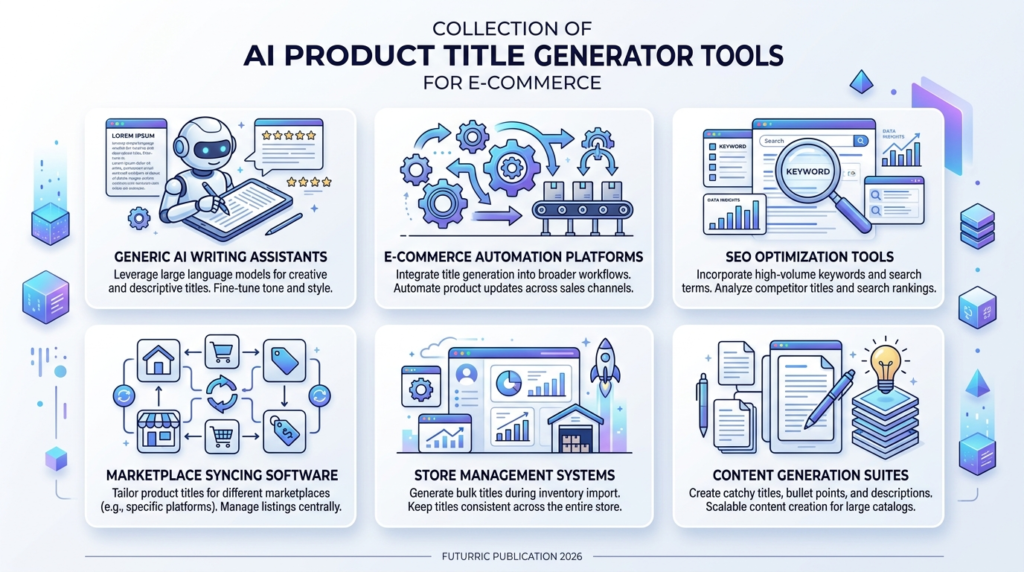
Quick answer: The best tool depends on your platform, catalog size, and how much control you want. General AI assistants like ChatGPT are the most flexible for custom prompts, dedicated product-title tools like AdNabu handle marketplace formatting automatically, and platform-native options like Shopify Magic remove the need to move data between tools.
1. ChatGPT
ChatGPT works as a flexible title generator as long as you feed it structured product info and clear instructions. It can produce SEO titles, Amazon-style titles, Shopify titles, short versions, and localized variants—all from the same base prompt.
Best for: flexible, customized title workflows.
Example prompt:
Create 10 SEO-friendly product titles for a Shopify store. Keep each one natural and concise. Use the primary keyword once, and prioritize product type, material, key benefit, and color. Don’t keyword stuff.
2. AdNabu
AdNabu is a dedicated product title generator built specifically for e-commerce, not a general writing tool adapted for it. It formats titles for multiple marketplaces and comparison shopping engines (including Amazon and Google Shopping) from a single product URL, staying inside each platform’s character limits automatically.
Best for: sellers who list on several marketplaces and want platform-compliant titles without manual reformatting.
3. Hypotenuse AI
Hypotenuse AI is built for bulk generation with store sync, which makes it a fit for catalogs where you’re generating titles (and descriptions) for hundreds of SKUs at once rather than one at a time.
Best for: large catalogs that need bulk title generation tied to live store data.
4. Describely
Describely turns basic product details into titles, descriptions, bullet points, and metadata in one pass, and can fill in missing attributes rather than leaving gaps when your source data is incomplete.
Best for: catalogs with messy or incomplete product data that need enrichment alongside title generation.
5. Jasper
Jasper is built around marketing content more broadly, which makes it a fit if product titles are just one piece of a larger content pipeline.
Best for: marketing teams running e-commerce content at scale.
6. Copy.ai
Copy.ai’s workflow tools make sense when title generation is one step inside a bigger content-production process rather than a standalone task.
Best for: teams producing product and marketing content together.
7. Writesonic
Writesonic’s content-generation features can be adapted for product listings without much friction, especially alongside other SEO content work.
Best for: product content, SEO content, and marketing copy in one place.
8. Anyword
Anyword leans on predictive performance scoring, which is a different angle from most title generators—it’s less about wording rules and more about estimating which version is likely to perform better before you publish it.
Best for: sellers who want a data-driven way to choose between several AI-generated title options.
9. Shopify Magic
Because it’s built into Shopify itself, Magic cuts out the step of moving product data between separate tools—useful if you want AI assistance without leaving your store’s back end.
Best for: Shopify merchants who want AI baked into their existing workflow.
10. Canva Magic Write
Canva is a design tool first, but its writing features can handle short product copy—a natural fit if you’re already using Canva for product graphics or social content.
Best for: merchants already using Canva for visuals who want copy in the same place.
AI Product Title Generators Compared
Quick answer: No single tool wins for every seller. General AI assistants offer the most flexibility for custom prompts, dedicated title tools like AdNabu handle marketplace formatting out of the box, and bulk/PIM-style tools fit best when hundreds of SKUs need titles at once.
| Tool | Best For | Flexibility | E-Commerce Use |
|---|---|---|---|
| ChatGPT | Custom title generation | High | High |
| AdNabu | Multi-marketplace formatted titles | Medium | High |
| Hypotenuse AI | Bulk generation with store sync | Medium | High |
| Describely | Titles + data enrichment for messy catalogs | Medium | High |
| Jasper | Marketing teams | High | High |
| Copy.ai | Content workflows | High | High |
| Writesonic | SEO/content creation | High | High |
| Anyword | Performance-scored title testing | Medium | High |
| Shopify Magic | Shopify merchants | Medium | High |
| Canva Magic Write | Marketing + design | Medium | Medium |
Pricing, limits, and integrations change often—check the current offering before committing to one.
How to Create SEO-Friendly Product Titles With AI
Quick answer: A title earns “SEO-friendly” by describing the product clearly while working in the terms people actually search for—not by cramming in every keyword variant you can think of. Front-load the product type and its most important attribute, then add supporting detail.
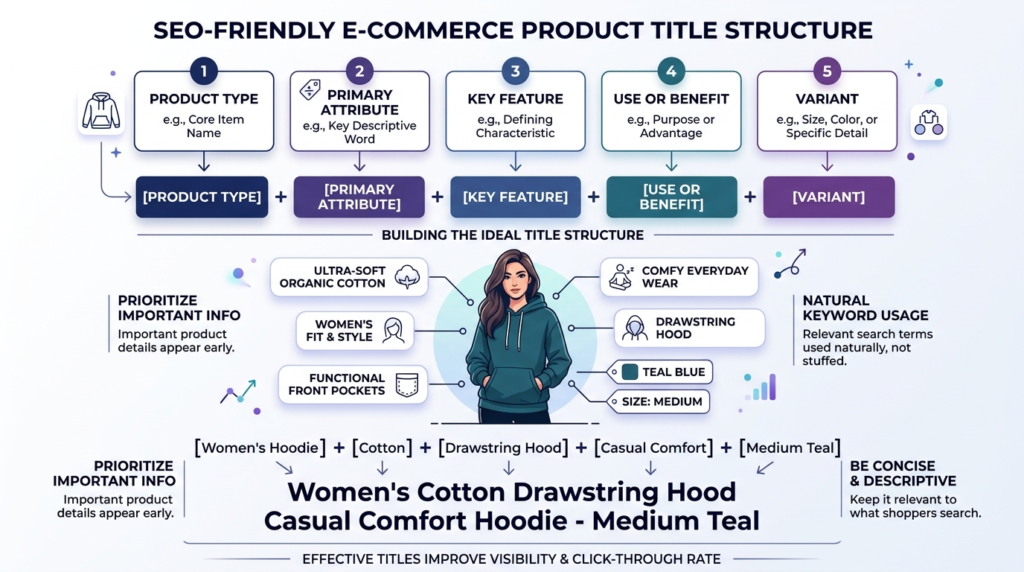
A workable structure:
[Product Type] + [Primary Attribute] + [Key Feature] + [Use/Benefit] + [Variant]
Women’s Cotton Oversized Hoodie – Soft Fleece Casual Sweatshirt, Black
Use the Keyword the Way Someone Would Search It
If your primary keyword is “stainless steel water bottle,” write:
750ml Stainless Steel Water Bottle – Insulated Leak-Proof Bottle
rather than repeating the exact phrase twice to “make sure it’s in there.”
Front-load the Important Part.
Shoppers skim. Product type and the single most important attribute should show up in the first few words, not buried at the end.
Pick Attributes That Actually Matter for the Category
Material, size, capacity, color, model, compatibility, quantity, use case, standout feature—pick what’s relevant to that specific product, not a fixed template applied blindly.
Don’t Write a Keyword List and Call It a Title
Bad:
Running Shoes Men’s Shoes Sports Shoes Athletic Shoes Sneakers Black Shoes
Better:
Men’s Running Shoes – Lightweight Athletic Sneakers, Black
Same keywords, one version a person can actually parse.
AI Product Title Optimization for Amazon, Shopify, and Google Shopping
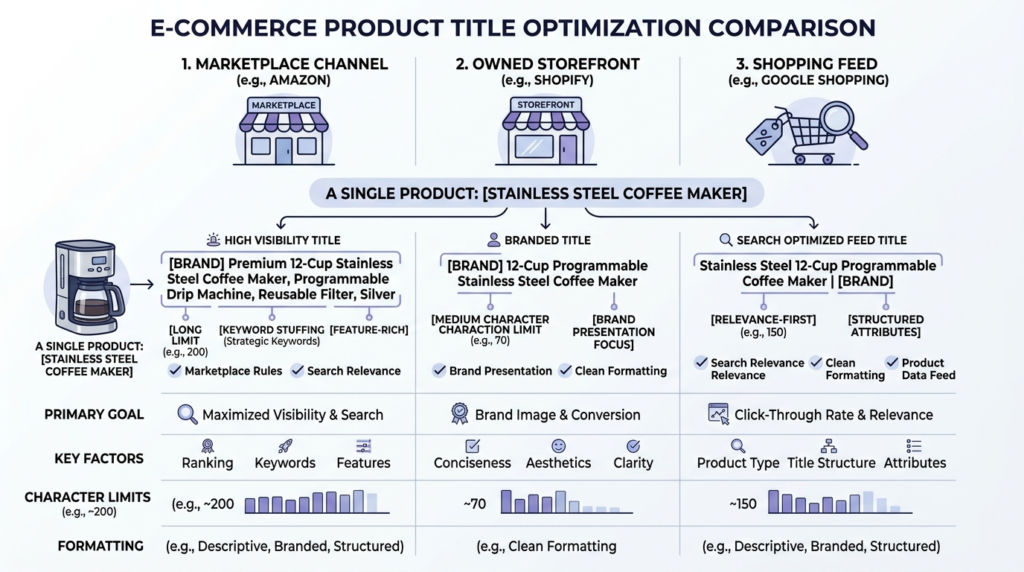
Quick answer: Amazon, Shopify, and Google Shopping each read titles differently, so one AI-generated title reused across all three usually underperforms on at least one of them. Generate platform-specific versions and check each channel’s current rules before publishing.
Amazon
Amazon titles need to balance keyword relevance with strict, category-specific formatting rules. Depending on the category, that usually means brand, product type, model, key feature, size, color, and quantity—in whatever order Amazon’s style guide for that category expects. Amazon publishes category-specific style guides in Seller Central; check the current one for your category before publishing, since requirements vary and change.
Shopify
Shopify gives you more room to be brand-forward. A title like
CloudSoft Women’s Oversized Hoodie
can work as the product name, with the descriptive detail living in the description and metadata instead of being crammed into the title itself.
Google Shopping
Google Shopping titles work differently again—Google matches your feed to search intent rather than reading keywords the way a search engine does. Google’s own Merchant Center guidance recommends leading with the most identifying details (brand, product type, and key attributes), avoiding promotional text like “sale” or “free shipping” in the title field, and keeping formatting clean—no ALL CAPS, no excess punctuation, and no keyword stacking. Titles beyond the character limit get truncated, so front-loading matters here too.
Amazon vs. Shopify vs. Google Shopping — Quick Comparison
| Factor | Amazon | Shopify | Google Shopping |
|---|---|---|---|
| Who reads the title? | Amazon’s search algorithm + shoppers | Your storefront + on-site search | Google’s matching algorithm + shoppers |
| Structure driven by | Category-specific style guide | Brand voice + merchant preference | Merchant Center title/structured title guidance |
| Promotional text | Restricted, category-dependent | Allowed on-page (not required in title) | Not allowed (“sale,” “free shipping,” etc.) |
| Brand placement | Usually first | Optional, often first for brand recall | First, lesser-known brands can help with matching. |
| Best practice source | Amazon Seller Central style guides | Merchant’s own naming convention | Google Merchant Center Help |
Treat Every Channel Separately
Amazon title ≠ Shopify title ≠ Google Shopping title ≠ social commerce title.
The underlying product facts stay the same—the presentation shouldn’t.
Common Product Title Mistakes to Avoid
Quick answer: Most title problems trace back to a handful of repeatable habits—keyword stuffing, ignoring search intent, letting AI invent unverified details, making every title sound identical, and publishing without a review pass. AI will repeat all of these if your prompt or source data doesn’t rule them out.
Keyword Stuffing
Repeating the same phrase three times doesn’t rank better. It just reads worse.
Ignoring What the Shopper Is Actually Looking For
Someone searching “waterproof hiking backpack” needs to see immediately whether the product is actually waterproof—not implied, stated.
Letting AI Invent Details
Never let a generator add certifications, materials, warranty claims, specs, or performance guarantees that weren’t in your source data. If it’s not confirmed, it doesn’t go in the title.
Making Every Title Sound Identical
A consistent framework is good. A catalog where every single title follows the exact same rhythm starts to feel robotic—leave room for natural variation.
Publishing Without Reading It First
AI misreads product data more often than you’d expect. Someone still has to check the output before it goes live.
How to Get Better Results From AI Product Title Generators
Quick answer: Output quality depends heavily on input quality. Structured product data, a named platform, an explicit “don’t invent details” rule, and multiple generated variants to compare consistently beat a vague one-line prompt.
Feed It Structured Data, Not a Vague Ask
Weak prompt:
Make a title for this bottle.
Better:
Product: Insulated Water Bottle Capacity: 750ml Material: Stainless Steel Color: Black Feature: Leak-proof Audience: Adults Platform: Shopify Primary Keyword: stainless steel water bottle
A Reusable Prompt Template
For a repeatable workflow, keep a template like this and just swap the bracketed fields per product:
You are generating an e-commerce product title. Product type: [product type] Key attributes: [material, size, capacity, etc.] Primary keyword: [primary keyword] Platform: [Amazon / Shopify / Google Shopping] Tone: [neutral / brand-forward] Constraints: Front-load product type and primary attribute. Use the primary keyword once, naturally. Do not invent specifications, certifications, or claims not listed above. Stay under [character limit] characters. Generate 5 title variants: one keyword-first, one benefit-first, one short-form, one brand-forward, one platform-specific.
Ask for Several Versions, Not One
Generate 5–10 and compare on clarity, relevance, natural keyword use, and how well each one differentiates the product from competitors.
Add an Explicit “Don’t Invent Anything” Rule
One line does a lot of work here:
Use only the information provided. Do not invent specifications, certifications, benefits, materials, or claims.
Keep a Human Step in the Loop
AI draft → SEO review → product-data check → brand review → publish
beats
AI draft → publish
every time.
AI Product Title Generator vs. Manual Writing
Quick answer: AI generally wins on speed, consistency, and scale across large catalogs. Human writers generally win on brand nuance, product accuracy for unusual items, and creative differentiation. The strongest workflow uses AI for the first draft and a person for the final call.
| Factor | AI Generation | Manual Writing |
|---|---|---|
| Speed | Excellent | Slow |
| Large catalogs | Excellent | Difficult |
| Consistency | Excellent | Variable |
| Brand nuance | Moderate | Excellent |
| Product accuracy | Requires review | Strong |
| Creative variation | Good | Excellent |
| Scalability | Excellent | Limited |
The best approach isn’t necessarily choosing one over the other. Use AI for scale and humans for judgment.
Building a Smarter AI Title Workflow
Quick answer: The real payoff isn’t generating titles faster—it’s building a system that connects a naming formula, a quality checklist, and performance tracking into one repeatable process, instead of treating each title as a one-off task.
A Naming Formula Per Category
Standardize the structure so the whole catalog feels intentional rather than assembled piecemeal.
Shoes: Brand + Gender + Product Type + Key Feature + Use + Color Electronics: Brand + Product Type + Model + Main Specification + Compatibility Beauty: Brand + Product Type + Key Ingredient + Primary Benefit + Size
A Title Scoring Checklist
Score each AI draft before it publishes—a simple yes/no per line works fine:
- [ ] Product type is clear within the first few words
- [ ] Primary keyword appears once, naturally
- [ ] Every attribute listed is confirmed in the source data (nothing invented)
- [ ] Title fits the target platform’s character limit
- [ ] No promotional language (“best,” “sale,” “free shipping”) where the platform disallows it
- [ ] Reads naturally out loud, not like a keyword list
- [ ] Differentiates this product from similar ones in the catalog
- [ ] Grammar and spelling are correct
- [ ] Matches brand voice/tone guidelines
- [ ] A second person (not the one who generated it) has reviewed it
A title that fails two or more of these is worth regenerating rather than patching.
Judge Titles by Outcomes, Not by How They Sound
A title “sounding good” isn’t the bar. Where you can, track search impressions, click-through rate, product-page visits, conversion rate, add-to-cart rate, and revenue per visitor instead. A good title supports the customer’s decision—it isn’t just a box checked for SEO.
Trust and Editorial Standards for AI-Generated Titles
Quick answer: For stores running large catalogs, it helps to document how AI-generated titles get created and checked, rather than just claiming AI “optimizes” them. Two real, verifiable references worth building your standards around are Google’s Merchant Center title guidance and Amazon’s category-specific style guides.
Google Merchant Center publishes explicit title guidance: front-load identifying details, avoid promotional text and ALL CAPS, keep formatting clean, and expect truncation past the character limit (see Google’s title and structured title requirements). Any AI title heading to Google Shopping should be checked against this before it’s submitted.
Amazon requires titles to follow the style guide for the specific category you’re listing in, covering attribute order, character limits, and what can and can’t appear in the title field. These guides live in Seller Central and vary by category, so verify the current version for your product rather than assuming last year’s rules still apply.
Worth writing down internally, even informally:
- Where the product data comes from.
- Which AI tool is being used.
- Which attributes are mandatory in every title.
- Which claims are off-limits entirely.
- Who reviews AI output before it publishes.
- How marketplace compliance gets checked, and against which source (Google’s guidance, Amazon’s style guide, etc.).
Having this on paper — even a one-page internal doc — gives your team a clearer reason to trust the listings than just “we used AI to make it better.”
The Future of AI Product Title Generation
Quick answer: The direction this is heading isn’t more AI writing on its own—it’s tighter integration with product information systems, search data, and marketplace feeds, so titles adjust automatically as conditions change, with performance data feeding back into future generations.
The shift looks like this:
Simple version: AI writes a title.
Where it’s going: Product data → search intent → AI generation → platform-specific optimization → human validation → performance feedback → repeat.
That turns title optimization into an ongoing process instead of something you do once and forget.
Frequently Asked Questions
What is the best AI product title generator?
It depends on your platform and workflow. General tools like ChatGPT give you the most flexibility, dedicated tools like AdNabu handle marketplace formatting automatically, and bulk/PIM-style tools like Hypotenuse AI or Describely fit large catalogs best.
Are AI-generated product titles good for SEO?
They can be—when they’re accurate, relevant, and readable. AI doesn’t make a title SEO-friendly by default; keyword relevance, clarity, and human review still do most of the work.
Can AI write Amazon product titles?
Yes, using product attributes and target keywords as input. Always confirm the current category-specific style guide for your marketplace before publishing.
Can AI generate Shopify product titles?
Yes—based on product attributes, keywords, brand voice, and customer intent.
Should keywords be in product titles?
Yes, when they genuinely describe what someone is searching for. Natural relevance, not repetition, is the goal.
How long should an e-commerce product title be?
There’s no universal length. Google Merchant Center allows up to 150 characters but truncates on most devices well before that; Amazon’s limits vary by category. Check your specific channel’s current guidance rather than following a fixed rule.
Can AI create hundreds of product titles?
Yes—this is where it’s genuinely useful. With structured data and a consistent prompt or workflow, large batches come together far faster than writing each one by hand.
Should I use the same AI title on Amazon and Shopify?
No, generally. Different search environments and formatting rules mean channel-specific versions perform better than one title reused everywhere.
Can AI product titles improve conversion rates?
They can help—a clearer title makes it easier for a shopper to understand the product fast. But conversion also depends on price, images, reviews, and everything else on the page.
Is human review necessary for AI product titles?
Yes. Especially for large catalogs, regulated products, and anything with technical specs—AI can misread or invent details when the source data is incomplete.
Final Verdict
AI product title generator tools genuinely speed up catalog work, but they’re best treated as assistants, not autonomous writers.
The workflow that actually works: accurate product data + relevant search terms + AI generation + platform-specific optimization + human review.
For a small store, a general AI assistant is probably enough. For a large catalog, the real gain comes from building a repeatable system connecting product data, SEO, marketplace rules, and performance feedback.
The goal was never the most keyword-rich title. It’s the clearest, most relevant title for the right shopper on the right platform.
For related reading, see our guides on AI Product Content Tools in 2026: The Complete Guide & Best AI Product Description. Generator Tools and Free AI Product Description Generator Tools in 2026: 10 Free Tools