

AI Branding & Store Setup (2026): The Complete Guide to Building a Memorable AI-Powered eCommerce Brand
Table of Contents
Introduction
What is AI Branding & Store Setup?
Why AI Branding Matters in 2026
Industry Research & Statistics
Traditional Branding vs AI Branding
Core Elements of an AI Brand
How AI Changes Store Setup
AI Branding Framework
Benefits of AI Branding
Step-by-Step AI Store Setup
Best AI Branding Tools
Best AI Store Setup Tools
AI Design & Image Generation Tools
AI SEO & Content Tools
AI Marketing & Automation Tools
AI Customer Support Tools
Complete AI Store Setup Workflow
AI Tool Comparison Table
SEO, AEO & GEO for AI Branding & Store Setup
E-E-A-T & Information Gain
Common Mistakes to Avoid
Pro Tips
30/60/90-Day AI Branding Implementation Roadmap
Frequently Asked Questions
Key Takeaways, Final Verdict & Conclusion
Introduction
- Create a professional brand identity
- Design logos and visual assets
- Write compelling copy
- Generate product images
- Optimize SEO
- Personalize customer experiences
- Improve conversions
- Scale marketing with automation
What is AI Branding & Store Setup?
Quick Answer
- Brand name generation
- Logo creation
- Color palette selection
- Typography recommendations
- Brand voice development
- Product descriptions
- Website copy
- SEO optimization
- Marketing campaigns
- Customer support automation
AI Branding Includes
| Brand Strategy | Market analysis, positioning insights |
| Logo Design | AI-generated logo concepts |
| Color Palette | Color psychology recommendations |
| Typography | Font pairing suggestions |
| Brand Voice | Consistent messaging |
| Website Copy | AI copywriting |
| Product Content | Automated descriptions |
| Marketing | Campaign generation |
| SEO | Keyword optimization |
| Customer Support | AI chatbots and assistants |
Why AI Branding Matters in 2026
Quick Answer
- Automating repetitive branding tasks
- Maintaining a consistent brand voice
- Personalizing user experiences
- Improving content quality
- Accelerating store launches
- Enhancing decision-making with data
Key Trends Driving AI Branding
1. Hyper-Personalization
2. Faster Time-to-Market
3. Data-Driven Decisions
4. Omni channel Consistency
Research-Backed Insights
Recent industry research highlights why AI branding and personalization have become essential for modern eCommerce businesses:
| Research | Key Finding |
|---|---|
| McKinsey | 71% of consumers expect personalized experiences from brands. (McKinsey & Company) |
| McKinsey | 76% of customers become frustrated when personalization is missing. (McKinsey & Company) |
| McKinsey | Companies leading in personalization generate significantly more revenue from these initiatives than slower-growing competitors. (McKinsey & Company) |
| Shopify | AI personalization helps businesses tailor product recommendations, content, and customer journeys using real-time behavior. (Shopify) |
| Shopify | Early Shopify data indicates AI-referred shoppers convert at higher rates and have higher average order values than traditional organic visitors. (Shopify) |
Traditional Branding vs AI Branding
Quick Answer
| Logo Creation | Designer-led | AI-assisted |
| Copywriting | Manual | AI-generated drafts |
| Research | Time-intensive | AI-supported insights |
| SEO | Manual optimization | AI recommendations |
| Product Images | Professional photography | AI-generated visuals |
| Customer Support | Human agents | AI chatbots |
| Content Production | Slow | Rapid |
| Personalization | Limited | Dynamic |
| Analytics | Manual reporting | Predictive insights |
| Scaling | Resource-heavy | Automated |
Core Elements of an AI Brand
Quick Answer
1. Brand Purpose
- What problem do you solve?
- Who do you serve?
- What makes your brand different?
- What values guide your business?
2. Brand Positioning
- Target audience
- Competitor landscape
- Unique value proposition
- Customer pain points
3. Visual Identity
- Logo
- Color palette
- Typography
- Icons
- Photography style
- Illustrations
- Packaging
- Website aesthetics
4. Brand Voice
- Product pages
- Blog articles
- Emails
- Social media
- Customer support
- Advertisements
- Professional
- Friendly
- Premium
- Playful
- Technical
- Inspirational
5. Customer Experience
- Personalized recommendations
- Intelligent search
- Chatbots
- Dynamic pricing
- Automated follow-ups
How AI Changes Store Setup
Quick Answer
- Web designer
- Developer
- Copywriter
- SEO expert
- Photographer
- Marketing strategist
Areas AI Can Improve
| Homepage Copy | AI writing assistants |
| Product Descriptions | Automated generation |
| Category Pages | SEO-optimized content |
| Product Images | AI image creation |
| FAQs | AI-generated answers |
| Meta Titles | SEO recommendations |
| Navigation | User behavior analysis |
| Internal Linking | AI suggestions |
| Email Campaigns | Automated sequences |
| Customer Support | Conversational AI |
AI Branding Framework
Quick Answer
Step 1: Market Research
- Customer pain points
- Competitors
- Market gaps
- Emerging trends
Step 2: Define Your Brand Strategy
- Mission statement
- Vision
- Core values
- Unique selling proposition (USP)
- Brand personality
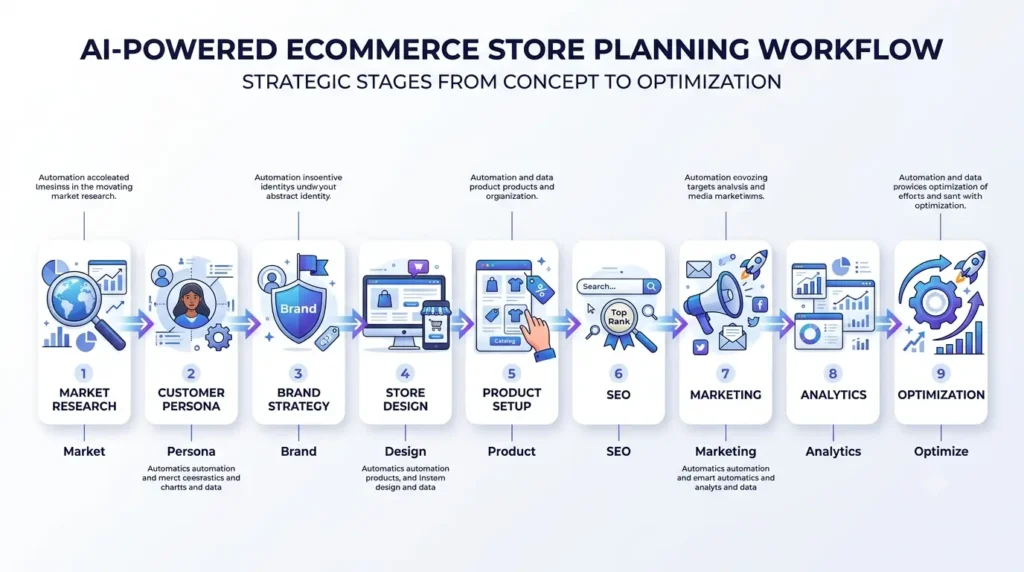
Step 3: Build Visual Identity
- Logo
- Color palette
- Typography
- Design system
- Iconography
Step 4: Create Messaging
- Homepage
- Product pages
- About page
- Emails
- Social media
- Ads
Step 5: Build Your Store
- Clean navigation
- Mobile responsiveness
- Fast loading speeds
- Accessible design
- Clear calls to action
Benefits of AI Branding
Quick Answer
Major Benefits
- Faster brand development
- Lower operational costs
- Improved consistency
- Better customer experiences
- Enhanced SEO performance
- Personalized marketing
- Scalable content production
- Smarter analytics
- Increased productivity
- Faster experimentation
Common Mistakes to Avoid
Quick Answer
- Using AI-generated content without editing
- Ignoring brand strategy
- Inconsistent visual identity
- Over-automation
- Poor quality control
- Neglecting accessibility
- Forgetting mobile optimization
- Copying competitors
- Overusing AI-generated imagery
- Failing to measure performance
Pro Tips
- Use AI to generate ideas, then refine them with human expertise.
- Develop a detailed brand style guide to maintain consistency.
- Regularly review AI-generated content for accuracy and originality.
- Test branding elements with real users before full-scale deployment.
- Use both AI insights and customer feedback to make better decisions. In the final sections, you’ll find helpful references and the main points to remember. To wrap up, review the expert insight and research placeholders.
Expert Insight
“AI should augment human creativity—not replace it. The organizations that see the greatest value use AI to enhance decision-making, personalization, and productivity while keeping humans in control of strategy and brand direction.” — McKinsey & Company
Practical Insight
The most successful AI-powered eCommerce brands treat AI as a collaborative assistant rather than an autonomous decision-maker. AI accelerates research, content creation, design ideation, and personalization, while humans ensure originality, emotional connection, and strategic consistency. Businesses that combine AI efficiency with human expertise typically build stronger customer trust and more sustainable brands.
AI Store Setup Step-by-Step (2026): Building eCommerce Store
Planning Your AI-Powered Store
Quick Answer
- Who is your ideal customer?
- What problem does your product solve?
- Why should customers buy from you instead of competitors?
- Which products will generate the highest profit?
- What emotions should your brand evoke?
- How will customers discover your store?
Planning Checklist
| Audience | Who are you targeting? |
| Products | What will you sell? |
| Competitors | What makes you different? |
| Pricing | Budget, premium, or luxury? |
| Branding | Professional, playful, modern, minimal? |
| Marketing | SEO, ads, email, social media? |
| Goals | Traffic, sales, subscriptions, or leads? |
Choosing the Right eCommerce Platform
Quick Answer
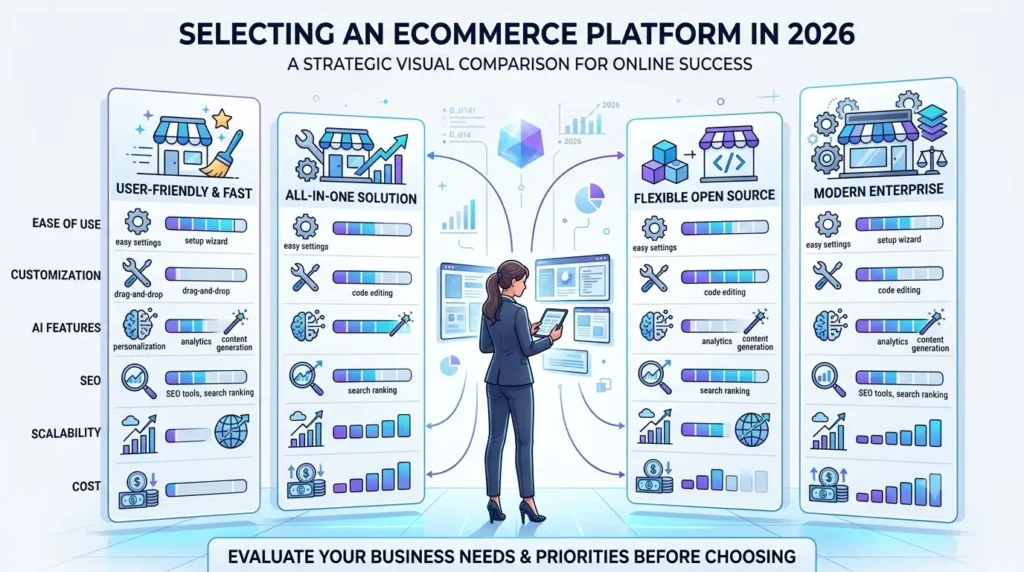
| Shopify | Beginners & growing brands | Apps, automation, AI assistants |
| WooCommerce | WordPress users | Flexible plugins, SEO control |
| BigCommerce | Scaling businesses | Enterprise automation |
| Wix | Small businesses | Built-in AI design tools |
| Squarespace | Creatives | AI content assistance |
Factors to Consider
- Ease of use
- SEO flexibility
- Mobile responsiveness
- AI integrations
- Payment gateways
- App ecosystem
- Security
- Scalability
- Performance
- Cost
Selecting the Perfect Domain Name
Quick Answer
Characteristics of a Great Domain
- Short
- Easy to pronounce
- Easy to remember
- Brandable
- No numbers
- No hyphens
- Relevant to your niche
AI Can Help Generate
- Brand names
- Domain ideas
- Available variations
- Taglines
- Business names
Web Hosting & Website Performance
Quick Answer
- SEO rankings
- User experience
- Conversion rate
- Bounce rate
- Customer satisfaction
- SSD storage
- CDN
- SSL certificate
- Daily backups
- Malware protection
- Automatic updates
- High uptime
Performance Checklist
- ✓ HTTPS enable
- ✓ Image optimization
- ✓ Lazy loading
- ✓ Caching
- ✓ CDN
- ✓ Fast server response
- ✓ Optimized database
Creating a Strong Brand Identity
Quick Answer
Logo
Color Palette
Typography
- Heading font
- Body font
- Accent font
Brand Personality
- Friendly
- Luxury
- Innovative
- Minimalist
- Sustainable
- Professional
- Energetic
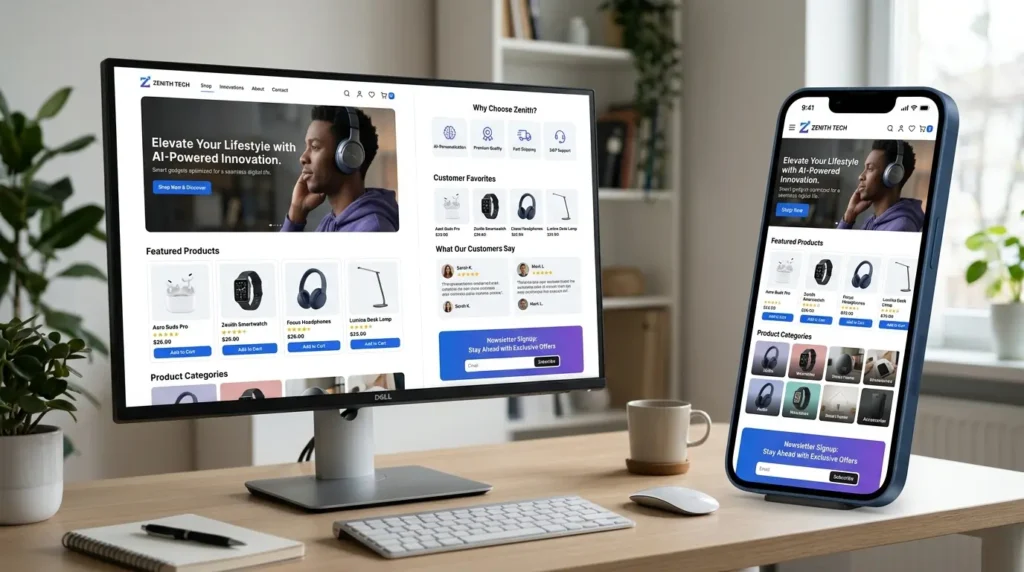
Designing a High-Converting Homepage
Quick Answer
Hero Section
Value Proposition
- What you offer
- Who it’s for
- Why it’s different
Featured Products
- Best sellers
- New arrivals
- Trending items
Categories
Customer Reviews
Newsletter
- Discount
- Free guide
- Exclusive offers
Footer
Navigation Best Practices
Quick Answer
Navigation Tips
Building a Scalable Site Structure
Quick Answer
│ ├── Guides
├── Comparisons
│ ├── Reviews
Why Structure Matters
Creating Effective Category Pages
Quick Answer
- Introductory content
- Category image
- Filters
- FAQs
- Buying guide
- Internal links
- Related categories
- Featured products
Mobile-First Store Design
Quick Answer
Sticky navigation
Simple checkout
Responsive images
UX Principles for AI Stores
Quick Answer
Accessibility & Trust
Quick Answer
- ✓ Alt text
- ✓ Color contrast
- ✓ Keyboard navigation
- ✓ Readable fonts
- ✓ Descriptive buttons
- ✓ Form labels
AI Workflow for Store Setup
Quick Answer
Suggested Workflow
Real-World Example: Building an AI-Powered Brand
Example
1: Shopify AI
A new online store owner launches a Shopify store using Shopify Magic.
AI assists with:
- Product descriptions
- Email copy
- Store content
- Customer support drafts
- Marketing copy
Instead of spending several days writing content manually, the merchant prepares a complete first draft in a few hours and then refines it to match the brand voice.
Example 2: Canva AI
A startup needs a complete visual identity.
Using Canva AI, the team creates:
- Brand logo concepts
- Social media graphics
- Product banners
- Presentation templates
- Brand Kit
Human designers then refine the AI-generated assets to maintain originality and consistency. This significantly reduces design time while preserving quality.
Example 3: Looka
Looka helps entrepreneurs quickly generate:
- Logo concepts
- Brand colors
- Typography
- Business card designs
- Brand guidelines
Instead of starting from a blank page, founders receive multiple branding directions that they can customize further.
Common Mistakes
- Choosing too many colors
- Weak homepage messaging
- Poor navigation
- Thin category pages
- Ignoring mobile users
- Slow website
- No trust badges
- Duplicate AI content
- No internal linking
- Inconsistent branding
Pro Tips
- ✔ Build a brand style guide before generating AI content.
- ✔ Create reusable AI prompts for consistency.
- ✔ Review every AI-generated asset manually.
- ✔ Optimize for humans first and search engines second.
- ✔ Test layouts using heat maps and analytics.
High-Converting Product Pages, AI Content & Conversion Optimization (2026)
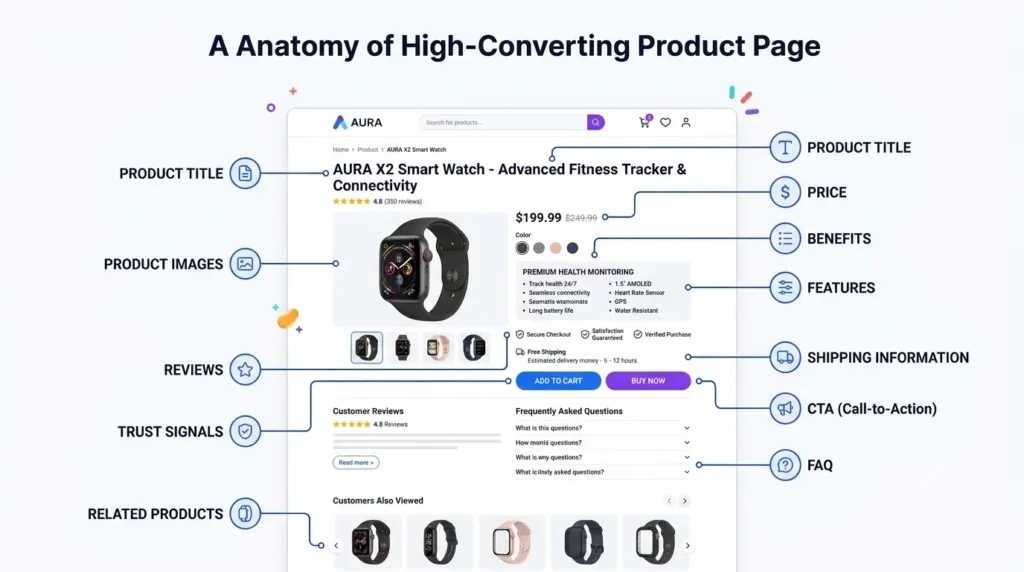
Creating High-Converting Product Pages
Quick Answer
- Product title
- High-quality images
- Product video (optional but recommended)
- Clear pricing
- Availability status
- Product description
- Key features
- Technical specifications
- Benefits
- Customer reviews
- Shipping details
- Return policy
- Related products
- Frequently Asked Questions
- Strong Call-to-Action (CTA)
Recommended Product Page Structure
| Product Title | Clearly identify the item |
| Hero Images | Showcase the product |
| Price | Display cost and discounts |
| CTA Button | Encourage purchase |
| Features | Explain what the product offers |
| Benefits | Show why it matters |
| Specifications | Provide technical details |
| Reviews | Build credibility |
| FAQs | Address common concerns |
| Related Products | Increase average order value |
Writing AI-Optimized Product Descriptions
Quick Answer
- What problem the product solves
- Who it is designed for
- Why customers should choose it
- How it improves everyday life
- What makes it different from competitors
Poor Example
Wireless Bluetooth Headphones with Noise Cancellation and 40-Hour Battery.
Better Example
Enjoy immersive sound wherever you go with wireless Bluetooth headphones designed for work, travel, and entertainment. Advanced noise cancellation minimizes distractions, while the long-lasting battery keeps your music playing throughout the day without frequent charging.
Description Formula
Feature vs Benefit
| Waterproof | Use confidently in rain or workouts |
| Fast Charging | Spend less time waiting |
| AI Camera | Capture clearer, sharper photos |
| Lightweight | More comfortable to carry |
| Eco-friendly Material | Better for the environment |
Product Images & Visual Branding
Quick Answer
- Front view
- Side view
- Back view
- Lifestyle image
- Close-up details
- Packaging
- Size comparison
- Infographic
- 360° view (if available)
Image Optimization Checklist
- ✓ WebP format
- ✓ Compressed files
- ✓ Descriptive filenames
- ✓ Alt text
- ✓ Responsive images
- ✓ Consistent aspect ratio
- ✓ Fast loading
Example
AI Can Generate
- Lifestyle backgrounds
- Product mockups
- Marketing banners
- Infographics
- Promotional graphics
- Color variations
- Social media creatives
Smart Pricing Strategy
Quick Answer
- Premium pricing
- Competitive pricing
- Psychological pricing
- Value-based pricing
- Dynamic pricing
- Bundle pricing
Example Comparison
| Premium | Luxury brands |
| Competitive | Established markets |
| Bundle | Increasing average order value |
| Dynamic | High-demand products |
| Psychological | Consumer goods |
Building Customer Trust
Quick Answer
- HTTPS security
- Secure checkout
- Verified reviews
- Contact information
- About page
- Refund policy
- Shipping policy
- Privacy policy
- Terms & Conditions
- Trust badges
Trust Checklist
- ✓ SSL Certificate
- ✓ Contact Page
- ✓ Return Policy
- ✓ FAQ
- ✓ Real Images
- ✓ Customer Reviews
- ✓ Business Address (if applicable)
- ✓ Secure Payment Icons
AI Personalization
Quick Answer
Personalized Recommendations
Personalized Emails
- Welcome emails
- Abandoned cart reminders
- Product recommendations
- Birthday offers
- Loyalty rewards
Dynamic Homepage
- Relevant products
- Personalized offers
- Recently viewed items
- Recommended categories
Conversion Rate Optimization (CRO)
Quick Answer
Faster Loading
Better CTA Buttons
Clear Product Benefits
Reduced Checkout Friction
AI Heat maps
- Click behavior
- Scroll depth
- User engagement
- Exit points
CRO Metrics
| Conversion Rate | Measures sales performance |
| Bounce Rate | Indicates user engagement |
| Average Order Value | Tracks spending per purchase |
| Cart Abandonment | Identifies checkout issues |
| Revenue per Visitor | Measures profitability |
Customer Reviews & Social Proof
Quick Answer
Review Best Practices
AI Product Content Workflow
Quick Answer
Recommended Workflow
Common Mistakes
- Copying manufacturer descriptions
- Publishing unedited AI content
- Using low-quality images
- Writing keyword-stuffed copy
- Missing FAQs
- Ignoring mobile layouts
- Hiding shipping costs
- Weak CTA buttons
- No product specifications
- No customer reviews
Pro Tips
- ✔ Write for customers first, search engines second.
- ✔ Show benefits before features.
- ✔ Use AI to brainstorm, then refine with human expertise.
- ✔ Add FAQs to answer purchase objections.
- ✔ Continuously update product pages based on analytics and customer feedback.
Checkout Optimization, Technical SEO & AI Launch Strategy (2026)
Checkout Optimization
Quick Answer
Best Practices
- Allow guest checkout
- Minimize required form fields
- Show shipping costs early
- Display estimated delivery dates
- Offer multiple payment options
- Auto-fill address information when possible
- Enable one-click checkout for returning customers
- Provide a clear progress indicator
Recommended Checkout Flow
Technical SEO for AI Stores
Quick Answer
Essential Technical SEO Checklist
| HTTPS | Security & trust |
| XML Sitemap | Easier indexing |
| Robots.txt | Crawl control |
| Canonical URLs | Prevent duplicate content |
| Schema Markup | Rich results |
| Mobile Optimization | Better rankings |
| Core Web Vitals | User experience |
| Image Optimization | Faster loading |
| Clean URLs | Improved readability |
| Breadcrumbs | Better navigation |
SEO-Friendly URL Example
Internal Linking Strategy
Quick Answer
Suggested Content Structure
Internal Linking Opportunities
- Blog → Product pages
- Product → Related products
- Category → Buying guides
- Buying guide → Category
- FAQ → Relevant products
- Homepage → Top categories
Anchor Text Examples
- AI branding tools
- Store setup guide
- Product comparison
- AI logo generators
- eCommerce automation software
- Click here
- Learn more
- Read this
AI-Powered SEO Workflow
Quick Answer
Recommended Workflow
AI Can Assist With
- Keyword clustering
- Topic research
- Outline creation
- Meta titles
- Meta descriptions
- Product descriptions
- FAQ generation
- Content summaries
- Alt text suggestions
- Internal link recommendations
Security & Performance
Quick Answer
Security Checklist
- ✓ SSL Certificate
- ✓ Two-Factor Authentication
- ✓ Strong Password Policy
- ✓ Daily Backups
- ✓ Malware Scanning
- ✓ Firewall Protection
- ✓ Regular Software Updates
- ✓ Secure Payment Gateway
Performance Checklist
- ✓ Image compression
- ✓ Browser caching
- ✓ Content Delivery Network (CDN)
- ✓ Lazy loading
- ✓ Optimized CSS & JavaScript
- ✓ Fast hosting
- ✓ Database optimization
- ✓ Mobile responsiveness
Store Launch Checklist
Quick Answer
Branding
- ✓ Logo finalized
- ✓ Brand colors consistent
- ✓ Typography consistent
- ✓ Favicon added
Store Pages
- ✓ Homepage
- ✓ About
- ✓ Contact
- ✓ Shop
- ✓ Categories
- ✓ Product pages
- ✓ FAQ
- ✓ Privacy Policy
- ✓ Terms & Conditions
- ✓ Shipping Policy
- ✓ Return Policy
SEO
- ✓ Meta titles
- ✓ Meta description
- ✓ Alt text
- ✓ Internal links
- ✓ XML sitemap
- ✓ Robots.txt
- ✓ Canonical tags
- ✓ Schema markup
Technical
- ✓ SSL active
- ✓ Analytics installed
- ✓ Search Console connected
- ✓ Performance tested
- ✓ Mobile tested
- ✓ Broken links checked
Marketing
- ✓ Email signup form
- ✓ Welcome email automation
- ✓ Social media links
- ✓ Tracking pixels
- ✓ Newsletter setup
Key Performance Indicators (KPIs)
- Quick Answer
- KPIs measure how effectively your store attracts visitors, converts customers, and generates revenue. Tracking these metrics helps identify opportunities for improvement and guides future optimization efforts.
Important Metrics
| Organic Traffic | Increase visibility |
| Conversion Rate | Improve sales |
| Bounce Rate | Reduce exits |
| Average Order Value | Increase revenue |
| Customer Lifetime Value | Grow retention |
| Cart Abandonment Rate | Reduce lost sales |
| Revenue Per Visitor | Improve profitability |
| Returning Customers | Increase loyalty |
| Email Signup Rate | Build audience |
| Page Speed | Improve UX |
Continuous Optimization
Quick Answer
Monthly Tasks
- Update product descriptions
- Refresh blog content
- Analyze keyword rankings
- Review customer feedback
- Improve internal links
- Optimize slow pages
- Test new CTAs
- Update images
- Review AI-generated content
- Check broken links
Quarterly Tasks
- Conduct competitor analysis
- Refresh homepage messaging
- Audit technical SEO
- Improve category pages
- Evaluate AI tools and workflows
- Review conversion funnels
Common Mistakes
- Launching without testing
- Ignoring Core Web Vitals
- Duplicate product content
- Missing structured data
- Poor internal linking
- Weak CTAs
- Slow mobile experience
- Inconsistent branding
- Outdated product information
- Neglecting analytics
Pro Tips
- Build content around customer intent, not just keywords.
- Update high-performing pages regularly to keep information fresh.
- Use AI to speed up repetitive tasks, but maintain editorial oversight.
- Create topic clusters that connect guides, comparisons, and product pages.
- Review user behavior with analytics and heatmaps to identify friction points.
- Test checkout improvements incrementally and measure their impact on conversion rates.
Best AI Tools, Workflows & Automation for AI Branding & Store Setup (2026)
Why AI Tools Matter
Quick Answer
- Brand strategist
- Graphic designer
- Copywriter
- SEO expert
- Web developer
- Marketing specialist
- Customer support team
Benefits of an AI-Powered Workflow
- Faster execution
- Lower operational costs
- Consistent branding
- Scalable content creation
- Personalized customer experiences
- Improved marketing performance
- Better decision-making through analytics
Choosing the Right AI Stack
Quick Answer
- Business goals
- Budget
- Technical expertise
- Team size
- Platform compatibility
- Scalability
- Integration capabilities
- Data privacy
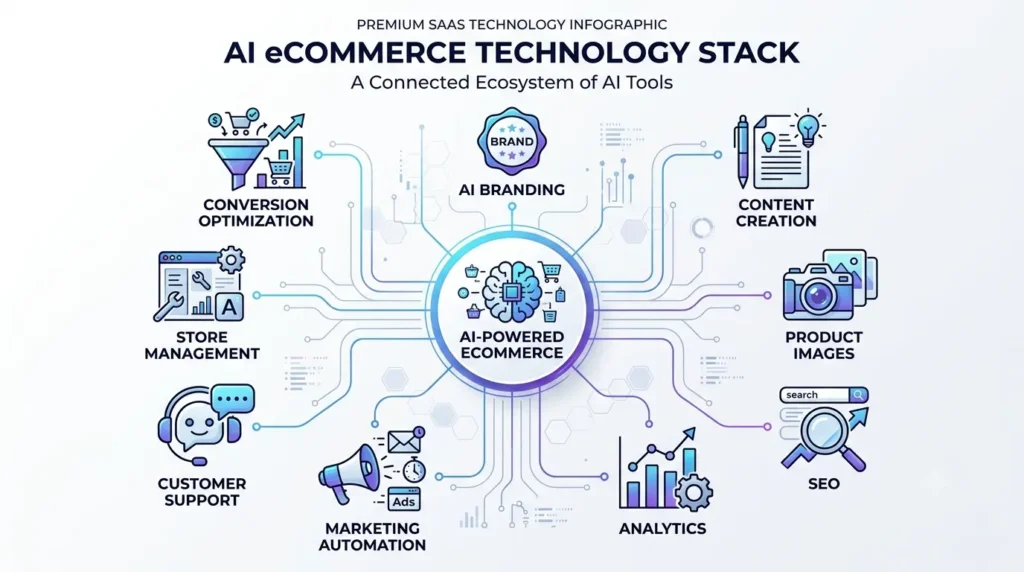
Best AI Branding Tools
Quick Answer
1. ChatGPT
Best For
- Brand strategy
- Naming ideas
- Brand voice
- Messaging
- Content planning
- Marketing ideas
- Excellent brainstorming
- Flexible prompting
- Fast content generation
2. Canva AI
- Logos
- Social graphics
- Presentations
- Marketing assets
- Brand kits
- Magic Design
- Background removal
- AI image generation
- Brand templates
3. Adobe Express AI
- Brand graphics
- Promotional banners
- Product visuals
- Marketing creatives
4. Microsoft Designer
- Social media graphics
- Ads
- Marketing visuals
- AI-generated designs
5. Looka
- Logo generation
- Brand identity
- Brand kits
- Business cards
- Social assets
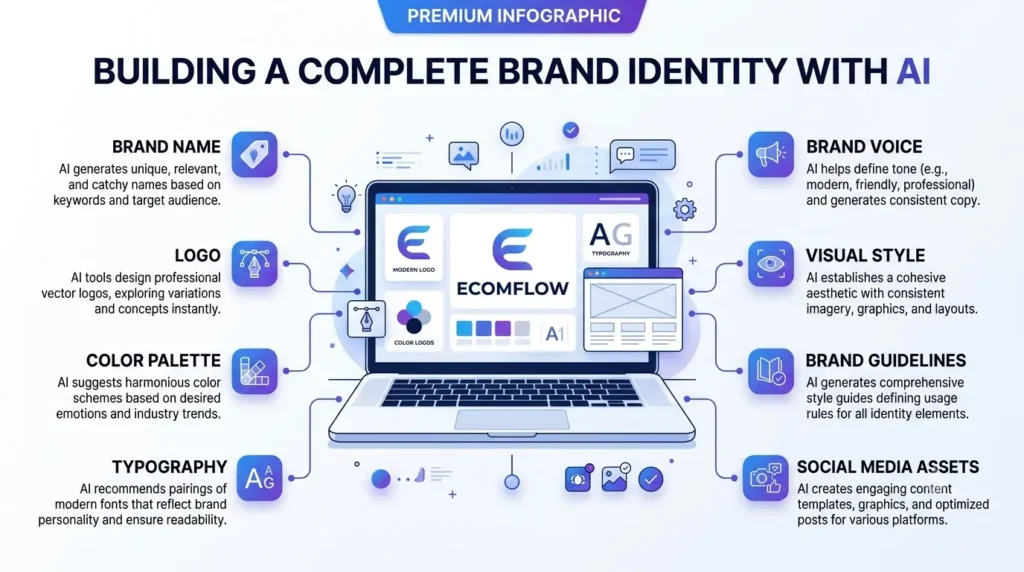
Best AI Store Setup Tools
Quick Answer
Shopify AI
- Product descriptions
- Store setup
- Store management
- Automation
- Marketing
WooCommerce + AI Plugins
- WordPress flexibility
- SEO
- Content marketing
- Custom development
Wix AI
- AI website generation
- Quick setup
- Simple customization
Squarespace AI
- Creative businesses
- Portfolio stores
- Small brands
AI Design & Image Generation Tools
Quick Answer
Canva AI
- Social graphics
- Ads
- Infographics
- Blog graphics
- Product banners
Adobe Firefly
- Creative backgrounds
- Marketing visuals
- Product mockups
Photoroom
- Background removal
- Product photography enhancement
- Marketplace images
Pebblely
- AI-generated product backgrounds
- Lifestyle product images
- E-commerce photography
Pixelcut
- Marketplace sellers
- Product listings
- Promotional graphics

AI SEO & Content Tools
Quick Answer
ChatGPT
- Article outlines
- FAQs
- Meta descriptions
- Product descriptions
- Internal linking ideas
Surfer SEO
- On-page optimization
- NLP keyword suggestions
- Content scoring
Ahrefs
- Keyword research
- Competitor analysis
- Backlink monitoring
- Content opportunities
Semrush
- Technical audits
- Keyword tracking
- Competitive insights
- Site health monitoring
Grammarly
- Grammar
- Clarity
- Readability
- Tone consistency
AI Marketing & Automation Tools
Quick Answer
Klaviyo
- Email automation
- SMS marketing
- Customer segmentation
- Personalization
Mailchimp AI
- Email campaigns
- Audience management
- Marketing automation
HubSpot AI
- CRM
- Marketing
- Sales automation
- Customer lifecycle management
Buffer AI
- Social media scheduling
- Content planning
- Multi-platform publishing
AI Customer Support Tools
Quick Answer
AI Chatbots
- Order tracking
- Product recommendations
- FAQs
- Returns
- Shipping questions
Help Desk Automation
- Faster responses
- Ticket categorization
- Knowledge base suggestions
- 24/7 availability
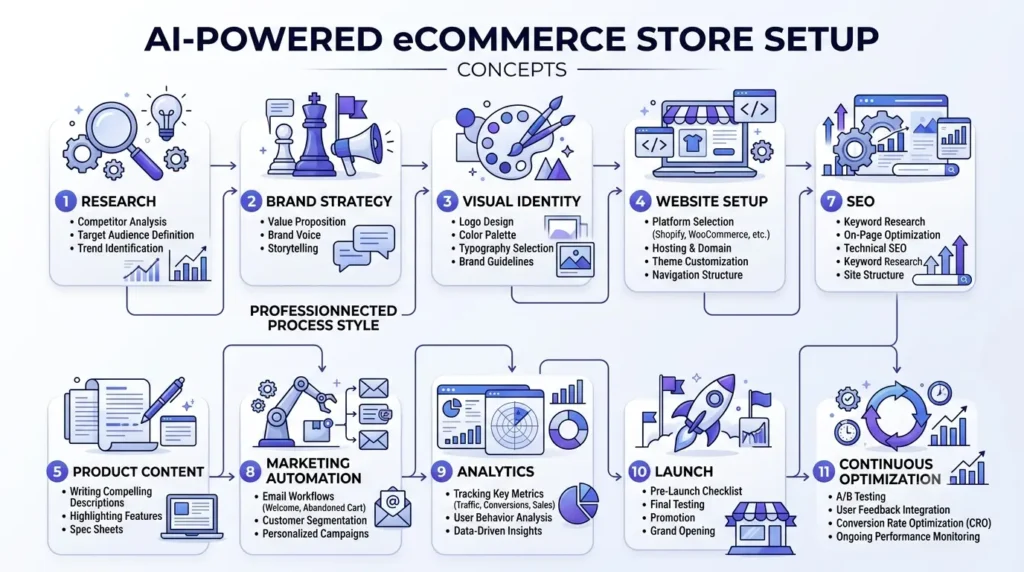
Complete AI Store Setup Workflow
Quick Answer
AI Tool Comparison Table
| AI Assistant | ChatGPT | Content & Strategy | All businesses |
| Design | Canva AI | Graphics | Beginners |
| Brand Identity | Looka | Logo & Branding | Startups |
| Image Editing | Photoroom | Product Images | eCommerce |
| AI Backgrounds | Pebblely | Lifestyle Photos | Product Marketing |
| Marketplace Images | Pixelcut | Product Listings | Online Sellers |
| SEO | Surfer SEO | On-Page SEO | Content Teams |
| Research | Ahrefs | SEO Research | Advanced Users |
| Marketing | Klaviyo | Email Automation | eCommerce |
| CRM | HubSpot | Sales & Marketing | Growing Businesses |
| Grammar | Grammarly | Editing | Content Creators |
Building an Integrated AI Ecosystem
Quick Answer
Example Workflow
- Research customer intent with SEO tools.
- Use ChatGPT to create a content brief.
- Design brand assets in Canva AI or Looka.
- Generate product visuals with Photoroom or Pebblely.
- Optimize content with Surfer SEO.
- Publish products and blog content.
- Launch automated email campaigns with Klaviyo.
- Monitor analytics and refine based on performance.
Common Mistakes
- Using multiple tools that perform the same function.
- Publishing AI-generated content without fact-checking.
- Ignoring brand voice across different platforms.
- Choosing tools based only on popularity instead of business needs.
- Failing to train team members on AI workflows.
- Neglecting data privacy and security considerations.
Pro Tips
- Start with a small, focused AI toolkit and expand as your business grows.
- Create standardized prompts and templates for consistent outputs.
- Schedule regular reviews of AI-generated content and assets.
- Measure ROI for each AI tool to ensure it provides tangible business value.
- Keep human creativity at the center of branding decisions while using AI to improve efficiency.
Key Takeaways
- AI tools can streamline branding, store setup, SEO, marketing, and customer support.
- Build a focused AI stack that aligns with your goals instead of adopting every available tool.
- Integrate your tools into a connected workflow for maximum efficiency.
- Maintain human oversight to ensure quality, originality, and brand consistency.
- Continuously evaluate tool performance and adapt your stack as your business evolves.
AI Prompt Library & Advanced Automation Framework (2026)
Why Prompt Engineering Matters
Quick Answer
“Write a product description.”
- Target audience
- Brand personality
- Tone of voice
- Desired length
- SEO keywords
- Call-to-action
- Formatting requirements
Prompt Writing Framework
Quick Answer
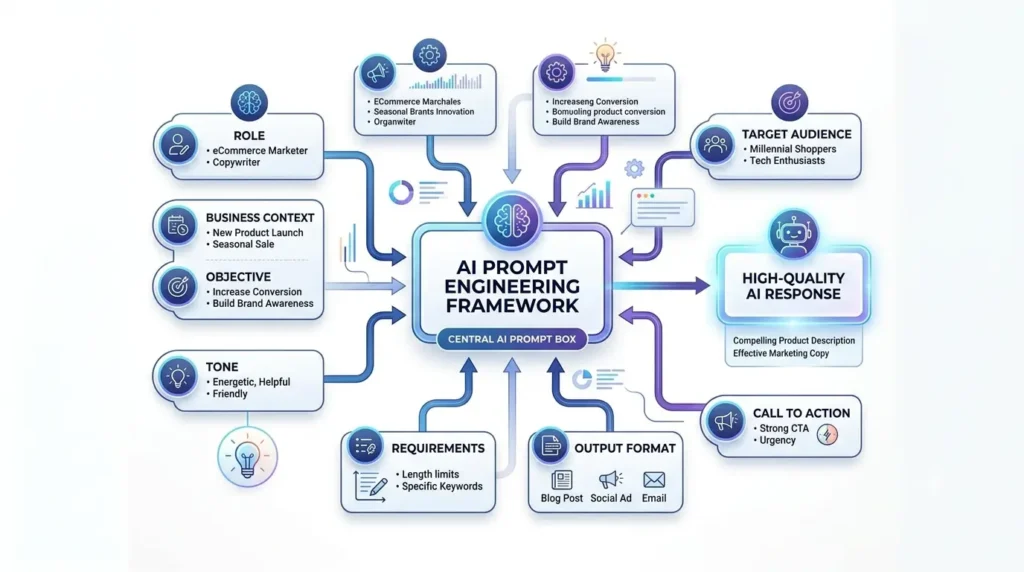
Universal Prompt Formula
Example Structure
• SEO optimization
• Benefits before features
- FAQ
- CTA
Brand Strategy Prompts
Quick Answer
Brand Identity Prompt
Create:
- Mission
- Vision
- Core values
- Brand personality
- Unique Value Proposition
- Brand voice
- Messaging pillars
Brand Name Prompt
Store Setup Prompts
Quick Answer
Homepage Prompt
Navigation Prompt
Product Description Prompts
Quick Answer
Product Prompt
Comparison Prompt
SEO Content Prompts
Quick Answer
Blog Prompt
FAQ Prompt
Marketing Prompts
Quick Answer
Email Campaign Prompt
Social Media Prompt
- 30 LinkedIn posts
- 30 Pinterest descriptions
- 30 X posts Use consistent branding. Include CTAs.
Customer Support Prompts
Quick Answer
Chatbot Prompt
FAQ Generator
AI Automation Framework
Quick Answer
Workflow
Automation Opportunities
- Blog publishing
- Email marketing
- Social scheduling
- Product updates
- Review requests
- Customer segmentation
- Inventory notifications
- Analytics reporting
AI Workflow Templates
Quick Answer
Content Workflow
Product Workflow
Marketing Workflow
Prompt Library Best Practices
- Define a clear role for the AI.
- Include business context and target audience.
- Specify tone, style, and desired length.
- Request structured outputs (tables, checklists, FAQs) when appropriate.
- Encourage originality instead of copying existing content.
- Include review and fact-checking steps before publication.
Common Mistakes
- Using vague or overly broad instructions.
- Omitting audience or brand context.
- Requesting too many unrelated tasks in a single prompt.
- Publishing AI output without review.
- Ignoring factual accuracy or legal considerations.
- Failing to update prompts as business goals evolve.
Pro Tips
- Create reusable prompt templates for recurring tasks.
- Version-control your prompts and document improvements.
- Test multiple prompt variations to identify the best-performing outputs.
- Pair AI-generated drafts with human expertise for higher quality.
- Build prompt libraries for branding, SEO, customer support, and marketing to ensure consistency across teams.
Generative Engine Optimization (GEO) & AI Search Optimization (2026)
What Is Generative Engine Optimization (GEO)?
Quick Answer
- Accurate
- Well-structured
- Easy to scan
- Supported by evidence
- Regularly updated
- Focused on solving real user problems
Why GEO Matters in 2026
Quick Answer
- “What are the best AI branding tools?”
- “How do I launch an AI-powered online store?”
- “Which eCommerce platform is best for beginners?”
- Answers questions directly
- Covers topics comprehensively
- Demonstrates expertise
- Includes practical examples
- Is easy to interpret programmatically
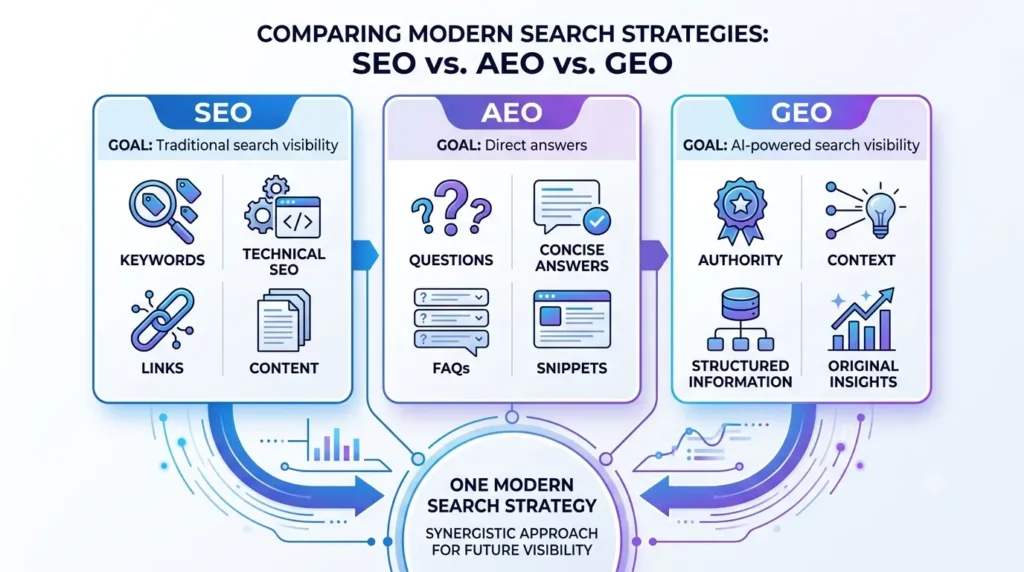
SEO vs AEO vs GEO
Quick Answer
| SEO | Rank in search results | Keywords, links, technical optimization |
| AEO | Win direct answers | Featured snippets, FAQs, concise responses |
| GEO | Support AI-generated answers | Structured, authoritative, context-rich content |
Optimizing for Google AI Overviews
Quick Answer
Best Practices
- Start each major section with a concise answer.
- Use descriptive headings and subheadings.
- Break complex topics into logical sections.
- Include tables, lists, and step-by-step guidance.
- Support claims with reputable sources where appropriate.
- Keep content updated as products and best practices evolve.
Content Structure Example
Optimizing for ChatGPT, Gemini & Perplexity
Quick Answer
Characteristics of AI-Friendly Content
- Clear definitions
- Logical structure
- Comprehensive coverage
- Practical examples
- Balanced explanations
- Consistent terminology
- Actionable recommendations
Include
- Definitions
- Comparisons
- Tables
- Checklists
- FAQs
- Examples
- Decision frameworks
- Step-by-step instructions
Avoid
- Thin content
- Excessive repetition
- Keyword stuffing
- Unsupported claims
- Misleading headlines
- Outdated information
Semantic SEO & Entity Optimization
Quick Answer
Example Topic Cluster
- Brand identity
- Visual design
- Brand voice
- Logo creation
- Customer experience
- Personalization
- eCommerce strategy
- Conversion optimization
- Digital marketing
Semantic Content Framework
AI Citation Strategy
Quick Answer
Increase Citation Potential By:
- Publishing original research or case studies
- Sharing real-world workflows
- Explaining complex topics clearly
- Updating content regularly
- Including practical checklists
- Covering related user questions in one resource
Content That Adds Value
“AI branding is important.”
- Why it matters
- When to use it
- Common challenges
- Practical implementation steps
- Real-world examples
- Metrics for success
Structured Content for AI
Quick Answer
Recommended Elements
- Heading hierarchy (H1–H3)
- Tables
- Bullet lists
- Numbered steps
- Comparison charts
- Definitions
- FAQs
- Key takeaways
- Checklists
Example Layout
GEO Checklist
Content
- Answer user questions directly.
- Cover topics comprehensively.
- Include practical examples.
- Update information regularly.
- Avoid unnecessary repetition.
Structure
- Use descriptive headings.
- Add tables where helpful.
- Include FAQs.
- Summarize key points.
- Maintain a logical flow.
Technical
- Fast page speed
- Mobile-friendly design
- Descriptive URLs
- Internal links
- Structured data (where appropriate)
- Accessible images with descriptive alt text
Quality
- Fact-check information.
- Edit AI-generated drafts.
- Maintain a consistent tone.
- Demonstrate expertise.
- Prioritize user value over search manipulation.
Common Mistakes
- Writing only for search engines instead of readers.
- Publishing unedited AI-generated content.
- Using repetitive keywords unnaturally.
- Neglecting updates after publication.
- Ignoring related user questions.
- Making claims without evidence or context.Avoiding these mistakes makes AI Branding & Store Setup more effective. Focus on useful AI applications, maintain human oversight, and keep your brand message consistent across every customer touchpoint.
Pro Tips
- Build comprehensive topic clusters rather than isolated articles.
- Add original examples, workflows, and templates that competitors do not provide.
- Keep introductions concise and answer the main question early.
- Review and refresh cornerstone content regularly.
- Monitor user feedback to identify gaps and opportunities for improvement.The best results from AI Branding & Store Setup come from combining automation with human judgment. Review AI-generated content, monitor performance, and improve your strategy based on real customer behavior.
E-E-A-T, Information Gain & Advanced GEO Framework (2026)
Understanding E-E-A-T
Quick Answer
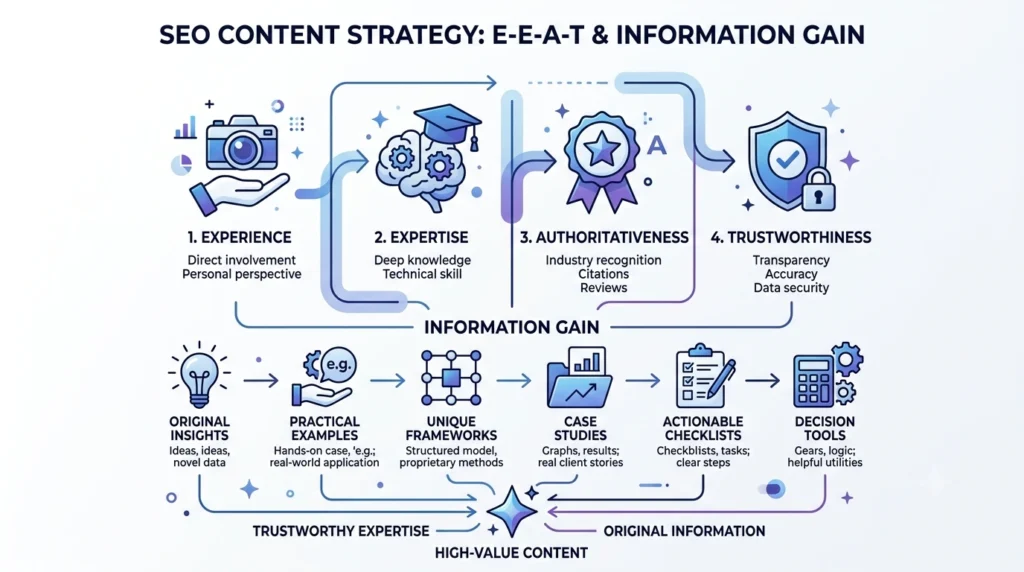
The Four Pillars
Experience | Demonstrate practical knowledge | Share implementation steps or lessons learned |
Expertise | Explain topics accurately | Publish detailed, well-researched guides |
Authoritativeness | Build recognition | Earn mentions, citations, and backlinks |
Trustworthiness | Increase confidence | Transparent policies, factual content, secure website |
Demonstrating Real Experience
Quick Answer
Ways to Show Experience
- Document step-by-step processes.
- Explain why specific decisions were made.
- Include before-and-after examples.
- Share implementation checklists.
- Describe challenges and solutions.
- Update content as practices evolve.
Practical Framework
Building Expertise & Authority
Quick Answer
Publish Content Such As
- Complete guides
- Tutorials
- Buying guides
- Comparisons
- FAQs
- Case studies
- Glossaries
- Best practices
- Industry trend analyses
Authority Signals
- Detailed author information
- Editorial review process
- Clear publication and update dates
- Consistent terminology
- High-quality visuals
- Logical internal linking
- Reliable outbound references where appropriate
Information Gain Strategy
Quick Answer
Move Beyond Basic Content
“What is AI Branding?”
- When to use AI branding
- Common implementation mistakes
- Industry-specific recommendations
- Decision frameworks
- Success metrics
- Optimization checklists
Information Gain Ideas
| Decision Matrix | Helps readers choose the right approach |
| Comparison Table | Simplifies evaluation |
| Workflow Diagram | Explains implementation |
| Checklists | Supports execution |
| Templates | Saves time |
| Practical Examples | Improves understanding |
Creating AI-Citable Content
Quick Answer
Characteristics of AI-Friendly Content
- Direct answers near the beginning of sections
- Consistent terminology
- Clear heading hierarchy
- Definitions of key concepts
- Tables and comparison charts
- Numbered procedures
- Practical examples
- Regular updates
Ideal Section Structure
Advanced SEO + AEO + GEO Checklist
Content Quality
- Clear search intent alignment
- Original insights
- Comprehensive coverage
- Readable formatting
- Consistent terminology
- Updated information
SEO
- Descriptive title
- Optimized meta description
- Logical heading hierarchy
- Internal links
- Descriptive URLs
- Image optimization
- Fast-loading pages
AEO
- Quick Answer block for major sections
- FAQ section
- Concise definitions
- Step-by-step guidance
- Tables and bullet lists
GEO
- Complete topical coverage
- Semantic relationships
- Information Gain
- Structured formatting
- Practical examples
- Consistent entity usage
- Trust-focused content
Technical Quality
- Mobile-friendly design
- HTTPS
- Accessible navigation
- XML sitemap
- Robots.txt
- Canonical URLs
- Structured data where relevant
- Optimized Core Web Vitals
Common Mistakes to Avoid
- Publishing thin or repetitive content.
- Overusing keywords at the expense of readability.
- Depending entirely on AI without editorial review.
- Failing to update evergreen articles.
- Ignoring user questions that arise after publication.
- Making unsupported claims or exaggerating results.
- Inconsistent formatting across long-form guides.
- Neglecting accessibility and page performance.
Pro Tips
- Create cornerstone content that links to supporting cluster articles.
- Refresh high-value content on a regular schedule.
- Add decision trees, templates, and implementation checklists to increase practical value.
- Review analytics to identify unanswered user questions and expand content accordingly.
- Treat AI as an assistant for research and drafting while relying on human expertise for strategic decisions and quality control.
Frequently Asked Questions (FAQs)
1. What is AI Branding?
Quick Answer
Detailed Answer
- Brand names
- Logos
- Brand voice
- Color palettes
- Marketing copy
- Social media graphics
- Product images
- Brand guidelines
2. What is an AI-Powered Online Store?
Quick Answer
Examples
- Product descriptions
- Product recommendations
- Customer support
- Inventory forecasting
- Email marketing
- Pricing optimization
- Image generation
- Analytics
3. Why is AI Branding Important in 2026?
Quick Answer
Benefits
- Faster branding
- Lower design costs
- Better consistency
- Higher productivity
- Personalized marketing
- Faster product launches
- Improved customer engagement
- Scalable workflows
4. Can AI Replace Professional Designers?
Quick Answer
Best Practice
- Brainstorming
- Draft creation
- Repetitive design tasks
- Brand strategy
- Creative direction
- Final approval
- Quality assurance
5. Which AI Tool is Best for Branding?
Quick Answer
Suggested AI Stack
| Strategy | ChatGPT |
| Logo Design | Looka |
| Graphics | Canva AI |
| Product Images | Photoroom |
| SEO | Surfer SEO |
| Email Marketing | Klaviyo |
6. How Long Does It Take to Build an AI Store?
Quick Answer
Example Timeline
7. Does AI Improve SEO?
Quick Answer
AI Helps With
- Keyword clustering
- Content briefs
- FAQs
- Internal linking ideas
- Meta descriptions
- Content optimization
- Search intent analysis
8. Is AI Content Good for Google?
Quick Answer
Best Practices
- Edit AI output
- Fact-check claims
- Add original insights
- Include practical examples
- Keep content updated
9. Can Beginners Use AI for eCommerce?
Quick Answer
Recommended Starting Workflow
10. How Much Does AI Branding Cost?
Quick Answer
Typical Cost Factors
- AI software subscriptions
- Domain registration
- Web hosting
- eCommerce platform
- Premium themes
- Professional design
- Marketing tools
- Advertising budget
11. Is AI Branding Suitable for Small Businesses?
Quick Answer
Small Business Advantages
- Faster content creation
- Lower design expenses
- Improved productivity
- Better customer engagement
- Easier scalability
- More efficient marketing
12. What Are the Biggest Mistakes to Avoid?
Quick Answer
Common Mistakes Checklist
- ❌ Publishing AI content without editing
- ❌ Weak branding
- ❌ Poor navigation
- ❌Slow website
- ❌Keyword stuffing
- ❌Thin content
- ❌Duplicate pages
- ❌Poor mobile experience
- ❌ No internal linking
❌ Ignoring analytics
Article Schema Recommendations
Quick Answer
Recommended Primary Schema
Secondary Schema
Recommended Article Properties
- Headline
- Description
- Author
- Publisher
- Date Published
- Date Modified
- Main Image
- Keywords
- Article Section
- Word Count
- Language
- URL
Schema Best Practices
- Match schema to the visible page content.
- Keep publication and modification dates accurate.
- Use one primary schema type with relevant supporting schemas where applicable.
- Validate structured data after implementation.
- Update schema when major content changes are made.
13. Can AI help improve conversion rates?
Quick Answer
AI Applications
- Personalized recommendations
- Dynamic pricing insights
- AI chatbots
- Abandoned cart recovery
- Smart search
- Predictive analytics
14. Is AI branding expensive?
Quick Answer
Cost Categories
| Startup | Free or low-cost AI tools |
| Small Business | Subscription-based AI stack |
| Medium Business | AI + professional specialists |
| Enterprise | Integrated AI ecosystem |
15. Can AI create an entire eCommerce website?
Quick Answer
16. How often should I update my AI-generated content?
Quick Answer
Recommended Update Schedule
- Product pages: Monthly
- Blog articles: Every 3–6 months
- Buying guides: Quarterly
- Homepage: As campaigns or offers change
- Category pages: Quarterly
17. Is AI-generated content safe for eCommerce?
Quick Answer
Best Practices
- Verify facts
- Edit for clarity
- Match your brand voice
- Check originality
- Update outdated content
18. How does AI improve customer experience?
Quick Answer
Examples
- Product recommendations
- Personalized emails
- AI chat support
- Predictive search
- Smart product filtering
19. What industries benefit from AI branding?
Quick Answer
Examples
- Fashion
- Electronics
- Beauty
- Healthcare
- Education
- SaaS
- Food & Beverage
- Home & Living
- B2B Services
- Digital Products
20. What skills are needed for AI branding?
Quick Answer
Helpful Skills
- Brand strategy
- Copywriting
- Graphic design
- SEO
- UX design
- Marketing
- Analytics
- Prompt engineering
- Content editing
21. What is the biggest advantage of AI for eCommerce?
Quick Answer
22. Does AI help with customer retention?
Quick Answer
AI Retention Examples
- Loyalty rewards
- Product reminders
- Replenishment emails
- Personalized offers
- Win-back campaigns
23. Can AI improve product photography?
Quick Answer
24. How can I measure AI branding success?
Quick Answer
Important KPIs
| Organic Traffic | Measures discoverability |
| Conversion Rate | Tracks sales effectiveness |
| Revenue | Indicates business growth |
| Customer Retention | Measures loyalty |
| Brand Search Volume | Reflects brand awareness |
| Engagement | Shows audience interaction |
25. What is the future of AI branding?
Quick Answer
Future Trends
- Hyper-personalization
- Predictive marketing
- AI-assisted design
- Voice and multimodal search
- Smarter automation
- Improved analytics
- Greater workflow integration
FAQ Schema Recommendations
Quick Answer
Recommended FAQ Structure
- Question
- Clear answer
- Visible content on the page
- Plain language
- Accurate information
FAQ Writing Best Practices
- What is AI branding?
- How much does AI branding cost?
- Which AI tools are best for eCommerce?
- Can beginners use AI for online stores?
- How do I optimize my store for AI search?
Structured Data Best Practices
Keep Content Consistent
Maintain Accuracy
- Change FAQs
- Revise product information
- Update author details
- Modify publication dates
Use Relevant Schema Types
| Article | Main article |
| FAQPage | Frequently asked questions |
| BreadcrumbList | Navigation |
| Organization | Business information |
| Person | Author details |
| WebSite | Website information |
| ImageObject | Featured images |
Rich Results Optimization Checklist
Content
- Clear heading hierarchy
- Direct answers
- Helpful examples
- Comprehensive coverage
- Logical formatting
Technical
- Mobile-friendly layout
- Fast loading pages
- Secure HTTPS
- Optimized images
- Descriptive URLs
User Experience
- Easy navigation
- Readable typography
- Accessible design
- Clear calls to action
- Functional internal links
AI Search Optimization Checklist
- Answer the main question early.
- Cover related subtopics comprehensively.
- Include comparison tables and checklists where helpful.
- Explain concepts with practical examples.
- Keep terminology consistent throughout the article.
- Refresh cornerstone content regularly.
- Review and improve content based on user feedback and analytics.
Final FAQ Takeaways
- Reduce repetitive customer inquiries.
- Improve topical completeness.
- Support Answer Engine Optimization (AEO).
- Increase the usefulness of the article for readers.
- Complement a broader SEO and GEO strategy.
Final Verdict, Publishing Checklist, Roadmap & Resources (2026)
References & Resource Categories
Quick Answer
Recommended Reference Categories
Official Platform Documentation
- AI platform documentation
- eCommerce platform documentation
- Search engine documentation
- Web performance documentation
Industry Research
- AI adoption
- eCommerce trends
- Consumer behavior
- Digital marketing
- Search trends
- Conversion optimization
Academic & Research Sources
- Peer-reviewed AI research
- UX studies
- Consumer psychology research
- Human-computer interaction studies
- Digital commerce research
Expert Contributions
- Interviews
- Industry expert commentary
- Case studies
- Implementation examples
- Practical lessons learned
Recommended Internal Linking Strategy
Quick Answer
Suggested Cluster Structure
Pillar Page
Supporting Articles
- Best AI Logo Generators
- AI Product Image Tools
- AI Copywriting Tools
- AI Website Builders
- AI Chatbots
- AI Email Marketing
- AI SEO Tools
- AI Analytics Tools
- AI Automation Tools
- AI Product Description Tools
- AI Inventory Management
- AI Pricing Tools
- AI Customer Support
- AI Content Marketing
- AI Social Media Tools
- Link back to the pillar page.
- Link to related cluster articles where appropriate.
- Include contextual anchor text rather than generic phrases.
Suggested External Reference Categories
- Official product documentation
- Industry standards
- Academic publications
- Government guidance (where relevant)
- Original research reports
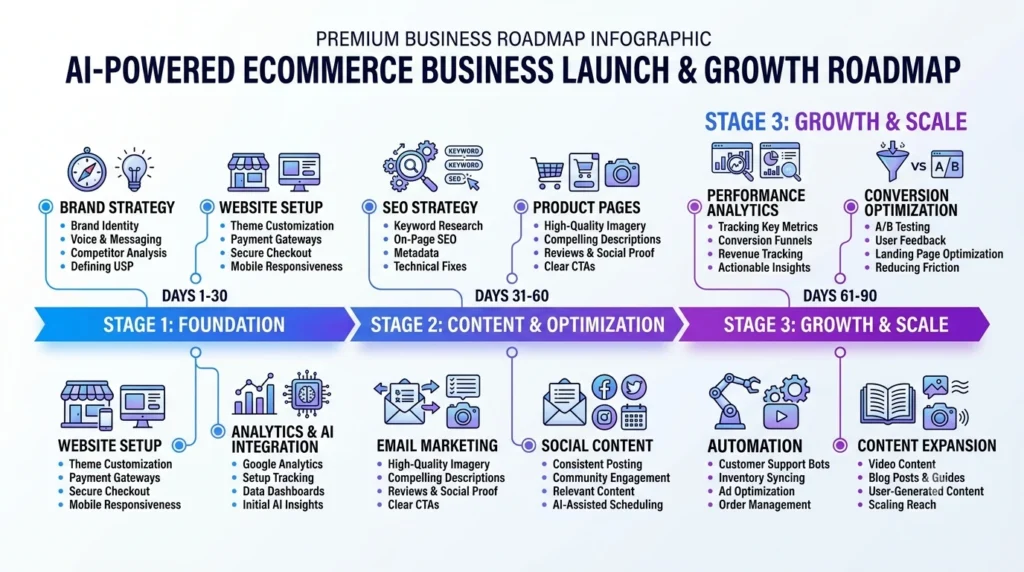
30/60/90-Day AI Branding Implementation Roadmap
First 30 Days – Build the Foundation
Branding
- Define your target audience.
- Create a unique value proposition.
- Finalize your brand voice.
- Design a logo.
- Choose a color palette.
- Create brand guidelines.
Website
- Register your domain.
- Configure hosting.
- Install your eCommerce platform.
- Build essential pages.
- Configure navigation.
- Set up analytics.
Days 31–60 – Content & Optimization
SEO
- Publish cornerstone content.
- Optimize category pages.
- Create product pages.
- Add internal links.
- Optimize images.
- Improve page speed.
Marketing
- Launch email automation.
- Create social media content.
- Build lead magnets.
- Start collecting customer reviews.
Days 61–90 – Scale & Improve
Growth
- Analyze performance metrics.
- Refresh high-performing content.
- Expand topic clusters.
- Improve conversion funnels.
- Test new landing pages.
- Refine AI prompts and workflows.A practical AI Branding & Store Setup roadmap helps businesses improve gradually instead of changing everything at once. Start with the brand foundation, then optimize content, store performance, automation, and customer experience.
Publishing Checklist
Content
- Unique title
- Compelling meta description
- Clear introduction
- Table of contents
- Logical heading hierarchy
- Quick Answer sections
- Tables and checklists
- FAQ section
- Strong conclusion
SEO
- Primary keyword used naturally
- Related keywords included
- Internal links added
- Relevant external references
- Optimized images
- Descriptive alt text
- Clean URLs
- Canonical URL
- XML sitemap updated
Technical
- Mobile responsive
- Fast loading
- HTTPS enabled
- No broken links
- Accessible design
- Structured data validated
User Experience
- Easy navigation
- Readable typography
- Clear CTAs
- Consistent branding
- Helpful visuals
- Logical page flow
Final Action Plan
Step 1
Step 2
Step 3
Step 4
Step 5
Step 6
Step 7
Common Pitfalls to Avoid
- Treating AI as a replacement for strategy.
- Publishing AI-generated content without review.
- Ignoring accessibility and mobile usability.
- Focusing on keywords instead of user intent.
- Failing to update cornerstone content.
- Using inconsistent branding across channels.
- Measuring success only by traffic instead of business outcomes.
Final Key Takeaways
- Build a clear brand foundation with a defined audience, positioning, voice, and visual identity.
- Use AI to accelerate branding and store setup, but keep human creativity and review at the center.
- Choose AI tools based on real business needs, including content, SEO, analytics, automation, and customer support.
- Optimize for SEO, AEO, and GEO with clear answers, useful content, structured information, and trustworthy sources.
- Measure, improve, and scale using a 30/60/90-day implementation approach.
AI can make eCommerce branding and store setup faster and more efficient, but the best results come from combining AI technology with human strategy, creativity, and customer understanding.
Further Reading & Official Resources
- Shopify Magic Documentation
- Shopify AI Personalization
- Canva AI
- Looka
- Google Search Central
- Google Structured Data
- Schema.org
- Google PageSpeed Insights
- Google Rich Results Test
- McKinsey AI Research
Our Recommendation
Based on current industry best practices, AI should be used to accelerate repetitive work such as drafting content, generating design concepts, keyword research, and personalization. Final decisions—including branding, messaging, and publishing—should always involve human review to ensure accuracy, originality, and long-term brand trust. This balanced approach aligns with guidance from both Shopify and McKinsey on effective AI adoption.
Final Verdict
Call-to-Action
Conclusion
- Easy for customers to navigate.
- Optimized for search engines and AI-driven discovery.
- Scalable as your business grows.
- Grounded in quality, transparency, and continuous improvement.
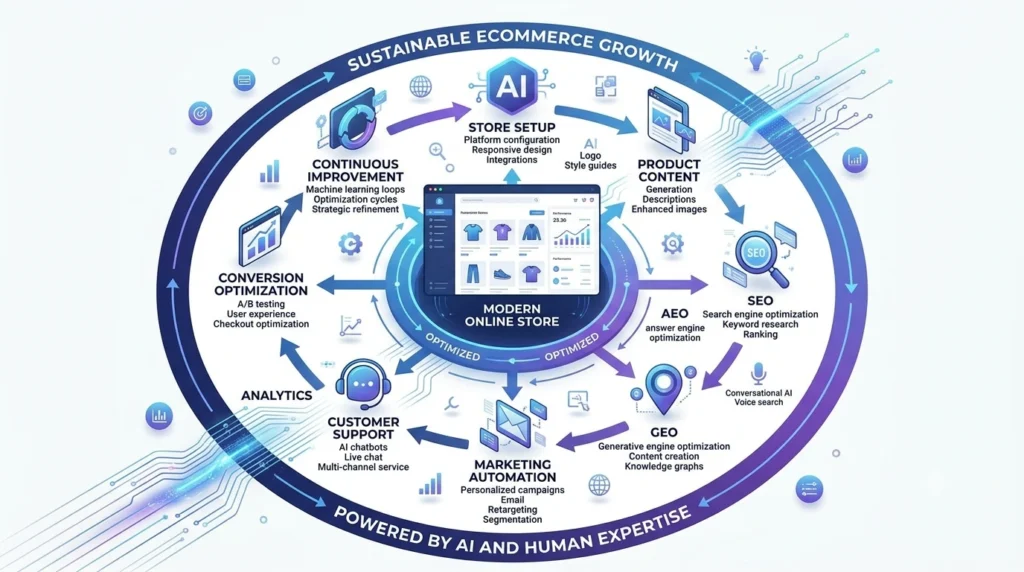
With the right strategy, AI Branding & Store Setup can support branding, store development, content, automation, and customer experience from one connected workflow.
Whether you’re launching your first online store or modernizing an existing business, this guide provides a practical roadmap for building a resilient, AI-assisted eCommerce presence that is ready for the future of digital commerce.
About the Author
AI Ecommerce Tools Editorial Team
- Independent and research-driven reviews
- Practical recommendations based on real use cases
- Regular content updates
- Focus on SEO, AEO, GEO, and E-E-A-T best practices.
- Commitment to accuracy, transparency, and user value
Editorial Note: This article was last reviewed in August 2026. We recommend revisiting this guide periodically, as AI marketing tools and features evolve rapidly.
Disclaimer
This content is provided for educational and informational purposes only. While we strive to keep all information accurate and up to date, AI software features, pricing, integrations, and availability may change over time. Always verify the latest information on the official website before making purchasing or business decisions.
How We Evaluate AI Tools
Every AI tool featured on AI Ecommerce Tools is evaluated using a consistent editorial methodology. We assess products based on:
- Features & capabilities
- Ease of use
- Pricing & overall value
- Integrations
- Customer support
- Security & privacy
- Real-world business use cases
- Performance and reliability
Our goal is to provide objective, research-based recommendations rather than promotional rankings.
Content Update Policy
We review this guide regularly to ensure accuracy. Whenever major AI platforms release new features, pricing updates, or significant improvements, this article is revised accordingly to keep readers informed with the latest information.
Share This Guide
If this guide was helpful, please share it with your colleagues, marketing team, or other business owners. Sharing reliable AI resources helps everyone make smarter choices about using artificial intelligence.