AI Ecommerce Trends 2026: How AI is Shaping the Future of Online Shopping
Table of Contents
- What Are AI Ecommerce Trends in 2026?
- Why AI Is Transforming Ecommerce in 2026
- AI Shopping Agents and Agentic Commerce
- Generative AI for Product Discovery
- AI-Powered Personalization
- Conversational Commerce and AI Shopping Assistants
- AI Product Recommendations
- AI Demand Forecasting and Inventory Management
- AI-Powered Pricing and Dynamic Offers
- Multimodal AI and Visual Shopping
- AI Content Creation for Ecommerce
- AI Customer Service and Autonomous Support
- AI Marketing and Predictive Customer Segmentation
- AI Fraud Detection and Ecommerce Security
- AI Analytics and Autonomous Decision-Making
- The Rise of AI-Readable Product Data
- AI Search, GEO, and the New Digital Shelf
- What Ecommerce Businesses Should Do in 2026
- Common AI Ecommerce Mistakes to Avoid
- AI Ecommerce Trends by Business Type
- The Future of AI Ecommerce Beyond 2026
- Frequently Asked Questions
What Are AI Ecommerce Trends in 2026?
Quick answer: Artificial intelligence has quietly moved from the back office of online retail into the middle of the customer journey. A few years ago, “AI in ecommerce” mostly meant product recommendations, a chatbot in the corner of the screen, automated email flows, and some forecasting spreadsheets running in the background. That’s no longer the whole picture.
That wider role is exactly what this guide to AI Ecommerce Trends 2026 breaks down—trend by trend, with what each one actually means for store owners.
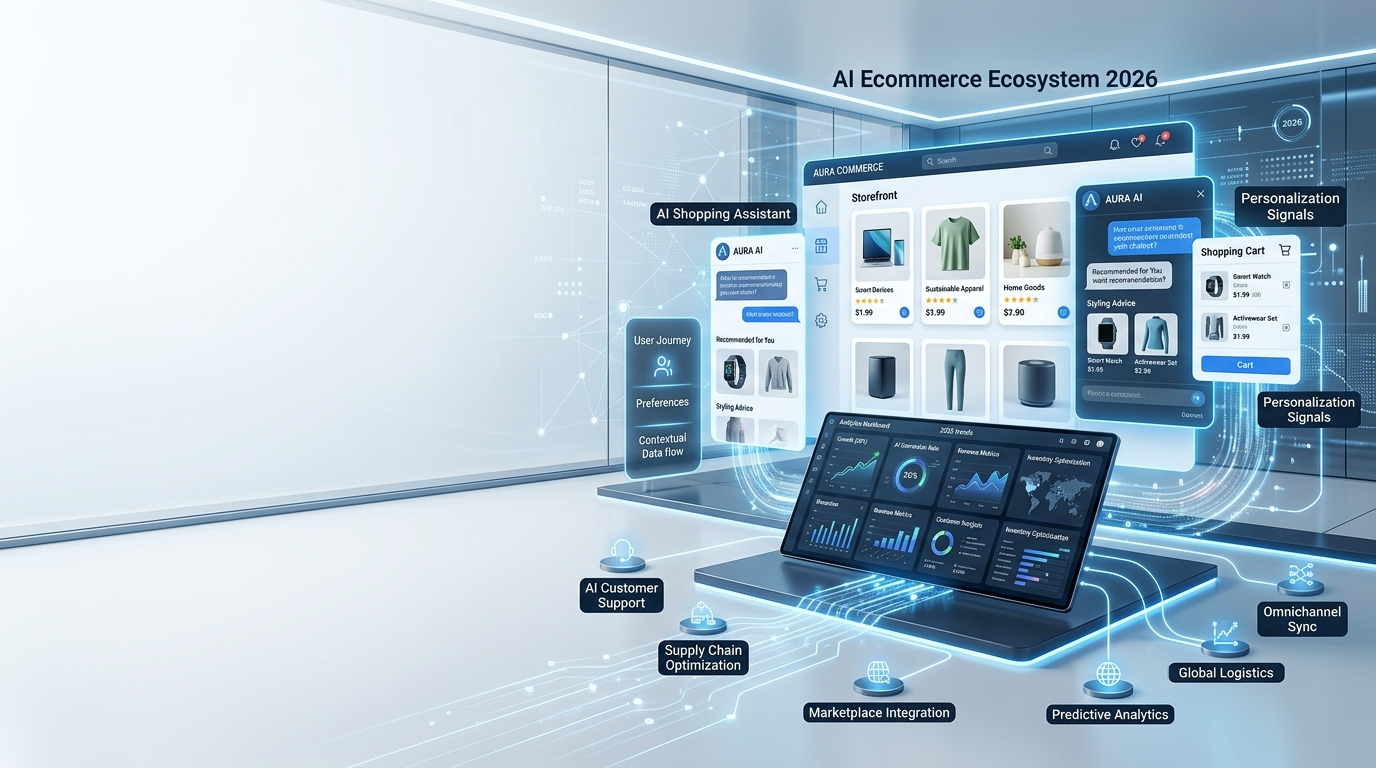
In 2026, AI touches nearly every stage of the shopping journey — discovery, research, comparison, recommendation, purchase, fulfillment, support, and retention. That’s a wider footprint than most store owners were planning for even eighteen months ago, and it’s why “AI ecommerce trends” now means something closer to a shift in how commerce works, not just another tool to bolt on.
The data backs this up. NielsenIQ found that 42% of consumers were already using AI tools to shop in 2026—mainly for discovery, comparison, pricing, and selection (NIQ). Separately, DHL’s 2026 ecommerce research found that 38% of shoppers and 36% of businesses were already using AI-powered chat or virtual assistants to buy and sell (DHL).
The takeaway for store owners is simple: AI is becoming part of the buying process itself, not just a tool your team uses behind the scenes.
If you’re new to AI-powered ecommerce, start with our AI Ecommerce Tool 2026: Complete Guide. It provides a broader overview of AI tools, strategies, and workflows that can help online stores choose the right technology for their business.
Why AI Is Transforming Ecommerce in 2026
Quick answer: Running an online store has gotten more competitive on nearly every front — acquisition costs, catalog size, global competition, and shopper expectations for instant, relevant answers. AI is spreading fast because it addresses several of these pressures at once.
| Driver | How AI Helps |
|---|---|
| Rising competition | Sharper targeting and differentiation |
| Large product catalogs | Automated discovery and recommendations |
| Higher customer expectations | Instant assistance, less waiting |
| Complex inventory | Better forecasting |
| Marketing costs | Automated optimization |
| Customer support volume | Handles repetitive questions |
| Data complexity | Surfaces patterns humans tend to miss |
| AI search | A genuinely new discovery channel |
Google frames 2026 as a shift toward “agentic commerce”—AI moving past passive browsing into helping execute multi-step shopping tasks on a person’s behalf (Google Cloud).This is the backdrop against which every one of the AI Ecommerce Trends 2026 discussed below is playing out
That raises a question every ecommerce brand should be asking itself right now: can your store be understood and selected by an AI system as easily as it can be understood by a human shopper?
AI Shopping Agents and Agentic Commerce
Quick answer: This is arguably the single biggest shift happening in ecommerce right now.
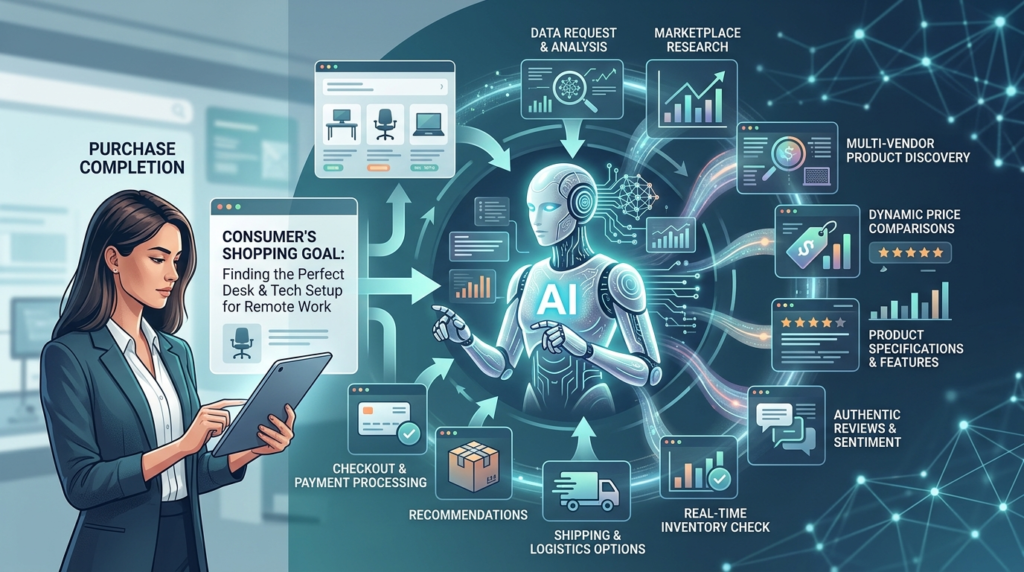
Traditional online shopping runs on a simple loop: a person searches, evaluates, clicks, and buys. Agentic commerce changes that loop — a person states a goal, and an AI agent researches, compares, recommends, and in some cases acts on it directly.
A shopper might tell an AI assistant something like: “Find me a lightweight laptop under $900 with at least 16GB RAM and good battery life.” Instead of opening a dozen product pages themselves, the agent evaluates listings against those requirements and narrows the field.
Why this matters for retailers
An AI agent weighing options might factor in product attributes, price, discounts, availability, shipping terms, reviews, brand reputation, return policies, stated customer preferences, compatibility, and even sustainability claims.
Google’s Universal Commerce Protocol is built specifically to let AI agents interact with retailer catalogs and commerce systems—retrieving live product data and working with carts directly (Google). Google has also rolled out Universal Cart features as part of the same agentic-shopping push (Google).
Your competitor may not be a website anymore
It might just be a product an AI agent decides is a better match for what the shopper asked for. That reframes product data from a back-office chore into something closer to a competitive asset.
Generative AI for Product Discovery
Quick answer: The old discovery path was typing a keyword, scanning search results, and landing on a product page. Generative AI opens a different path—describe a need in plain language; let the AI research, compare, and recommend.
A shopper might say: “I need a skincare routine for dry skin that costs less than $50.” A generative system can turn that loose request into concrete product requirements and start narrowing options from there.
What this means for ecommerce SEO
Keyword targeting still matters, but product information needs to carry a lot more detail than it used to. A listing titled simply “Premium Running Shoes” gives an AI system almost nothing to work with. A stronger dataset spells out weight, material, shoe type, cushioning, terrain, heel-to-toe drop, available sizes, color, price, warranty, recommended use, and customer ratings.
More context in the product data means more chances of being the option an AI system actually surfaces.
AI-Powered Personalization
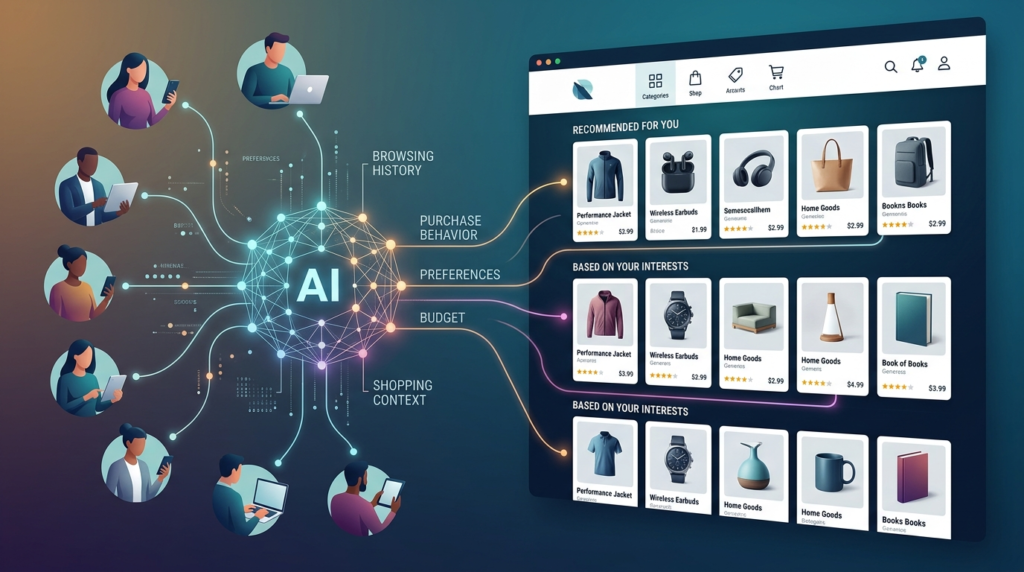
Personalization itself isn’t new — what’s changed is how many signals a system can weigh at once. The old version was “customers who bought X also bought Y.” The 2026 version pulls in browsing behavior, purchase history, search queries, cart activity, location, device, time of day, price sensitivity, and where a customer sits in their life cycle—all at the same time.
In practice, that might mean a returning customer who tends to buy premium products sees higher-value bundles and early-access offers, while a price-sensitive shopper sees discounts and budget alternatives instead. The goal isn’t to show customers more — it’s to show the right product at the right moment.
Conversational Commerce and AI Shopping Assistants
The old ecommerce chatbot mostly answered, “Where is my order?” The newer generation of shopping assistants can handle “Which one is better for me?”—a meaningfully harder question and a much more useful one.
Modern AI assistants are increasingly expected to help with product discovery, comparisons, size selection, compatibility questions, recommendations, order status, returns, cross-sells, and gift picks. DHL’s 2026 research confirms this shift is already underway globally, with both shoppers and businesses adopting AI chat and virtual assistants at scale (DHL).
One practical note: don’t train your assistant on product descriptions alone. Connect it to your full catalog, FAQs, policies, live inventory, shipping details, and reviews. An assistant that gives a confidently wrong answer damages trust faster than having no assistant at all.
AI Product Recommendations
Recommendation engines remain one of the most practical AI applications for ecommerce—but their usefulness lives or dies on context. Modern recommendation logic weighs customer intent, product attributes, behavior, situational context, and live inventory together, rather than relying on a single static rule.
A shopper browsing winter jackets might get very different suggestions depending on their climate, budget, past purchases, preferred brand, size, and activity level.
A common mistake worth flagging: more recommendations don’t equal better personalization. Thirty loosely related product suggestions just add noise. The better formula is relevance × context × timing — not volume.
AI Demand Forecasting and Inventory Management
Inventory is one of the places AI creates real operational value without customers ever noticing. Forecasting systems can factor in historical sales, seasonality, promotions, weather, advertising spend, and search demand together, rather than leaning on historical averages alone.
Say a store typically sells 1,000 units of a product a month. A traditional system extrapolates from past months. An AI forecasting system can also weigh upcoming holidays, planned ad campaigns, regional demand shifts, and recent price changes—producing a forecast that adjusts as conditions change, not just as the calendar turns.
Worth keeping in mind: don’t hand purchasing decisions over to AI blindly. Keep a human approval step for expensive or highly seasonal inventory.
AI-Powered Pricing and Dynamic Offers
Pricing decisions are increasingly data-driven, with AI systems weighing competitor pricing, demand, inventory levels, conversion rates, and product lifecycle stage together. That doesn’t always mean lower prices — sometimes the system determines a product can hold its current price, and other times it surfaces an opportunity for a bundle discount, loyalty incentive, or clearance move instead.
A real caution here: dynamic pricing needs to stay transparent and well-governed. If customers sense they’re being charged differently than someone else for no clear reason, the trust damage tends to outweigh whatever short-term revenue gain triggered it.
Multimodal AI and Visual Shopping
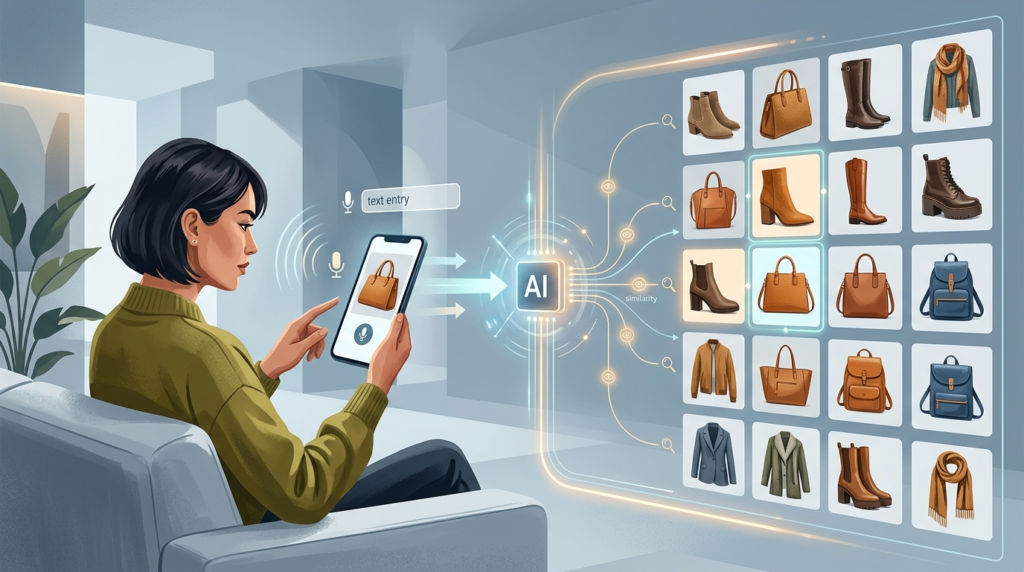
Search is becoming less dependent on typing. A shopper can upload a photo and ask, “Find me something similar to this jacket,” or describe an outfit and ask what shoes would work with it. Multimodal AI—systems that combine text, image, and sometimes video or audio—makes that kind of interaction possible.
That opens up image-based product search, visual similarity matching, virtual styling, and voice shopping as real discovery channels, not novelties.
What this means practically: every important product listing benefits from high-quality photos from multiple angles, descriptive filenames, accurate alt text, and consistent attribute data. Visual assets aren’t just a design nicety anymore—they’re part of the product data an AI system reads.
AI Content Creation for Ecommerce
Generative AI has genuinely cut production time for product descriptions, category copy, email campaigns, ad copy, FAQs, and comparison content. But there’s an important distinction worth repeating: AI-generated content isn’t automatically good content. Search engines and AI systems both still need information that’s accurate and genuinely useful, not just fluent.
A workflow that tends to hold up better in practice: research first, let AI draft, then have someone with real product knowledge review it, fact-check it, add an original observation or example, and only then publish. The human contribution is what carries the weight—direct experience, first-hand testing, brand voice, and details a generic AI draft simply wouldn’t know to include.
AI Customer Service and Autonomous Support
AI support has moved past scripted chatbots into systems that can retrieve context and handle more nuanced requests—Where’s my order? What’s your return policy? Which size should I pick? Is this compatible with that? The practical model that tends to work well is AI handling the routine volume while humans stay available for the exceptions: refund disputes, complex complaints, fraud concerns, and high-value customers.
The goal is a support experience that makes people feel helped — not one that traps them in a loop with no way to reach a person.
AI Marketing and Predictive Customer Segmentation
Traditional segmentation sorts customers into broad buckets—new, returning, high-value, and inactive. AI segmentation gets more dynamic: predicting which customers are likely to purchase in the next week, which are at risk of churning, and which are likely to respond to a specific offer.
Instead of blasting one email to a full list of 100,000 customers, a system might isolate the 15,000 most likely to buy soon and prioritize a relevant offer to them specifically, with different messaging going to the rest based on predicted intent.
AI Fraud Detection and Ecommerce Security
Fraud prevention has become something of an arms race, since fraudsters have access to automation and AI too. That’s pushing stores toward systems that can flag abnormal behavior quickly — unusual purchasing patterns, payment anomalies, account takeover signals, bot traffic, and abnormal refund activity.
Worth noting: a system that blocks a legitimate customer with no explanation creates real friction. The better setups combine AI detection with risk scoring, human review, and a clear path for a wrongly flagged customer to recover — protecting revenue without punishing real shoppers.
AI Analytics and Autonomous Decision-Making
Traditional analytics tells you conversion dropped 8%. AI-driven analytics is starting to explain why — for example, identifying that the drop was concentrated among mobile visitors after a checkout change, with payment failures as the likely cause.
That’s a meaningful shift from dashboard → insight toward insight → recommendation → action, and it’s where a lot of the near-term value in AI analytics is showing up for mid-sized retailers who don’t have a dedicated data team.
The Rise of AI-Readable Product Data
This might be the most important technical trend on this list, even though it’s the least glamorous.
Picture two stores selling the same running shoe. Store A lists it as “Premium Running Shoes — comfortable shoes for running.” Store B lists weight (280g), drop (8mm), cushioning level, terrain, upper material, recommended use, size range, current price, live inventory status, shipping terms, return policy, warranty, and customer rating.
An AI agent evaluating both has dramatically more to work with at Store B—and that’s the store more likely to get recommended.
| Data Element | Importance |
|---|---|
| Product name | Essential |
| Price | Essential |
| Availability | Essential |
| Product attributes | Essential |
| Images | High |
| Reviews | High |
| Shipping | High |
| Returns | High |
| Brand information | High |
| Structured data | High |
| FAQs | Useful |
| Compatibility information | Critical where relevant |
WooCommerce’s 2026 research on agentic commerce echoes this—structured product data, current inventory, and accurate pricing are the foundation AI-driven shopping is being built on (WooCommerce).
AI Search, GEO, and the New Digital Shelf
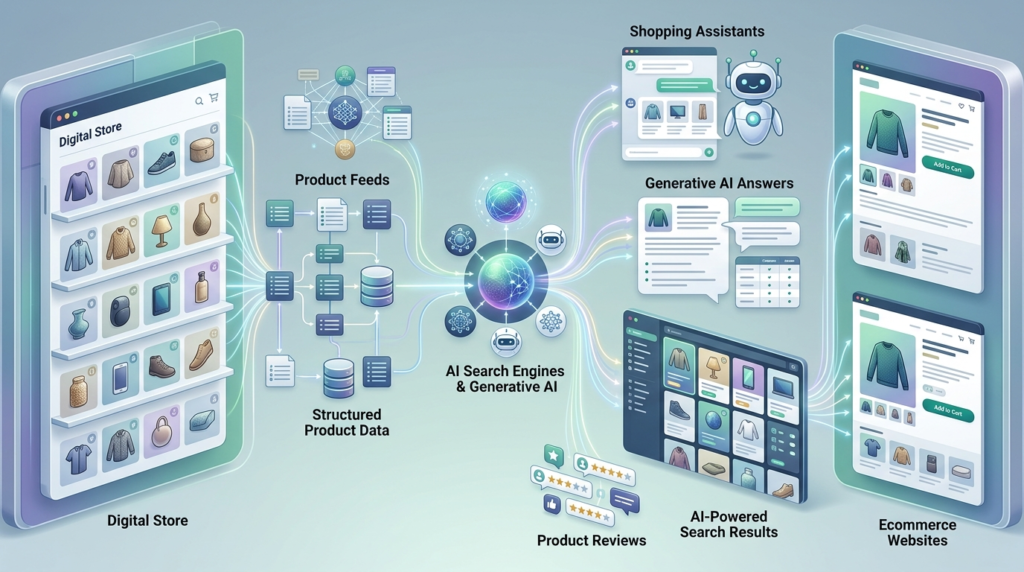
This is where traditional SEO and Generative Engine Optimization (GEO) start to overlap. Traditional SEO asks how to rank a page. GEO asks how to make AI systems understand — and confidently recommend — a brand or product. The difference is subtle, but it changes what you optimize for.
AI systems lean on evidence: product specs, reviews, brand information, pricing, availability, expert content, comparisons, policies, and structured data. A practical GEO approach starts with real customer questions—”Which running shoes are best for beginners?” or “What laptop is best for video editing under $1,000″—and answers them clearly and factually, backed by original research, first-hand testing, and transparent sourcing where possible.
What Ecommerce Businesses Should Do in 2026
You don’t need to chase every trend on this list at once — the AI Ecommerce Trends 2026 covered above span everything from agentic shopping to product data, and trying to adopt all of them simultaneously usually backfires. A phased approach tends to work better in practice.
Phase 1 — Fix the data foundation. Product information, inventory, customer data, pricing, analytics, reviews, and policies. Bad data produces bad AI output, full stop.
Phase 2 — Automate the repetitive work. Product descriptions, FAQs, email segmentation, reporting, basic support, content briefs.
Phase 3 — Improve the customer experience. AI search, recommendations, conversational shopping, personalized content, AI support.
Phase 4 — Prepare for AI-driven discovery. Product feeds, structured data, comparison pages, expert content, brand information.
Phase 5 — Experiment with agents. Only once the foundation is solid—agentic shopping, automated purchasing, AI-driven pricing, and advanced personalization.
Common AI Ecommerce Mistakes to Avoid
Adopting AI because competitors are. Start with the business problem you’re solving, not the tool.
Publishing raw AI content. It needs editing, fact-checking, and a real point of view added on top.
Ignoring product data quality. AI can’t recommend a product it can’t understand.
Automating sensitive decisions. Keep a human in the loop for fraud disputes, refund exceptions, high-value accounts, and major pricing shifts.
Measuring the wrong things. The number of prompts run or articles generated isn’t success. Conversion rate, revenue per visitor, AOV, satisfaction, and retention are key metrics.
AI Ecommerce Trends by Business Type
| Business Type | Highest-Priority AI Opportunities |
|---|---|
| Small ecommerce store | Content, support, email, recommendations |
| DTC brand | Personalization, marketing, customer insights |
| Marketplace | Search, recommendations, fraud detection |
| Fashion store | Visual AI, personalization, recommendations |
| Electronics store | Comparison, compatibility, AI support |
| Grocery ecommerce | Forecasting, recommendations, replenishment |
| B2B ecommerce | AI search, account personalization, forecasting |
| Enterprise retailer | Agents, predictive analytics, orchestration |
Not every business needs to act on all twelve AI Ecommerce Trends 2026 in the same order—priority depends heavily on business type. Small stores don’t need Amazon-level infrastructure — start with whatever removes the most repetitive work first. Mid-sized businesses get the most out of tying CRM, ecommerce, and analytics together. Enterprise retailers have the resources to push into agentic workflows, digital twins, and multi-agent orchestration.
The Future of AI Ecommerce Beyond 2026
The ecommerce website isn’t going away, but its role is shifting. Instead of being the only place a customer discovers a product, it becomes one node in a wider commerce ecosystem that includes AI search, shopping assistants, voice interfaces, and marketplaces.
NIQ describes agentic commerce as a genuine shift in the traditional funnel—AI agents increasingly discovering, comparing, and purchasing on a consumer’s behalf (NIQ). At the same time, Visa’s 2026 research points to real tension between consumers embracing AI shopping tools and wanting visibility into what those agents are actually doing on their behalf (Visa).
So the future isn’t just “more AI.” It’s more useful AI, backed by better data, real trust, and a human still holding the wheel.
Frequently Asked Questions
What are the biggest AI ecommerce trends in 2026?
AI shopping agents, agentic commerce, generative product discovery, deeper personalization, conversational shopping, predictive inventory, dynamic pricing, multimodal search, AI content creation, autonomous support, predictive analytics, and AI-readable product data.
How is AI changing ecommerce in 2026?
It’s influencing discovery, recommendations, marketing, pricing, inventory, support, analytics, and purchasing—and increasingly acting as a new interface between shoppers and retailers. The bigger shift is that AI is participating in decisions now, not just executing tasks.
What is agentic commerce?
Ecommerce where AI agents perform shopping tasks on a person’s behalf—researching, comparing, managing a cart, and in some cases completing a purchase with varying levels of human approval. It’s a move from “search and click” to “request and delegate.”
Will AI shopping agents replace ecommerce websites?
Unlikely to make them irrelevant, but they will change how people discover and interact with them. Websites still matter for product information, trust, fulfillment, and the actual transaction. The real question is whether your site is AI-readable in the first place.
How can stores prepare for AI search?
Keep product data accurate and structured; publish real comparison content; strengthen reviews and brand signals; keep pricing and inventory current; and answer the actual questions customers ask—not just target keywords.
What is GEO for ecommerce?
Generative Engine Optimization — improving how a brand shows up in AI-generated answers through structured data, authoritative content, reviews, FAQs, and clear product and brand entities. It complements traditional SEO rather than replacing it.
Is AI-generated ecommerce content good for SEO?
It can be, but only with real editing, fact-checking, and added expertise. Publishing large volumes of unreviewed AI text tends to backfire—treat AI as a production assistant, not a substitute for actual product knowledge.
Which AI trend should small businesses prioritize?
Usually AI customer support, content production, email personalization, recommendations, and basic analytics — practical wins that don’t require an in-house AI team.
How important is product data for AI ecommerce?
Extremely. AI systems can only recommend what they can accurately understand, and in agentic commerce, product data effectively becomes part of your sales infrastructure.
Is AI personalization worth implementing?
Yes, as long as it stays relevant rather than intrusive and respects customer privacy and preferences along the way.
What will ecommerce look like after 2026?
More conversational, multimodal, and agent-driven, with routine research and purchasing increasingly delegated to AI. The brands that hold up best will combine strong products, trustworthy data, real customer relationships, and AI-ready infrastructure.
Final Takeaway
The single biggest AI ecommerce trend in 2026 isn’t any one technology—it’s the shift from AI-assisted commerce to AI-mediated, increasingly agentic commerce. Shoppers are already using AI to research and compare. Businesses are deploying it across marketing, support, inventory, and product discovery. And major platforms are actively building the infrastructure to let AI systems interact with commerce directly.
For most ecommerce businesses, the practical priorities come down to a short list:
- Build clean, accurate product data.
- Make your site and content genuinely understandable to AI systems.
- Use AI to improve the customer experience, not just cut labor costs.
- Automate the repetitive decisions and keep humans on the important ones.
- Measure success by revenue, conversion, retention, and satisfaction — not activity.
- Get ready for AI-driven discovery and agentic shopping.
- Invest in trust, transparency, and data governance now, before it’s a scramble later.
The question worth sitting with isn’t whether your store uses AI. It’s whether AI can understand your store, trust what it finds there, and confidently recommend it to a customer. That is the real opportunity behind AI Ecommerce Trends 2026.
Editorial note: Product features, pricing, integrations, and availability can change over time. Always verify current information directly with the software provider before making a purchasing decision.
For related reading, see our guides on AI tools for Ecommerce: Complete Guide pillar page, AI tools for small ecommerce businesses,& best AI apps for Ecommerce in 2026: 25+ tools to automate